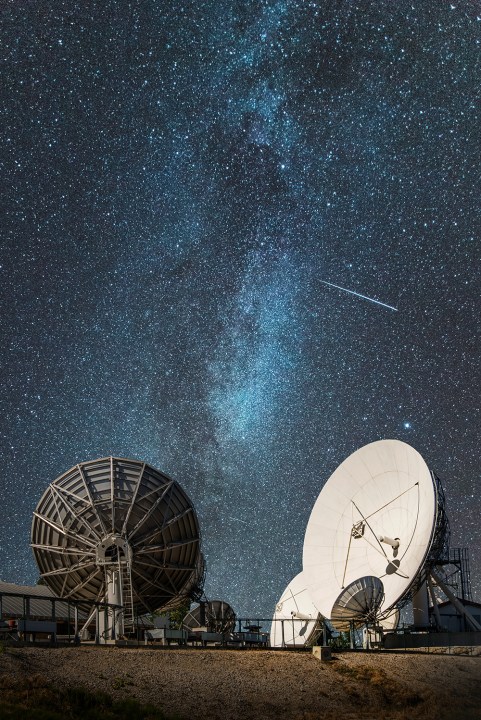
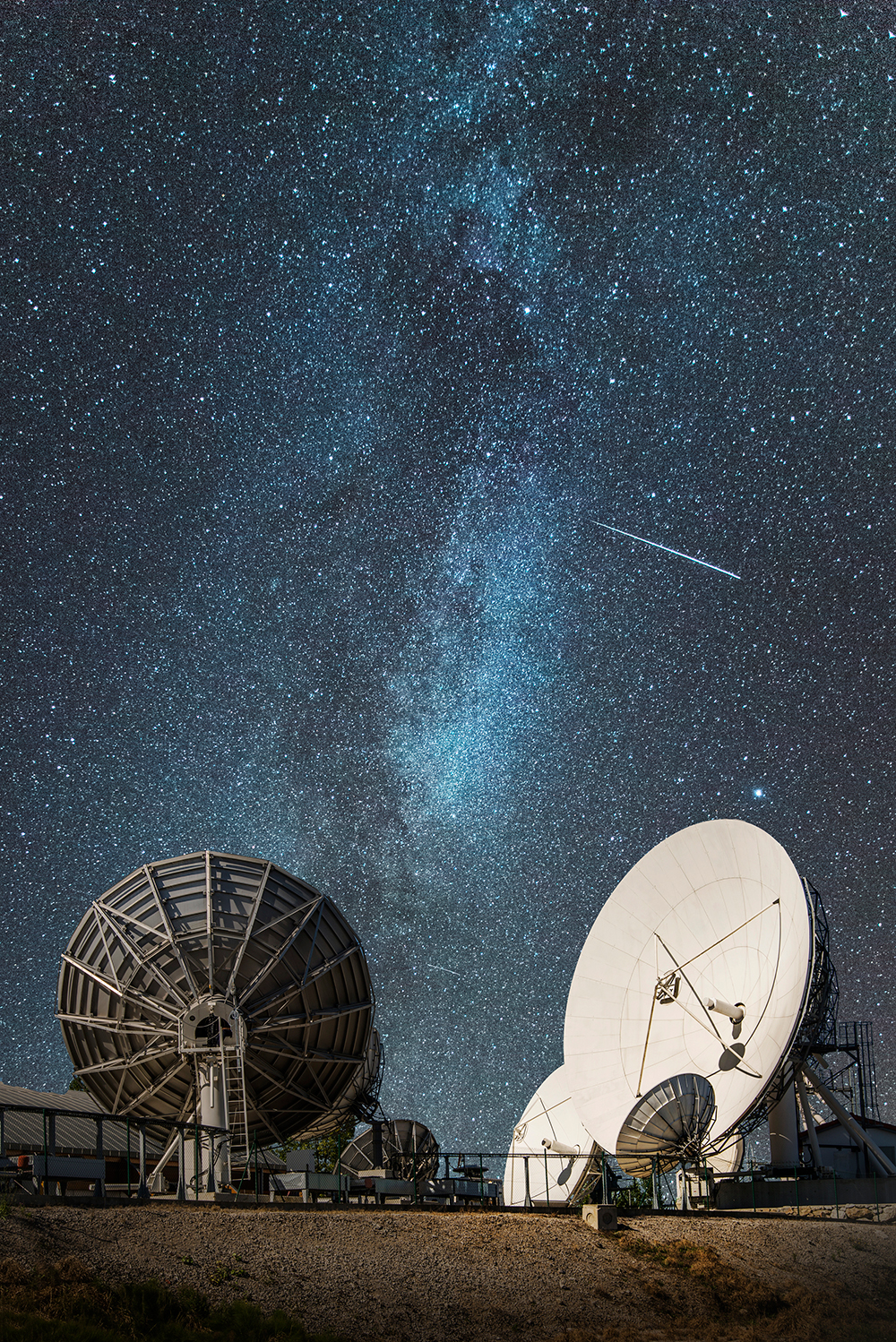
For more than 60 years, scientists have been on the stealthiest stakeout in history. Using state-of-the-art listening devices, they’ve tapped into thousands of homes, waiting patiently for their targets to reveal their presence, and ultimately been rewarded with silence. If this covert activity were occurring in our own country, one might have become impatient and simply walked up and knocked down the door. But the targets are not living in our country, or even on our planet or in our solar system. Our persons of interest are aliens. This is Seti: the Search for Extraterrestrial Intelligence, focused on life on planets orbiting other suns.
So far, we’ve found no sign of them. But this could change, as traditional spycraft is pushed aside by a new age of cosmic surveillance, powered by radio astronomy, supercomputers and artificial intelligence.
The signal itself is unlikely to arrive as a recognisable greeting but ratios like pi are the same on any planet
The question is not whether life exists elsewhere; sheer numbers mean that it almost certainly has evolved somewhere at some point in time. Extend your arm and block out a patch of sky with your thumb. In that tiny fragment alone lie hundreds of thousands of galaxies, each teeming with stars and planets. Seti is not so interested in any old microbial life, such as the extraterrestrial amoebas we might soon find in the oceans of Saturn’s moons, but in alien intelligence and, crucially, planets close enough that we stand a chance of making contact.
The first real search for extraterrestrial intelligence was carried out in 1960 by a young radio astronomer, Frank Drake. Pointing a radio dish at two nearby Sun-like stars, he listened, alone in a control room, for more than 100 hours. Patience and hope are essential to Seti; they shape a certain kind of researcher, thick-skinned enough to endure misplaced scepticism and content to carry on knowing that success may come too late for them to witness. Drake heard nothing, but his surveillance tool of choice, the radio telescope, is still our best bet for success.

Radio waves are the longest wavelength part of the electromagnetic spectrum, a range which includes many forms of light we will be familiar with in different settings: X-rays for diagnosing broken bones, UV for sterilising germs, infrared for tracking criminals in the night and microwaves for reheating last night’s leftovers. Radio is exceptionally good at travelling long distances unperturbed. Rain, trees, even the thick clouds of other planets are no obstacle to the radio wave, as it covertly travels through, leaving little trace of its mission.
The physics that marks out radio waves as the best form of communication on Earth will apply anywhere in the galaxy. Seti didn’t choose radio because it was cheap or available; it chose radio because the universe did. As we scroll through the radio stations, we come across bursts of news and music from all cultures and countries. So, in Seti, we turn that dial a little further, surfing the interstellar radio waves, straining to hear any sign of an alien signal.
We so often use the term ‘alien’ in daily life to mean anything that is not like us. Yet the universal laws of physics and mathematics mean we will have a lot in common when it comes to knowledge. The signal itself is unlikely to arrive as a recognisable greeting, as that depends on language, but ratios like pi, or prime numbers, are the same on any planet. These patterns can only be encoded into radio light by intelligent beings. The problem, then, is not one of translation, but where in the vast sky we should be looking, and over which frequencies.
Sending a powerful message into the galaxy takes energy, and any species would have to choose its targets carefully. We might not be it, or perhaps we are, but only once a year. Repetition of a signal is key if we are to believe it to be extraterrestrial, but this requires us to stare at multiple targets for a long period of time, producing intractable amounts of data.
One of the largest Seti operations of all time took place in living rooms. In the late 1990s and early 2000s, millions of people downloaded the SETI@home screensaver, quietly donating their computer’s idle time to sift through radio data from the Arecibo radio telescope. For a while, Seti became a kind of civilian intelligence network: fragments of radio observations distributed across the globe, processed piecemeal by volunteers. It was an early admission that the problem was not a lack of potential signals, but a lack of resources.

This is where the new age of Seti comes in, as we pit artificial intelligence against extraterrestrial intelligence. Until now, we have been a small network of spies searching in the dark. Faced with a multitude of possible signals spread across a vast range of radio frequencies and thousands of potentially habitable planets, we must admit that the traditional Seti stakeout is no longer sufficient. Today, our cosmic surveillance can scan huge swaths of the radio spectrum at once and for years at a time. These spies do not sleep or tire. They do not get disillusioned after decades of deafening quiet.
Perhaps AI will uncover a fresh signal. But it may just as plausibly emerge from a past transmission, a message-in-a-bottle intercepted long ago and placed on the shelves of science before we knew how to read it. Some of the most important intelligence breakthroughs do not come from new surveillance, but from returning to old intercepts with better tools.
How we process all that data may have just had an AI turbo-boost, but the way we gather that data has remained reassuringly the same. If a transmission does arrive, it will almost certainly come by radio. Quiet, persistent, unglamorous radio: the wave that crosses the space between the stars, slips through dust and cloud and falls upon the listening ears of great telescopes. The future of our search for aliens does not lie in looking harder but in listening with a kind of reasoning that is ‘alien’ to ourselves: artificial intelligence. We inhabit a radio universe full of the promise of life, and at last we are learning how to listen to it properly.
Dr Emma Chapman’s Radio Universe is published on 12 March.



Comments