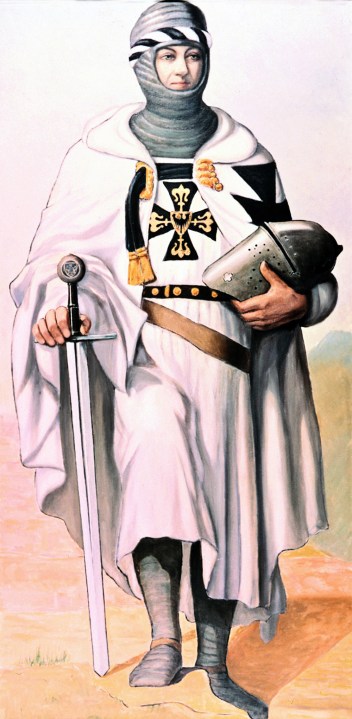
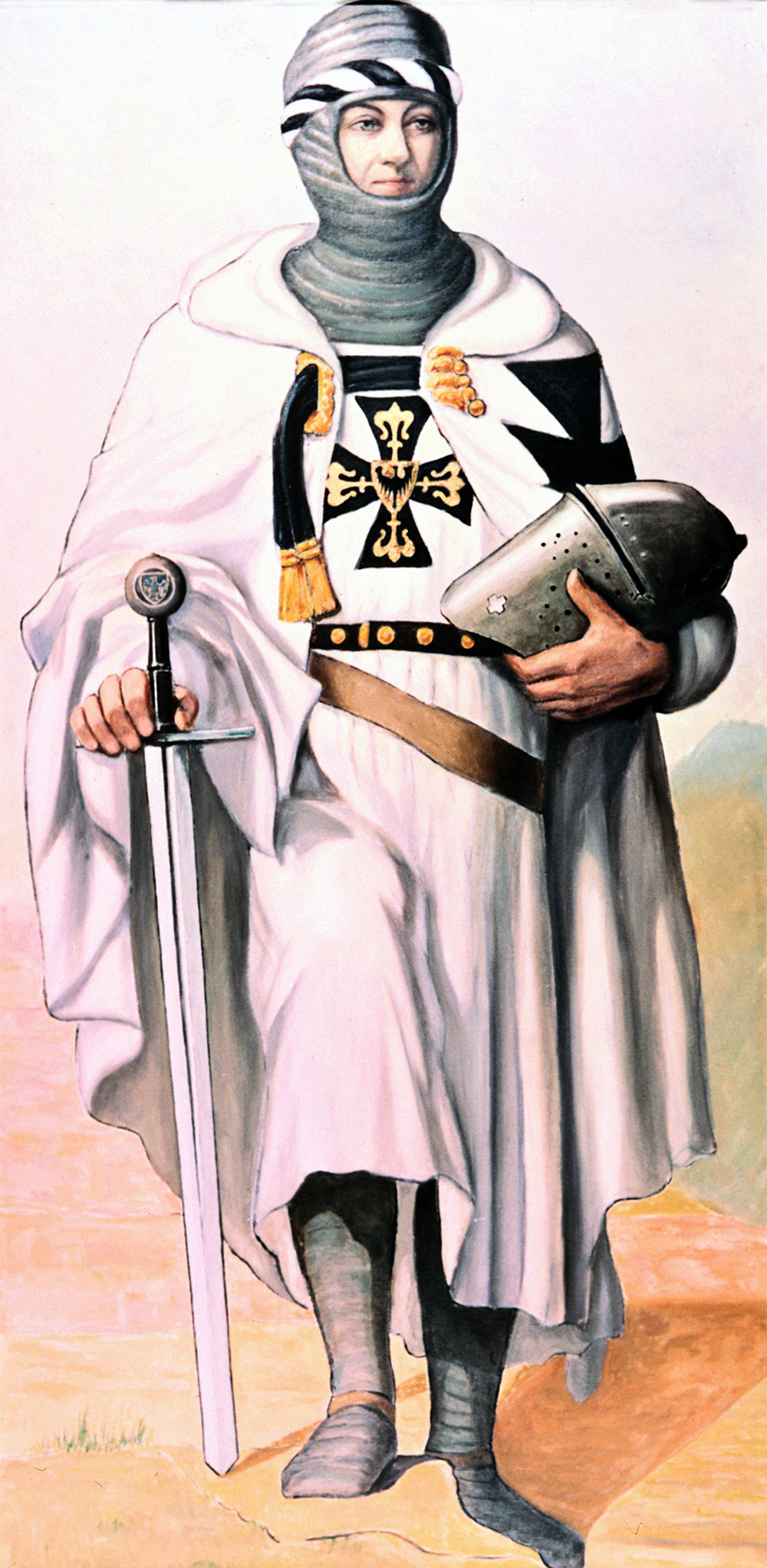
The crusades bring up images of the ancient cities and harsh deserts of the Levant, of Saladin, Richard Coeur de Lion and King Louis IX of France. The crusades to the Holy Land were a consuming obsession of Latin Christianity for four centuries and remain among the most famous episodes of the Middle Ages. Yet, in the perspective of history, they made almost no difference. The crusaders were defeated and expelled, leaving no trace in the life of the Middle East apart from a handful of churches and some spectacular ruined castles.
By comparison, very little attention is paid to other crusades – in the Baltic and against the Moors in Spain and Portugal – which were truly transformative. Over three centuries, from the 12th to the 15th, the Baltic crusades altered the destinies of a vast region extending from the river Elbe to the isthmus of Karelia, populating it with German settlers and imposing Christianity on Europe’s last pagan cultures. Their legacy endured until modern times.

The black cross of Aleksander Pluskow-ski’s title was the symbol of the Teutonic Order. This was not the only force behind the Baltic crusades; important contributions were also made by the Danes and the Swedes. But the Teutonic knights were the main instrument of the German settlement of the southern shores of the Baltic, and they are the focus of this history.
The Teutonic Order was founded at the end of the 12th century in Acre, the last redoubt to which the crusader state of Jerusalem had shrunk. It began as an order of hospitallers ministering to the needs of German pilgrims and settlers in the Holy Land. But like the Templars and the Hospitallers, it soon developed into a military organisation and early in the 13th century shifted its attention to another frontier of Christianity, in northern Europe.
In 1226 the German Emperor Frederick II granted Prussia to the Teutonic Order at a time when it was inhabited mainly by pagan tribes. Four years later Pope Gregory IX authorised them to conquer it. Prussia became the northern bastion of German Christianity. In the course of the next two centuries, the knights advanced into Poland, Livonia and Estonia. This brought them into conflict with the pagan Lithuanian empire and the already Christianised Russians of Polotsk and Novgorod in a struggle which became part of Russia’s foundational myth, commemorated in Sergei Eisenstein’s nationalist propaganda film AlexanderNevsky (1938).
At a time when crusading enthusiasm had few outlets in the Mediterranean, the Baltic crusades became the main means open to European noblemen of expanding frontiers of Christianity in this world and earning salvation in the next. At its height, the movement attracted some of the great paladins of European chivalry, including the French Marshal Boucicaut and the future King Henry IV of England. Decline did not set in until the 15th century, when the whole region became at least nominally Christian and its conflicts the business of increasingly organised military states, not associations of volunteers like the Teutonic knights.
The Teutonic knights are now viewed with embarrassment, associated with Hitlerian schemes of expansion
The Baltic crusades were military operations, but Pluskowski’s book is not really a military history or even a political one. To understand the course of events one must turn to Eric Christiansen’s excellent The Northern Crusades, still available from Penguin and the most readable account of the subject. The Black Cross is essentially a cultural history. Its themes are the Christianisation and Germanisation of the Baltic region. War is a constant presence in the background. The Baltic crusades were at least as much an economic movement as a religious one. The author is an archeologist. The testimony of the spade has revealed much that we know about settlement, agricultural exploitation, the early towns and the advancing frontiers of faith and language.
Pluskowski is particularly good on the great monuments left by the crusaders. The buildings of the knights are today among the most imposing of the German Middle Ages. The austere castle of Marienburg in East Prussia (now Malbork in northern Poland) is the largest in Europe. The fortified cathedral of Marianwerder (now Kwidzyn in Polish Pomerania) and the beautiful ruins of Wenden (now Cesis in Latvia) give one a good idea of the power and organising skills of this remarkable body of men.
The deeds of the Teutonic knights were once part of Germany’s foundational myth. Today, the subject is often viewed with embarrassment. The knights are associated with Hitlerian schemes of expansion, the black cross with the swastika, the German bishops and religious orders with brutal religious persecution.
Germany was the principal Baltic power from the 13th to the 20th century, but the world of the Baltic Germans has vanished in a generation. West Prussia is still German, but the other conquests of the knights are divided between Poland, Belarus, Russia and the three Baltic republics. Ruthless frontier changes and forced population transfers since 1944 have cleared away the junker minority which once dominated the region, presiding over impressive mansions and great agricultural estates, and serving in the armies, courts and bureaucracies of Germany, Russia and Sweden.



Comments