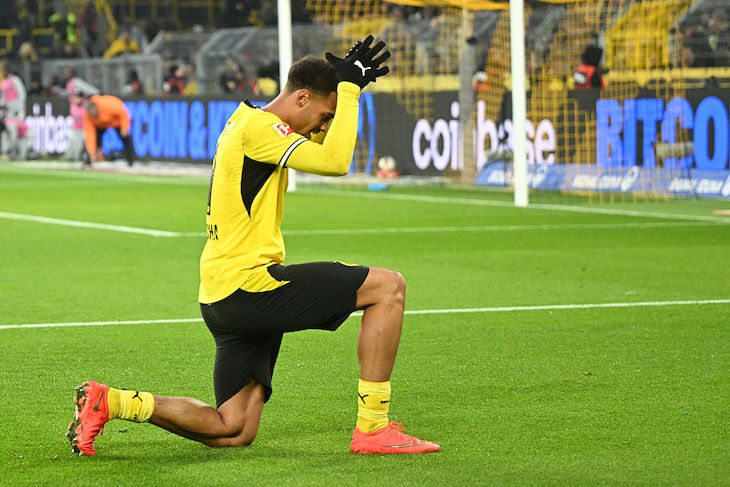
It’s not unusual to hear stories about footballers getting into trouble. Aggressive fouls on the pitch, racist gestures, drunken nights out: all have landed football players on the front, rather than the back, pages of newspapers. But this week, midfielder Felix Nmecha caught headlines not for debauchery, but devoutness; celebrating his goal for Borussia Dortmund by kneeling down, removing an imaginary crown and laying it in the ground.
In a world where prayer might now be considered a crime, it’s no wonder the Church is worried
The gesture was intended to express his belief that Jesus, rather than any earthly achievement, deserves ultimate glory. But Dortmund’s official supporters’ group was unimpressed. It accused the player of being associated with Christian networks that promote homophobia and transphobia, declaring that “where religious convictions are used to deny people their dignity or equal worth, our tolerance for intolerance comes to an end”. Nmecha responded on Instagram clarifying that his celebration was about pointing to Jesus, not spreading hatred, and that Christianity’s message was one of love and respect for everyone.
The great irony, of course, is that the very concept of equal worth and tolerance is uniquely and profoundly Christian. What made Jesus Christ so remarkable as a leader was not that he dined with political heroes; he dwelt among sinners. The cheating tax collectors; the multi-divorced woman at the well; the blind beggar; the shunned and the broken. His message was not that all people were equally good people, but that all were equally sinful, rebellious, and in need of forgiveness.
In his social media post, Nmecha referenced John 3.16. The famous Bible verse that God so loved the world – (i.e., everyone, no matter who they are and what they had done) – that he gave his only son, so that whosoever – (no matter their background or identity) – believes in him should not perish, but have eternal life.
And so, the norm of equality spread slowly and unmistakably throughout the Earth.
In pre-Christian Rome, society was comfortable with the idea of killing off slaves on the basis of a hierarchical understanding of human value. Baby girls were exposed on rubbish heaps to die as a result of their sex. Women were bought and sold for men’s pleasure for as little as loaf of bread
It was only through the establishment of Christian values that the very concept of human rights became foundational in the West. Similarly, it was Christians who championed equality in modern Britain. William Wilberforce was inspired by his faith to work tirelessly to end the international slave trade. Lord Shaftesbury was motivated by Biblical teaching to introduce reforms ending cruel child labour and to provide schools to the poor across the country. The modern concept of human equality rests on the historic principle of the Imago Dei: that each person is made in the image of God.
That image of equality and dignity extends to those who identify as LGBT. But respect and love for the human person does not demand total agreement with all of their values. Respect is only tested and affirmed where there is a diversity of viewpoint.
It is no headline news story that the Bible teaches homosexuality is a sin. Marriage is taught to be between a man and a woman, for the complementary creation of stable family units of mums and dads. Many Christians in Britain today still adhere to orthodox family values; yet are perfectly happy to share a cup of tea with the gay couple next door. Disagreeing with someone’s values does not make a person intolerant. Forcing somebody to agree with your own point of view against their will, does.
And here, the strange irony. Christians like Felix Nmecha are the ones accused of being bigots because they don’t conform to the views and opinions of a more powerful societal group.
It seems the same formulaic story emerges every week. The Finnish politician barred from the UK after being convicted of a “hate crime” for expressing a Christian view of sexuality. The English priest reported to “PREVENT” after telling children in an assembly that they didn’t have to “go along with” all the assertions of the Pride movement. And now, a draft bill undergoing parliamentary scrutiny seeks to take discrimination against religious beliefs to the next level.
The stated purpose of the government’s draft “conversion practices” bill is to protect people from abusive practices intended to “change” their sexual orientation or transgender identity. The imagery conjures up horrendous scenes of physical torture or child abuse. We all obviously stand firmly against this – and it’s already firmly illegal.
The difficulty is that the draft Bill reaches into territory where sincere religious belief, ordinary conversation and pastoral care can become ensnared with criminal law. The legislation appears to define “abuse” broadly, encompassing not only behaviours, but “words” intended to influence a person’s sexual orientation or transgender identity, where they might amount to “emotional pressure”. Those convicted could face up to five years in prison.
On 2 November, the parliamentary committee examining the Bill heard evidence from Jayne Ozanne, a prominent campaigner for conversion practices legislation. Ozanne was very clear about the target, telling the committee, “We don’t have sufficient law in place at the moment to cover this most insidious form [of conversion practice] which is prayer.”
Not torture. Not physical abuse. Prayer.
Asked about a private prayer that nobody else witnessed, Ozanne compared the evidential difficulty with rape: “A lot of women get raped but they cannot prove it, and the CPS will not prosecute. This, sadly, is very similar.”
In a world where prayer might now be considered a crime, it’s no wonder the Church is worried. How is a priest to react when a person identifying as LGBT deliberately seeks them out for prayer and faith-based counselling? Could they be prosecuted for encouraging a man to stay with his wife and family rather than explore a new “sexual identity”? With every interaction on the topic being such a perilous dance with the law, will faith leaders not be pushed to ignore and shun those seeking their guidance on personal identity issues, rather than treat them as equals amongst the flock?
Polling suggests the public understands the danger. A Whitestone Insight survey of 4,201 adults, conducted in July, found three quarters supported the freedom to express non-coercive religious views. More revealing still, initial support for a conversion practices ban collapsed when respondents were presented with its potential implications. Across 15 scenarios, including a father advising his son against sexual intercourse, a minister advising a man not to leave his wife for another man, and someone praying with their son about pornography, support among all adults fell from half to just six per cent.
A genuinely inclusive society must accommodate people who disagree profoundly about human sexuality. Inclusion cannot mean that everyone is welcome provided they check their faith-based beliefs at the door. Freedom of religion – integral to international human rights law – means more than the right to keep one’s beliefs inside one’s head, but rather includes the freedom to share them, to offer sensitive counsel, to engage in prayer and to explain why one’s faith shapes one’s understanding of human flourishing.
Nmecha’s celebration was a rare reminder that Christians too have the right to express their beliefs. If Western society cannot tolerate a footballer laying his crown at Jesus’ feet, or a pastor praying graciously with those who seek it, it has a serious problem with tolerance beyond what it can even grasp.




Comments