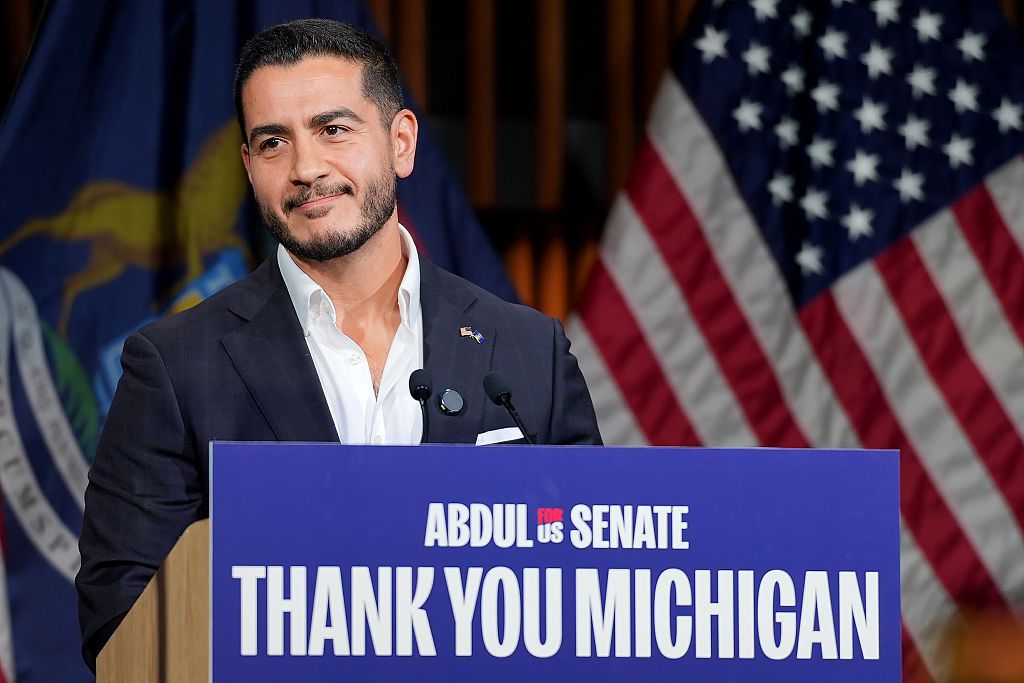
Donald Trump’s Republicans have suffered a monumental defeat. Deep-red states such as Texas and South Carolina sent Democrats to the Senate. The war in Iran, the price of groceries and petrol, and a breathtaking array of ragtag candidates help explain this stunning reversal of Trump’s 2024 mandate. But one race, the Senate contest in Michigan, speaks to something more: something we Europeans have grown all too accustomed to, and which is only now dawning on the United States.
The United States has had its first taste of the blight that has been eating at European democracies for five decades
Abdul El-Sayed is an epidemiologist from Michigan, a Rhodes scholar and a Columbia-trained physician. He is young, sly and deftly talented. His campaign was professional, his communication modern and effective. Endorsed by Sanders, Warren and Ocasio-Cortez, the party’s socialist wing, he is in many ways the ideal modern Democratic candidate. He is also, beneath the veneer of electoral respectability, a man of profoundly problematic opinions who has been accused of having close ties to the Muslim Brotherhood. He held a leadership role in the University of Michigan’s Muslim Students’ Association, which members and sympathisers of the Brotherhood played a key role in founding. His half-sister has written that their mother was a Brotherhood activist in Egypt in the 70s (El-Sayed says he is now estranged from his mother). His father-in-law held positions at ISNA and CAIR, both named as unindicted co-conspirators in the Holy Land Foundation terror-financing trial (neither organisation was charged with any crime). When Ayatollah Khamenei was killed by an Israeli strike in February, El-Sayed refused to say a word about it; on a leaked campaign call the next day, he explained: ‘there are a lot of people in Dearborn who are sad today.’ He has, in a manner Europeans know all too well, repeatedly denied having any links to the Brotherhood. But the facts speak for themselves.
The Democratic primary that put him on the ballot was perhaps the first election in American history decided by a confessional bloc. Michigan is less than 3 per cent Muslim, but it includes places like Dearborn, the first Arab-majority city in the United States. In neighbouring Hamtramck, the entire city council is Muslim; in 2023 it voted unanimously to ban the Pride flag from public buildings. In Dearborn, a school board meeting had to be shut down by the fire marshal after hundreds of parents packed it to protest against library books teaching children about homosexuality. In August, these cities voted overwhelmingly for El-Sayed against Congresswoman Haley Stevens: 78 per cent in Dearborn, with turnout nearly doubling in Dearborn Heights. Statewide, he won by fewer than 14,000 votes out of 1.5 million. In Dearborn and Dearborn Heights alone, his margin was more than 16,000. Without Dearborn, no El-Sayed.
The United States has had its first taste of the blight that has been eating at European democracies for five decades: Muslim immigration without integration or assimilation, leading to the election of sectarian candidates whose values conflict with those of the host nation. This, in essence, is democracy’s fatal flaw. Universal suffrage, plus immigration, minus integration, equals the election of illiberal candidates. Nothing about El-Sayed’s election is undemocratic. Nor was there anything undemocratic about Iqbal Mohamed, the independent MP for Dewsbury and Batley, rising in the Commons to defend first-cousin marriage because it ‘helps build family bonds’; or Mothin Ali, who dedicated his Leeds council seat to ‘the people of Gaza’ with a cry of ‘Allahu Akbar’; or Rima Hassan, the La France Insoumise MEP who called Hamas’s action on 7 October ‘legitimate’. They are democracy made manifest. But given enough time, they may destroy it.
None of this would have surprised the liberals of old. John Stuart Mill wrote that ‘free institutions are next to impossible in a country made up of different nationalities. Among a people without fellow-feeling… the united public opinion, necessary to the working of representative government, cannot exist.’ Lee Kuan Yew, Singapore’s founding prime minister, put it more bluntly: in a multiracial society, people do not vote according to their interests but according to their race and religion.
The ancient Athenians knew it too. The prospect that non-Athenians might take part in elections haunted democracy’s first architects. In 451 BC, alarmed by the swelling number of citizens, the assembly passed Pericles’ law: no one would be a citizen unless both his parents were Athenian. The metics, resident foreigners nearly half as numerous as the citizens themselves, paid a special tax and served in the army, but never voted, could not own land, and risked enslavement if they married an Athenian woman. Aristotle defined the citizen as one who ‘shares in the administration of justice and in offices’, and held that a city should be composed, as far as possible, of equals and people who are similar.
Israel faces the same problem today. It has long been accused of apartheid, and few have the courage to explain the arithmetic that makes equality impossible. Between the Jordan and the Mediterranean live some seven million Jews and some seven and a half million Arabs. Give them all an equal vote and the Jews become a minority in a state built to protect them. Israel’s own leaders have said as much: Ehud Olmert warned in 2007 that if the two-state solution collapsed, ‘the State of Israel is finished’. Sensing which way the tide of history runs, the Knesset passed a Basic Law in 2018 declaring the right to national self-determination in Israel ‘exclusive to the Jewish People’. It is profoundly undemocratic, and perfectly understandable.
Western societies, by embracing multiculturalism or falling helplessly victim to it, may have sown the seeds of their own destruction. It falls to our generation and the next to solve the problem that Karl Popper glimpsed 80 years ago: must we be illiberal to protect liberalism?


Comments