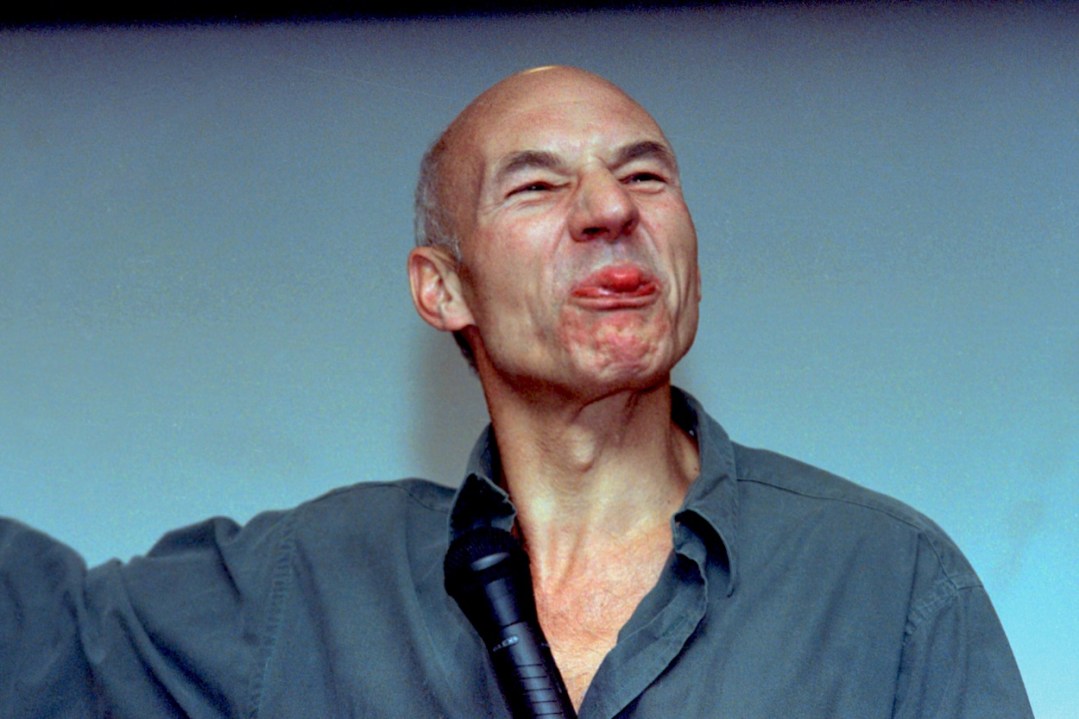
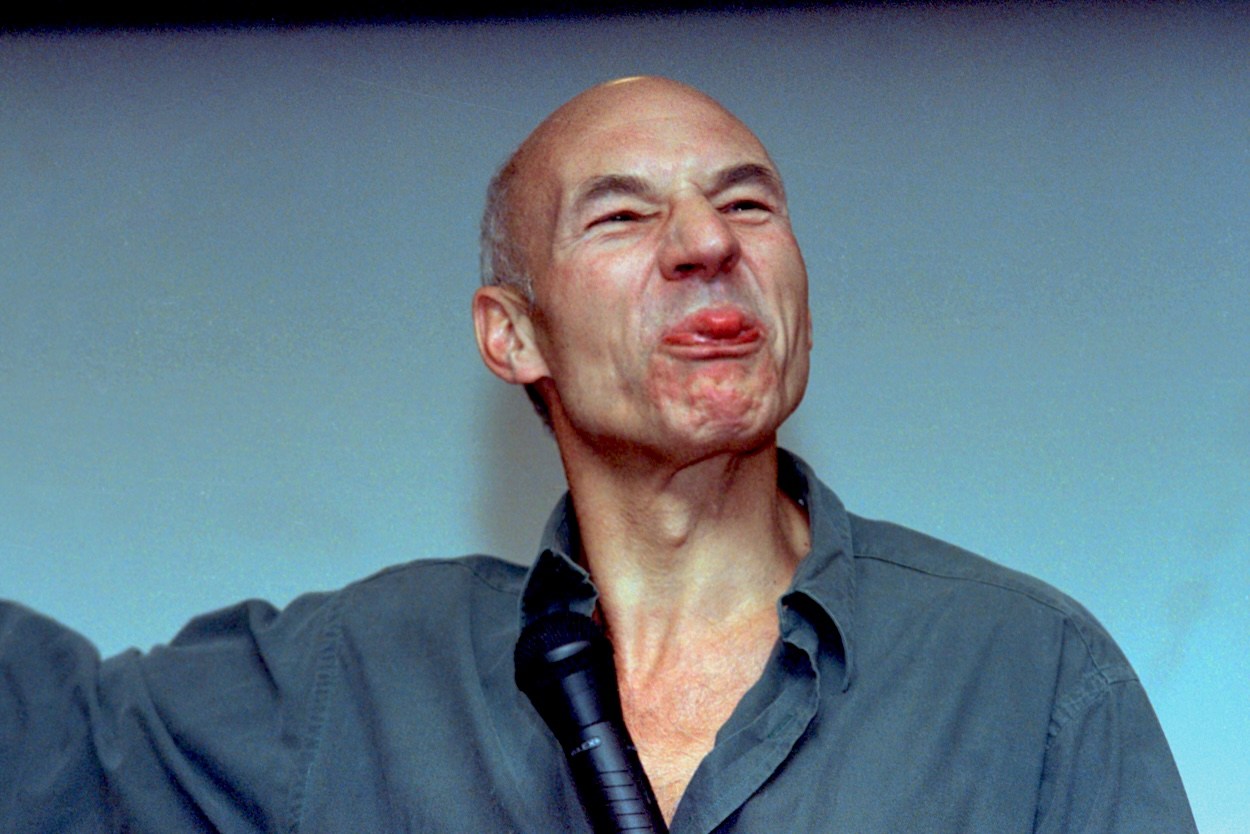
The death last week of Sir Patrick Stewart brought about the expected outpouring of admiration from fellow thespians. There was a particularly histrionic show of grief by Harriet Walter, who claimed that the world would be very poor without him and that she’d never heard a bad word against him. Well, here are two bad words: he could be arrogant and pompous. I discovered this when I went to interview him in April 1996 for the Daily Mail.
Stewart could be arrogant and pompous. I discovered this when I went to interview him in April 1996
His seven years of portraying Captain Picard in Star Trek: The Next Generation had left him extremely wealthy. He lived in a sumptuous house in Los Angeles but was visiting London to promote his new film, called Jeffrey, which he hoped would burnish his politically correct credentials. In it he played a gay interior designer who lives with his chorus-boy partner in Aids-riddled New York. (God knows what the Trekkies made of their heroic captain prancing around the streets of New York in a pink beret.)
He was holed up at London’s most exclusive new hotel, the Lanesborough, at Hyde Park Corner. Ushered into his luxurious suite, I found him lounging on a sofa in faux-bohemian pose, barefoot and wearing a pair of faded jeans. It struck me as tad pretentious. Lurking nearby was a beady-eyed PR man, which put me on alert. It was during the 1990s that every celebrity suddenly acquired a firewall of ‘people’: PRs, agents and managers demanding full control over the interviews their clients gave. Journalists should not be allowed to ask ‘inconvenient’ questions – their purpose was to further pump up the professional profile of ‘the talent’. To plug their latest project, not dig into their psyches. But that isn’t journalism, is it?
I knew from my research that Stewart had grown up in Yorkshire and had an unhappy childhood; there was poverty and a violent father. Acting in church pantos had been his escape from all that and set him on the road to his glittering career. I hoped to explore this a little further in our interview. My book Dreams and Doorways, published three years earlier, was a collection of interviews with famous people about how the experiences and influences in their early lives forged them into the successful adults they became. This is a hugely important theme in life, which helps us to understand people.
Stewart was all smiles until I mentioned the word ‘childhood’, at which he stiffened and gave me an icy look. Standing behind him the PR flunky, whose earlier demeanour had been of the Uriah Heepish ‘too humble to be called a friend’ type, now scowled at me and shook his head. ‘We’re here to talk about Mr Stewart’s film,’ he stated.
‘Yes, and we will,’ I assured them both, holding up the press handout I’d been given. ‘But my feature can’t be only about that. It needs to be a more rounded look at your life, your past, your influential relationships. Then we’ll get on to Jeffrey, which sounds really interesting…’ I knew what my newspaper wanted, and it wasn’t merely another anodyne press release.
But the PR cut me off. ‘This interview is over.’ Stewart continued giving me the stony, silent treatment as I was hustled out the door. And I hadn’t even mentioned his extramarital affair and messy divorce!
Back at the office I raided the cuttings library. Then I composed my piece: a fairly thorough picture of the actor’s journey from Yorkshire poverty to Hollywood fame. The next day, the headline doubtless made him seethe: Patrick’s new star-spangled manner. And the caption under his photo posed the question: Has stardom gone to his head? How much more complimentary it would all have been with a bit of gracious cooperation on his part.
I think Stewart’s background as a great classical stage actor – a veteran of the Royal Shakespeare Company – had imbued him with a certain tendency towards haughtiness. This was obvious during his first season on Star Trek, when he scolded his co-stars for joking around on set, then stormed off when they merely laughed at him. ‘We are not here to have fun,’ he famously declared. Having won plaudits for his performances on the classical stage, he clearly regarded the cast of a somewhat juvenile TV show his inferiors. And of course they were, but he was there to earn megabucks, not to do Shakespeare, so there was no call for such pomposity. To his credit, he admitted as much in his 2023 memoir.
I’m not the only journalist to have received an icy Patrick Stewart stare in response to an unwelcome question. Not by a long shot. For example there was Eamonn Forde’s 2017 interview for the Big Issue. Stewart arrived late at Claridge’s, complaining about the ‘calamitous’ traffic – the taxi ride from Leicester Square took 50 minutes when it should have taken ten. When Forde says he could have taken the Tube, ‘he shoots me a gaze of either pity or contempt that I would even suggest such a thing, given his enormous fame…’ Yep, that’s the great actor I remember.




Comments