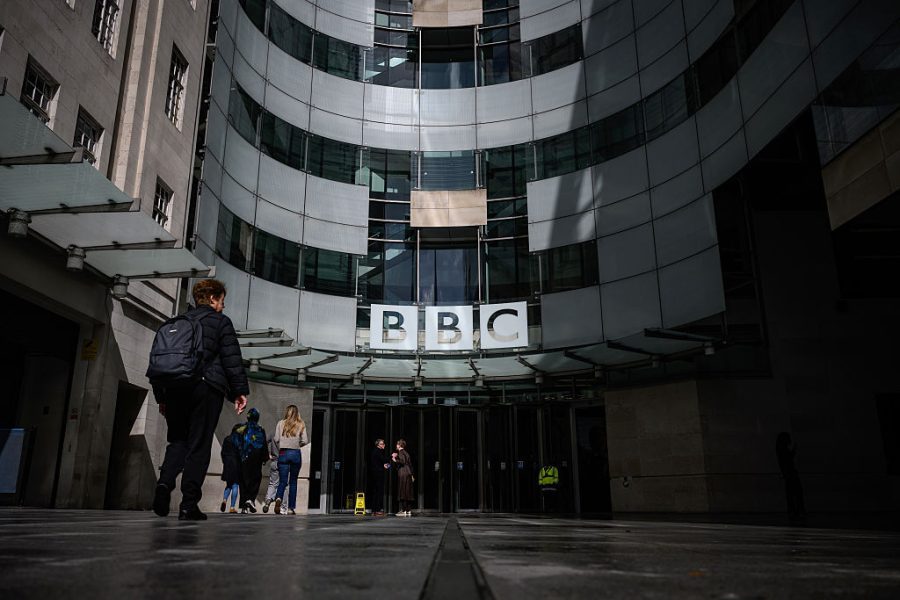
I don’t think I’ve ever been more wrong than when I was booed in a synagogue around twenty years ago. The occasion was a panel on media bias against Israel. One of the audience had asked a question about the BBC’s ‘institutional anti-Semitism’ and I responded – I shudder now to think how wrong I was – that while it was obviously biased against Israel, that reflected the left-liberal mindset of the overwhelming majority of its newsroom rather than anti-Semitism as such.
The years since the Hamas massacre on 7 October 2023 have been an object lesson in how wrong I was. The BBC’s reports have consistently repeated Hamas propaganda as fact, as with its international editor Jeremy Bowen’s coverage of the alleged bombing of a hospital in Gaza on 17 October that year. Hamas claimed an Israeli airstrike led to the blast, which it said killed at least 500 people. Bowen reported on BBC One’s News at Ten that:
The problems with the BBC’s on-screen reporting do not come out of nowhere
The missile hit the hospital not long after dark. You can hear the impact. The explosion destroyed Al-Ahli hospital. It was already damaged from a smaller attack at the weekend. The building was flattened.
In fact, the blast was caused by a misfired rocket from Palestinian Islamic Jihad, the hospital was entirely untouched and the damage was to a nearby car park. Bowen later accepted that he was ‘wrong’ but ‘doesn’t regret one thing’ about his reporting.
Danny Cohen, the former director of BBC television, has said that its repeated broadcasts of false reports mean that something deeper is at work than poor journalism:
Mistakes happen once, perhaps twice, but when they keep happening, you have to ask why. I think there are institutional biases.
But those of us who are forced to pay for the BBC’s bias through the licence fee only see one side of this institutional anti-Semitism: its reporting. We don’t see the inner workings of its newsroom, the comments behind the scenes or – given that we are talking about institutional anti-Semitism – the way its Jewish employees are treated.
That changed today with the revelation that the BBC has paid out £400,000 to Lucie Kon. She is one of the most lauded documentary makers of her generation and an Emmy and Oscar winner – and also happens to be Jewish.
Kon’s account of her time at the BBC after the 7 October massacre is a devastating indictment. After she suggested making a film about the massacre, she was told that ‘if you want to call Hamas terrorists then you have to call Israel terrorists, too’ and that she should ‘think about what drove Hamas to do what they did’. The proposed film should ‘contextualise’ the terrorist attack and empathise with what had driven the perpetrators. Then she was told that she should not oversee it because, as a Jew, she was ‘too partial’ – in relation to a film about the murder, rape and mutilation of Israelis.
Colleagues told her that ‘Zionists’ such as her are ‘evil’. Kon says that after 7 October, ‘It was like having Jew stamped on my forehead’. She says that a colleague told her it was ‘disgusting’ that the then prime minister Rishi Sunak was visiting a Jewish school as prime minister to offer support and reassurance to the Jewish community. As she puts it:
I was open about being a Zionist. The BBC says, bring your authentic self to work. And I did. And I lost my job as a result.
After making a formal complaint, Kon was ordered to stay at home for months and then made redundant. The BBC has now paid her £400,000, although it has not admitted liability, apologised or accepted that she was the victim of anti-Semitism.
The problems with the BBC’s on-screen reporting do not come out of nowhere. Kon’s case is instructive because it is the first concrete example of what lies behind the bias in the BBC’s reporting: Jew hate. Much of the BBC’s output shows that its default position is that Israel is the real problem in the Middle East. It is hardly a surprise that behind the scenes, the view that Zionists are evil is considered uncontroversial.
One of the characteristics of anti-Semites is that they believe they are privy to the reality of the world – that Jews are the key to everything that is wrong. So they think they are merely stating the obvious when they say that Zionists are evil or that a Jew should not oversee a programme about a massacre of Jews.
Kon was a jewel in the BBC’s crown but was attacked by colleagues because she is a Jew. I have heard similar stories from other Jews who, for entirely understandable reasons, have decided to keep their head down, accept they work for an organisation in which open Jew hate flourishes, and get on with their job. But now that Lucie Kon has taken the courageous step of fighting the BBC’s institutional anti-Semitism, never again can it pretend the problem is not real – and raging.




Comments