
If it weren’t for blood, I wouldn’t be here. And by here, I mean in The Spectator. Until my school tutor pointed out that my inability to cope with blood might complicate my desire to become a doctor, that was what I thought I would end up doing.
Everyone knows that giving blood is a ‘good thing to do’ (just do it!) and later, while at university, I really did try. But after fainting in a church hall while wearing a mini skirt, I was asked to give it a break. Don’t call us, etc.
Then came pregnancy, and blood going in all sorts of directions. It was time to man up. Besides, as the midwives kept telling me, I was O-negative, the universal donor, a ‘first responder’. Had I considered donating?
So now, every few months, I’m nudged by the NHS to sign up via the Blood Donor app. It is amazingly simple to use. We are often rude about the NHS, but its blood donation programme is a model of efficiency.
Blood is a vital resource and as Roderick Bailey points out in The Lifesavers, Britain has pioneered its use. In 1665, an English physician transfused blood between dogs. Then in 1818, the British obstetrician James Blundell performed the first successful human blood transfusion.
When my turn to donate arrives, I spend the morning bracing myself and usually have sausages for lunch. The donor centre is near Broadcasting House, next to Bravissimo. I begin by answering questions about whether I have recently had anal sex or contracted Ebola or mad cow disease. If I haven’t, they are happy to take my blood, which I exchange for a packet of salt-and-vinegar crisps and a mint-flavoured Club.
As with jury duty and visiting the polling booth, donating blood gives one that pleasant feeling of doing something ‘civic’. It is not exactly enjoyable, but there is too much enjoyment in life.
That said, I have grown fonder of the process and like seeing the other donors, who come from all walks of life and always seem much more relaxed than I am. Why is everyone so sanguine about needles and blood? Is it because we are the Botox and Ozempic generation, accustomed to injecting ourselves in the pursuit of beauty? Or is everyone made of stronger stuff than I am?
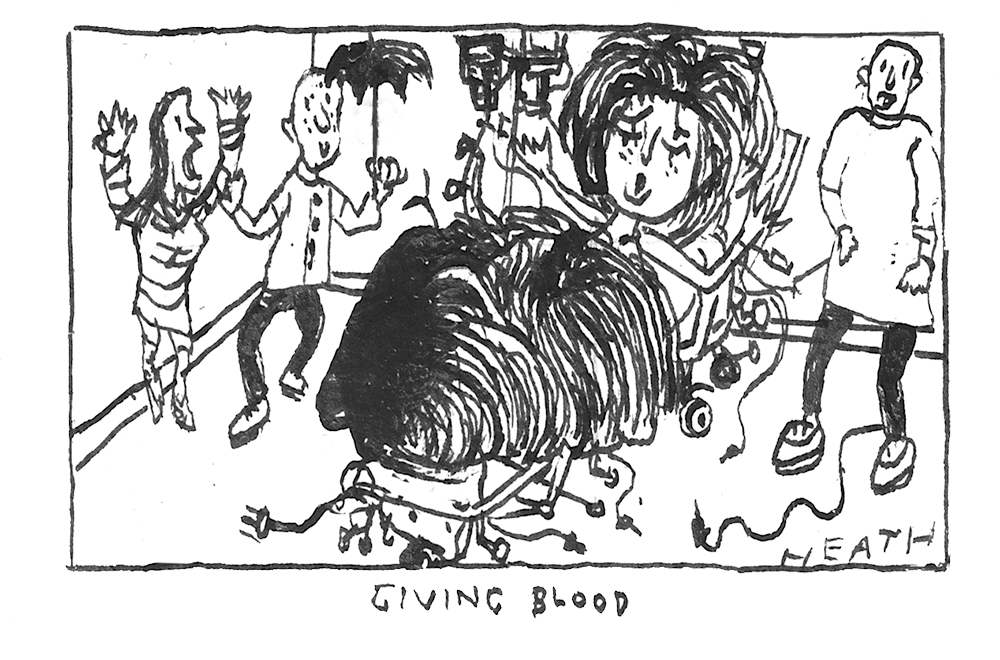
The needle punctures my skin. I start to feel faint, and the kind nurses come to check on me, looking worried as I turn pale. Back goes the big blue chair. ‘Squeeze your bottom, please,’ they say, as I listen to the latest hits on Capital FM.
Then, after about ten minutes, the needle comes out. I sip a pint of lemon squash, to replace the pint of dark red juice now hanging in a bag next to me. I feel lighter, dizzier.
At my most recent donation, one woman asked if she could keep a vial of her blood. It was the anniversary of her mother’s death and she wanted a souvenir. Unfortunately, the NHS couldn’t allow this, but the nurse expressed her sympathy for the woman’s loss. Blood connects us to our families, but it binds us to the strangers we replenish, too.
Occasionally, I receive a message about where mine has ended up. ‘Your blood has been on a journey!’ it reads, and I discover it has been deployed at Queen Alexandra Hospital in Portsmouth, Royal Sussex County Hospital in Brighton or London’s UCL. The last donation went to a neonatal unit. So, reluctantly, I sign up again on the app and start to dread it. Selfishly, I know I am really doing it just to prove something to myself.



Comments