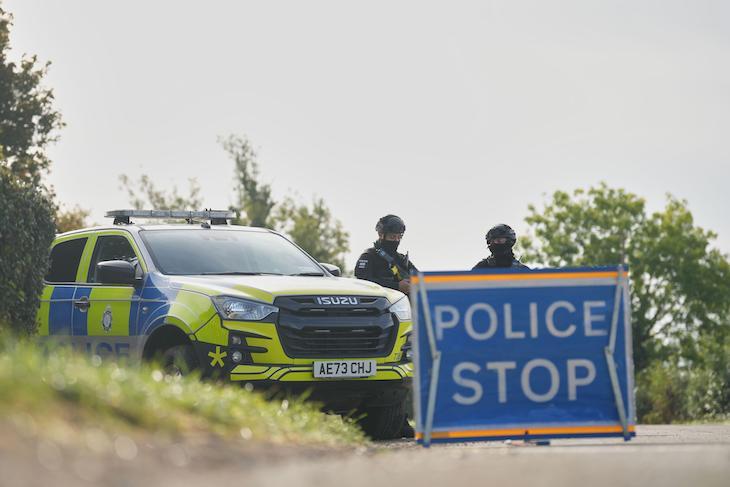
The whole thing was absurdly hilarious. At one point, someone suggested it could have been a stag party gone wrong, and that a farmer on her way home foiled the plot, which neatly sums it up. The government called for people not to speculate. Andy Burnham then said, before any trial, that strong indications suggested Iran had played a part. The men arrested at RAF Fairford, treated by the president of the United States as the work of a foreign actor and by our own government as likely Iranian terrorists, have all been let out on bail.
The recruit has now proved himself reliable and handed over compromising material that can never be taken back
So what happened at RAF Fairford? One possibility is that the Iranians, or the Russians, or someone else who has it in for us, are recruiting through online game chat rooms. Pay to slay. Pay-as-you-go terrorism. From our opponents’ point of view, the problem is that you might not get the best and the brightest. Some real comic-gold moments in the Fairford story point to an Ealing comedy, not an episode of 24. But the comedy hides a deeper, ongoing vulnerability, and a problem that has only been escalating.
The recent spate of arrests in connection with arson attacks across London, announced by counter-terrorist police, confirmed what many in Britain’s beleaguered Jewish community had known and feared for weeks. An insidious new form of anti-Semitic violence has arrived on British streets. This time it is not the work of lone fanatics or the supposedly spontaneous pro-Palestine protests that have repeatedly spiralled out of control. No, this could be something colder, more calculated, and, I fear, far harder to stop.
Detectives investigating a wave of arson attacks on Jewish targets across London have made a string of arrests since late March, some in connection with the firebombing of Hatzola ambulances in Golders Green on 23 March, others in connection with attacks on synagogues in Finchley and Harrow, a Persian-Iranian dissident media outlet, and another Jewish charity. A group calling itself Harakat Ashab al-Yamin al-Islamiyah (HAYI) has claimed responsibility for the campaign in videos that also show drones flying near and over the Israeli embassy in Kensington. Police are investigating possible links between the group and Iran.

This model is brutal, simple and vicious. They identify local criminals or disaffected youth who need cash quickly. They give them a small, relatively low-risk target. They pay them in bitcoin, or one of a dozen other untraceable cryptocurrencies. If they perform reliably, the sponsor escalates the jobs. The sponsor stays invisible, untouchable, and unknown. There is complete deniability. But the fear is real. This is asymmetrical warfare and grey-zone aggression at its most vicious.
The logistics of this pay-as-you-go Jew-hatred, in the model police are now examining, are as simple as they are sinister. Recruiters scour Telegram channels, online gaming sites and other social-media platforms for disaffected young men and petty criminals who are vulnerable and desperate for cash. These targets are essentially groomed and offered a couple of hundred pounds to commit an initial, relatively minor crime – for example, shoving a burning bin against a dissident Persian radio station or lobbing a petrol bomb at a synagogue. The real wickedness lies in requiring them to video the act on their phones and immediately upload the footage via secure messenger apps such as Telegram or Threema. Only once the handlers have this proof is trust – and leverage – established. The recruit has now proved himself reliable and handed over compromising material that can never be taken back. From that point, the proxies are moved up the ladder by their abusers to bigger, more serious crimes in return for substantially higher payments in untraceable cryptocurrency.
It’s cheap, effective, and almost impossible to trace back to the state ultimately pulling the strings. The Metropolitan Police assistant commissioner Vicki Evans, the senior national coordinator for counterterrorism, put it plainly: “I’ve spoken previously about the Iranian regime’s use of criminal proxies, and we’re considering whether this tactic is being used here in London.”
Evans has previously spoken about the Iranian regime’s routine use of criminal proxies. HAYI has also claimed identical attacks on Jewish sites in Belgium and the Netherlands. This is swiftly becoming a new operating method for hostile states seeking deniable operations on British soil. The New York Times has now given it a name – gig-economy warfare, fought with “disposable agents” – and treated the Fairford incident as the moment the same method was aimed at a base flying American bombers. One of the men called the police himself. That is not evidence the threat is small. It is evidence the people hired to carry it out are disposable, which is why the sponsor can afford them.
The anti-Israel Boycott, Divestment and Sanctions (BDS) movement has spent years tirelessly mainstreaming the idea that Jews are legitimate targets for resistance. Over the past few years, we have seen everything in Britain from campus encampments that celebrated the October 7 massacre to local councils that fly the Palestinian flag. Meanwhile, Jewish schools are installing panic rooms.
The same week, as whatever exactly was happening at Fairford, the Green Party conference kicked off in Brighton. There, the party voted to class Zionism as a form of racism. Green Party MPs have been desperately scrambling, trying to somehow insist that there is no conflict between Jewish rights in Palestine or Israel and Palestinian rights in Israel or Palestine. As confusing as that sentence is, it barely shows the level of confusion of Green Party MPs. They are clearly out of step with their electorate.
Over the last couple of months, I’ve been lurking in about a dozen different Green party member WhatsApp groups. I’ve been singularly impressed by the discipline and the organisation. This group and others not only created that motion, but brought it forward despite real opposition and made it happen. It has been very worrying and impressive to see.
There were QR codes, with step-by-step guides on how to vote and when to vote. There was live coverage on the day for those who registered to vote online. The vote management was superb. They managed which amendments to support and which to vote against from start to finish.
In the weeks leading up to the conference, a brilliant campaign was run. One group even arranged transport to the conference for those who could not afford to get there. This is a machine; a well-disciplined, well-run party machine.
We are supposed to believe that this was the work of middle-class perennial students. Those who are there for the cause, as long as it is not before 9am. But this was no fringe losing its temper. Green party members succeeded in pushing through a motion explicitly attacking Zionism.
The guy who’s paid a couple of hundred pounds to put a bottle through a synagogue window in the early hours of a Sunday morning hardly needs to read the motion. He can be, and is, easily directed, and he is easily led, to vote or come to any conclusion.
An insidious new form of anti-Semitic violence has arrived on British streets
Rarely before has a global campaign had such a uniform purpose. Isolated anti-Semitic incidents have always existed, sadly. But what we are seeing is a return to the industrial-scale ideological preparation that is increasingly making large sections of the population receptive to the idea that attacking Jews is once again somehow justified.
The sheer randomness and low-level nature of these attacks make them particularly insidious. The ignorant, thuggish random idiot paid a couple of hundred pounds to commit arson has no idea of the seriousness of what he is doing. He is simply a disposable tool. Yet the cumulative effect will be devastating. Jewish schools, synagogues, charities, ambulances and community centres must now operate under ever more extreme security.
Hatzola north-west chairman Shloimie Richman called the Golders Green attack “the darkest day in the close to 50 years of our existence,” highlighting the bitter irony that vehicles used for life-saving work were deliberately targeted. Now parents worry about sending their children to youth clubs. Families will debate whether Britain is still a safe place to raise Jewish children.
This low-level terror will slowly make Jewish life in London and other major cities impossible. Some will respond by retreating behind ever higher gates and stronger security. But many others will eventually conclude that the only long-term answer is to leave for Israel.
Either way, Britain loses. It loses some of its best citizens and control of its streets. The government and police have been commendably quick to make arrests. That is the right response. But arrests alone are not enough.
We still await a clear public statement from a minister naming the suspected state sponsor behind the campaign. Burnham has gone further on Fairford than any minister managed in the spring, and still stopped short of saying who pays. This outsourced, deniable model is dangerous precisely because it works so well. It allows a hostile foreign state to wage war on British soil while maintaining plausible deniability. It will turn our own criminal underclass into unwitting proxies. And it exploits the very openness and rule of law that make Britain a civilised democratic country.
If we are serious about protecting our Jewish communities the dissidents we host from various brutal regimes, and national security on a broader scale, then we need to call this for what it is: state-sponsored anti-Semitic terrorism delivered on the cheap through bitcoin and local thugs.
Proscribe the group claiming responsibility, sanction the crypto wallets and publicly scrutinise the IRGC’s (Islamic Revolutionary Guard Corps) role. Anything else will invite further escalation. The real test will be whether ministers have the courage of their convictions to name the suspected sponsor, dismantle the financial and ideological infrastructure that makes pay-as-you-go Jew-hate possible.






Comments