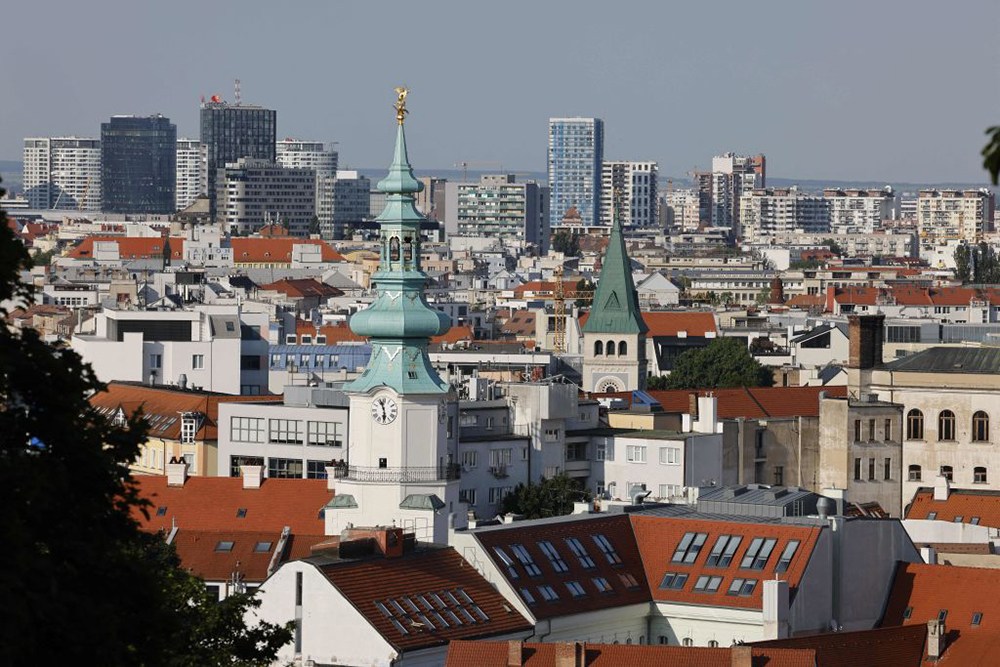

It is difficult to discern a unifying cultural theme in Trenčín, a midsized Slovakian town with an imposing castle, a charming Habsburg square and a surplus of specialty coffee shops. This is a common feeling in many central and Eastern European cities, which have played host to various religions, ethnicities and foreign occupiers over the centuries. It is especially true of Slovakia, a country that has only existed since 1993 and lacks the historical pedigree of its Hungarian, Polish and Czech neighbours.
Trenčín (pronounced Tren-cheen) is experiencing a sudden influx of visitors because it was named one of two European Capitals of Culture this year. The other, Oulu, is somewhere in Finland.
There is no mystery to the Finns. They are taciturn, they love saunas and beer and they have a dry sense of humor. Finland is always at the top of global happiness rankings despite its citizens’ aversion to small talk, smiling, or any behavior that might be considered friendly. One suspects the country’s reputation for happiness rests on efficiency, cleanliness and a collective unwillingness to express dissatisfaction on opinion surveys.
Generous EU subsidies have helped restore the castle, but they haven’t resolved Trenčín’s identity crisis
While Finnish identity is well established, Slovakia is a different story. It is often confused with nearby Slovenia, another young country that at least has the Alps, the Adriatic and easy access to Italy. Slovakia is also overshadowed by neighboring Czechia, which was very much the senior partner in the relationship until Czechoslovakia was dissolved and independent Slovakia created in the so-called Velvet Divorce of 1993. The two peoples speak similar languages, but the Czechs have been wealthier and more connected to the rest of Europe since the Middle Ages. The Slovakians have always been a bit of an afterthought.
Trenčín’s own cityscape reflects the imprint of outsiders. A local street commemorates Marcus Aurelius, the Roman philosopher-emperor whose legions left a stone inscription nearby to commemorate a hard-fought campaign against the Germans. The castle was built and then enlarged by a succession of powerful nobles from the Kingdom of Hungary, which dominated the region for most of the Middle Ages. The city’s downtown, with its cobblestone square, baroque ornamentation and pastel colors, is a product of the Habsburg period. The outlying industrial neighborhoods, clearly visible from the castle battlements, were built up during the Soviet era. The biggest draw today is Pohoda, a music festival held annually at Trenčín Airport.
Generous EU subsidies have helped restore the castle and the downtown, but they haven’t resolved Trenčín’s identity crisis. Many of the EU-funded accoutrements seem generic and uninspired. The T-shirts at the castle gift shop have a stale Corporate Memphis-like design. And in one of the restored rooms, a Portuguese artist has installed what looks to be a deconstructed loom. It is all rather bland.
The silliest product of this cultural spending spree is an exhibit located next to the castle well. It “interrogates” the legend of Omar and Fatima, a charming but probably apocryphal story that survives from the Ottoman era (the Turks never captured the castle, but Trenčín was right on the border of the Ottoman Empire at its height). Fatima, so the story goes, was captured by Stephen Zápolya, the local Hungarian castellan. Zápolya refused all offers of ransom, telling her beloved Omar that Fatima would only be released if he could extract water from the castle’s rocky foundation. After three years of backbreaking work, Omar managed to dig a well and free his beloved.
The new exhibition reinterprets this fable in the most tendentious way possible. According to the display, the story “serves as a pedagogical tool for masculinity, presenting the pursuit of a beloved as a grueling physical challenge – a practice for a man’s life in a patriarchal society.” One sympathizes with whoever had to translate this passage from Slovakian into English.
With its short history, precarious sense of nationhood and economic and political dependence on an integrated Europe, Slovakia seems the ideal 21st-century EU member state. Yet even the Slovakians have proven resistant to the Brussels borg. One reason for this skepticism is that it’s hard to be sure what the EU is selling. The exhibitions one sees are all about distant historical eras or vaguely fashionable political buzzwords (feminism, green tech, European integration and so forth). None of this has much to say about what it means to be a Slovakian in 2026.
The locals nevertheless seem quite attached to their country, even if it lacks the name recognition of its more famous neighbors. Though Slovakia is a member of NATO and the EU, Robert Fico, the Prime Minister, has repeatedly clashed with Brussels over aid to Ukraine, encroaching cultural liberalism, and what he calls the defense of “national identity.”
It’s not that Slovakians are eager to leave the European Union. They’re just happy with the current equilibrium, which allows them to receive economic subsidies, collective security and cultural cachet from Brussels without giving up much in the way of sovereignty. This is a deal that most European voters seem to like, including those with right-wing or populist sympathies. To the south, Hungarians recently replaced the antagonistic Viktor Orbán with Péter Magyar, who promises to improve relations with the EU without changing his country’s approach to border control and immigration.
Politics aside, Trenčín is worth a weekend trip if you happen to be in Prague, Budapest or Bratislava. The locals are friendly and most young people speak at least a little English. The hectoring displays deconstructing local history can be easily ignored. The castle is very lovely and, unlike many of the medieval ruins that dot the Slovakian countryside, extremely well-preserved. There is, to be sure, a generic Ruritanian quality to the town and its environs – you can easily imagine the same landscape in nearby Poland, Hungary or Czechia. But don’t mention this to the locals. They’ll quickly remind you that you are, in fact, in Slovakia.




Comments