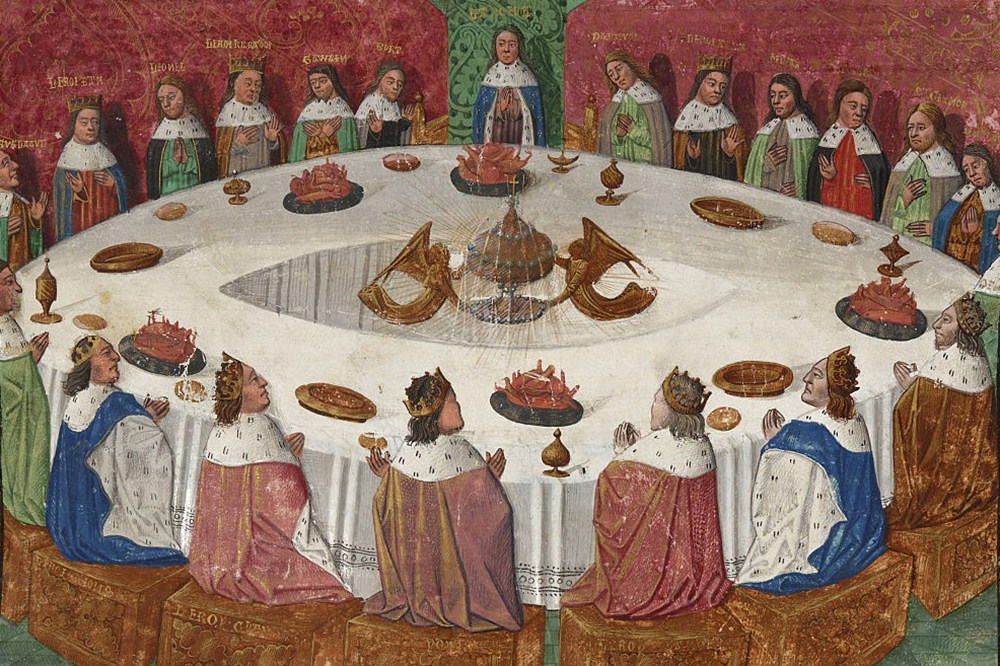



I was honored to speak with Malcolm Guite, a poet and Anglican priest, about storytelling, attention and contemporary life. Guite’s latest project is a retelling of the Arthurian legends in verse, beginning with Galahad and the Grail.
Arthurian legend might seem an unusual place to start for a conversation about technology. But I believe that repairing our relationship with the internet and the devices that permeate our lives begins with changing how we pay attention.
Much ink has been spilled about how the digital age has fractured our attention spans and much less on what it looks like, practically, to fix them besides the old panacea of “log off,” “touch grass.”
In my estimation, the best – and most human – place to start recovering is the art of the story. Here is a small part of our conversation:
‘An instant wow, an instant sensation… and then it’s forgotten and you’re on to the next thing’
KATHERINE DEE: It seems like the art of story has been lost in the digital age.
MALCOLM GUITE: A story is the opposite of random. It’s coherent. It’s meaningful. It’s got a beginning, a middle and an end. We’re not only storytelling creatures but story-bearing creatures. We work best when we know we’re inside a story and it’s a good story.
KD: Part of it, I think, is that the internet warps time. We don’t have a sense of beginning, middle and end. It’s been completely upended.
MG: The present moment is the only time when you can do something effectively. If we’re to fulfill the great commandment to love God and to love our neighbors, the only time in which it’s possible effectively to love is the present. You can’t say, well, I would have loved you in the past, or I’m going to love you in the future. You’ve got to love now, otherwise love has no reality. On social media such as Facebook and TikTok, there’s a tremendous pressure to curate yourself and be the best at every moment and present something which is perhaps more than you really are. No sooner have you done that than it’s finished and the next thing comes and you’re only as good as your last post. Teenagers have enough anxiety just in the course of nature and hormones without having it multiplied and exaggerated by the anxieties of self-presentation and curation on social media.
KD: I’m curious with the “end of reading” discussion – if maybe the best way back into reading is first telling stories orally.

MG: I would always start with rhythm games and nursery rhymes. I remember as a younger child being taught Lewis Carroll’s wonderful nonsense… the “Jabberwocky.” I just loved the strangeness of the sounds and I was very proud of being able to recite it. YouTube calls them shorts and I think Facebook calls them reels. The idea is it’s only like a minute-and-a-half and then you scroll on to the next thing and it’s randomly there. An instant wow, an instant sensation and then it’s forgotten and you’re on to the next thing, so you never learn how to build these longer slower pleasures, these deferred pleasures, this waiting to see what happens to the hero, getting them through the dark bit, the satisfaction of the rescue, all of that kind of thing. We almost lose the pleasure of that because we’re dazzled by a series of instant hits. So we have to resist that, I think, and enjoy together more of a patient build-up. I think audiobooks are a good development. I’m not snooty about them at all. Lots of people tell me they put the audiobook [of his retelling] on but they still have the physical book and they turn the pages and see the pictures and it’s like I’m reading the book to them.
KD: What do you think a contemporary person can learn from King Arthur?
MG: Everybody is going to have to grow up to a certain kind of sovereignty over themselves and a certain just way of dealing with others and the notion of coming to a throne is a good image of that. The whole reason that Galahad, who’s the grandson of the wounded king, goes back to the castle is to heal the land and to heal his grandfather. So there’s an intergenerational healing thing going on here. You can get to the Grail castle and you can get healed, but you can only do so by passing through the wasteland. The knight has to get through the wasteland in order to achieve the Grail and heal the wasteland.
KD: Are there wrong ways to engage with a story on the side of the listener?
MG: Trust the story and let the story do its work, and recognize that the story will have many things to tell you and it won’t tell you them all at once and some of them it won’t tell you until you’re old enough to hear them. I think one of the worst things you can do if you’re reading to kids is try to explain it all quickly. Great storytelling is trying to wake something up inside you, a whole new way of hearing and reading and seeing the world. Instantly doing rational explanations or trying to get a quick moral lesson out of it spoils that.
KD: Can it be a person’s fault if they enter a story and they refuse to come out?
MG: Not necessarily. I mean, it would depend on how long they refused to come out and why. If a child is in a really sad and miserable house, it’s great for the child to go into a fairy story world. There are some things that are worth escaping from. And there’s always consolations that we need. We need to be consoled. I think there would come a point in the child’s development where they needed, perhaps having gathered this from the stories themselves, the courage to turn around and face their situation and do something with it or about it. Some children might need longer than others. I think it’s a matter of judgment and discernment.






Comments