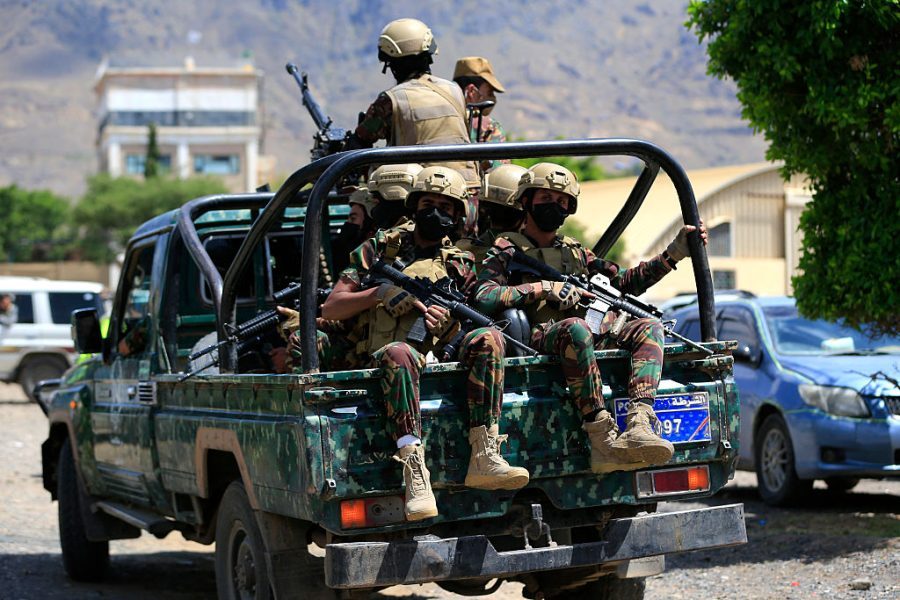
The British military has plenty of enemies, but few are as persistent as paperwork. The Houthi terror group, by contrast, has opted for a rather less bureaucratic procurement model. The Yemeni militia has become skilled at rapidly turning old weapons into new ones, transforming its ageing Soviet-era stock into a modern arsenal featuring AI-powered drones and experimental loitering torpedoes. In South Wales, meanwhile, 700 talented engineers have devoted sixteen years and almost £6 billion of taxpayers’ money to building a bespoke armoured vehicle – Ajax – for the British army. But there’s just one slight hitch: it still isn’t ready. While the Houthis have spent the past two years learning to fight, Britain has spent them doing paperwork.
The comparison is grotesquely unfair, and extremely useful. Britain has vastly better resources, but the Houthis have shown quite how much can be achieved with speed and improvisation. This month, the group took Perim, an island that sits in the middle of the strategically important Bab al-Mandeb strait. In a phenomenal demonstration of asymmetric warfare, a navy without ships and an air force without planes managed to halve traffic through one of the world’s busiest waterways in a single day. In doing so, the Houthis learnt that they have no need to dominate or outnumber their opponents. They have built a strategy around forcing richer enemies into bad bargains: accept disruption or stay away. Whitehall might find it embarrassing, but it should be taking notes.
We must focus on making attacks on British interests disproportionately expensive
The Houthis carefully watch which drones their adversaries swat away with the least effort and change the design accordingly. In the time it takes Britain to conduct a full review of operations, the Houthis will have simply flown the thing again. The drone that failed last month will soon return in a modified form, slightly harder and more expensive to stop. A Houthi militiaman does not need a procurement board’s blessing before trying version two.
The British military’s Ajax programme provides a dismal contrast. In 2022, the Public Accounts Committee reported that, after over a decade of development, billions of pounds had produced not one deployable vehicle. Ajax was declared ready last November, but was withdrawn from training within weeks after soldiers came back from an exercise vomiting and shaking.

The glaring failure of the programme points to a broader lesson. Where the technology is evolving rapidly, Britain should buy equipment that already exists, in small batches, getting it into soldiers’ hands early. The aim should not be to obtain perfect, bespoke weapons systems that will be used for a war that may have changed by the time it arrives. In the modern age of conflicts, speed is key. Britain must accept that a good system fielded now is often more useful than a perfect one delivered years late.
The militia’s most effective weapon, however, is economic. The Houthis do not need warships of their own to combat those of their adversaries. They only need to make deploying them painfully expensive. Spending a million dollars destroying a drone may seem perfectly rational when that drone is minutes away from striking a billion-dollar destroyer. The Houthis hold the power of when they force their adversaries to make such decisions.
Taking a leaf out of the Houthis’ book, Whitehall should ask a simpler question: how much do their actions make the enemy spend? Britain has spent billions projecting power. The Houthis have spent a fraction making that power far too costly to use.
This points towards a different model of deterrence for Britain. It is unrealistic, and unnecessary, for us to attempt to replicate America’s ability to dominate every geographical theatre. We must instead focus on making attacks on British interests disproportionately expensive. The Houthis have successfully leveraged the threat of imposing pain as a method of deterrence; it is time we did similar.
There is a further lesson in who gets to make decisions. When a Houthi commander notices a problem, he can take action to fix it that same afternoon. A British commander, however, must fight an uphill battle through regulation and layers of approval.
Britain’s top-heavy structure hardly helps: We have nearly twice as many admirals as destroyers, frigates, and carriers combined, most of them working ashore. The problem is a system in which too many routine decisions travel too far up the chain of command. It is crucial that an officer is able to approve a repair without multiple bureaucrats reviewing the paperwork. Such decentralisation of authority over routine operational decisions would be far more valuable than another form to fill in.
Britain will never out-Houthi the Houthis, and it most certainly should not try to. But it might at least learn from them. The group has learnt to spend less and make us pay more and, in doing so, has mastered something of the art of modern warfare. Britain has vastly greater firepower. Whitehall, unfortunately, still appears to be loading.






Comments