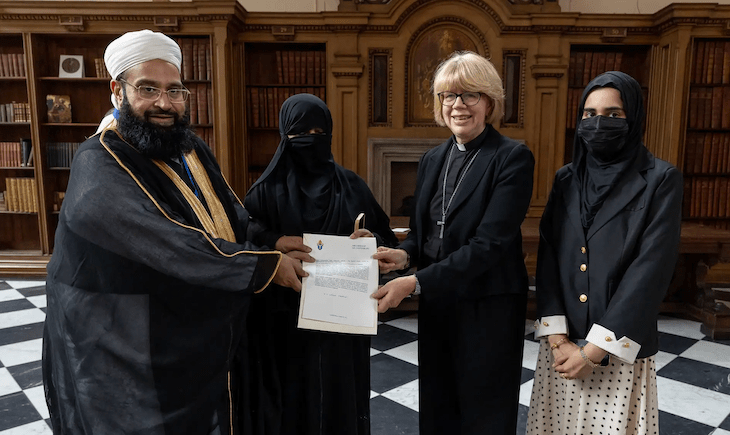
Many of Britain’s institutions are being destroyed from within by leaders who do not seem to understand what they are for. But even by those standards, the Church of England is a special case, as shown by its decision to spend the 25th anniversary of 9/11 giving a supporter of Osama bin Laden a prize for ‘reconciliation and interfaith cooperation.’
The tragedy of the Church of England – and it is a tragedy – is that we have seldom been in greater need of spiritual and moral leadership. As Matthew Arnold’s famous Dover Beach, lamenting the Sea of Faith’s ‘melancholy, long, withdrawing roar,’ puts it: ‘We are here as on a darkling plain/ Swept with confused alarms of struggle and fight/ Where ignorant armies clash by night.’ If that was so in Arnold’s 1850s, how much more true it is now.
‘Welby was always happier talking about asylum seekers or Tory cuts’
Yet the award of the Hubert Walter prize to the Pakistani cleric Hafiz Tahir Ashrafi is the latest evidence that the Church is not capable of providing that leadership, because it does not know what it is for. Ashrafi, as a three-minute Google search would have found, gave bin Laden the honorific title of Saifullah, or Sword of God, in 2007, in response to the knighting of Salman Rushdie. As the renowned champion of reconciliation and peace explained: ‘If a blasphemer can be given the title ‘Sir’ by the West… then a mujahid who has been fighting for Islam against the Russians, Americans and British must be given the lofty title of Islam, Saifullah.’
More recently, he exulted in the 7 October massacre, saying that ‘Allah crushed the pride of Israel through the Palestinian freedom fighters;’ shared a conspiracy theory that the US and Israeli missile strikes on Iran were a plot to control his own country (‘Under the cover of Iran, the target of the Jews and Christians is nuclear-armed Pakistan’) and chaired a meeting which condemned the Charlie Hebdo cartoons as an act of terrorism, two weeks after an actual act of terrorism in which 12 of the magazine’s staff and others were murdered.

The Ashrafi affront comes in the same week we learned that St Paul’s Cathedral had signed a four-year deal with the Fabric nightclub to hold ‘contemporary music events’ in the main body of the cathedral, described by the mayor of London, Sadiq Khan, ‘pairing world-class music with one of our most special landmarks.’ But St Paul’s is more than ‘special landmark,’ Sadiq. It is, or was, a sacred place.
Six years ago, this country faced the Covid pandemic, which shut tens of millions in their homes, threw millions out of work, upended all the normal routines of life – and killed 200,000 people. I cannot remember hearing a single word of spiritual encouragement or comfort from the official spiritual leader of the English people, the then Archbishop of Canterbury, Justin Welby.
A search turns up some low-key statements, but the Church was almost invisible during the greatest crisis in Britain’s recent history; Welby was always happier talking about asylum seekers or Tory cuts. Churches were closed, even for solo prayer. Sarah Mulally, Welby’s successor who gave and then subsequently retracted the prize from Ashrafi, has been described as playing ‘a key role leading the Church of England’s response to the Covid pandemic,’ a response which even Welby later admitted was excessive.
It’s unfair to say that Mulally and the leaders of the modern Church don’t believe in anything. They just don’t seem to believe in moral and spiritual leadership, and they don’t believe in the same things as most of their flock. They do believe deeply in ‘inclusion,’ which means opening up their cathedrals to nightclubs or subjecting Pakistani clerics to a lower level of scrutiny and investigation than they would apply to, say, a British politician under consideration for the same award. But a part of moral and spiritual leadership is exclusion – or at least toughness, making it clear when something falls below standard, as I think supporting mass murder might. Moral clarity was also, perhaps, a little lacking in addressing the Church’s abuse scandals.
The fruits of this are seen in the catastrophic trajectory of church attendance – down a third since 2010 alone, with little more than half a million people now attending a C of E service on a Sunday. Another part of what the Church should be about is promoting the institutions which cement society, such as marriage. That’s even quite ‘inclusive,’ albeit in a different way from LGBT interfaith friendship circles. Lots of people who don’t do organised religion still want to get married. But since 2010 marriages in Anglican churches have crashed even more than attendances – by around two-thirds, in fact.
Both the big Christian churches are under pressure. Mass attendance in the Catholic Church, an institution less affected by soft-headedness and woolly-mindedness, is also well down, though not by quite as much as the C of E’s. But if Anglicanism carries on like this, in about thirty years’ time it will literally have disappeared. Maybe some will see that as a good thing. I think it would be a shame.






Comments