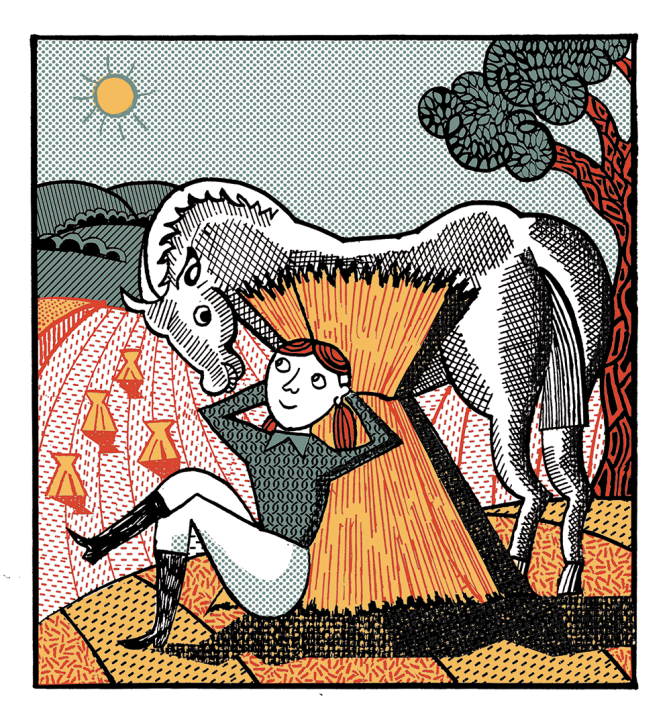
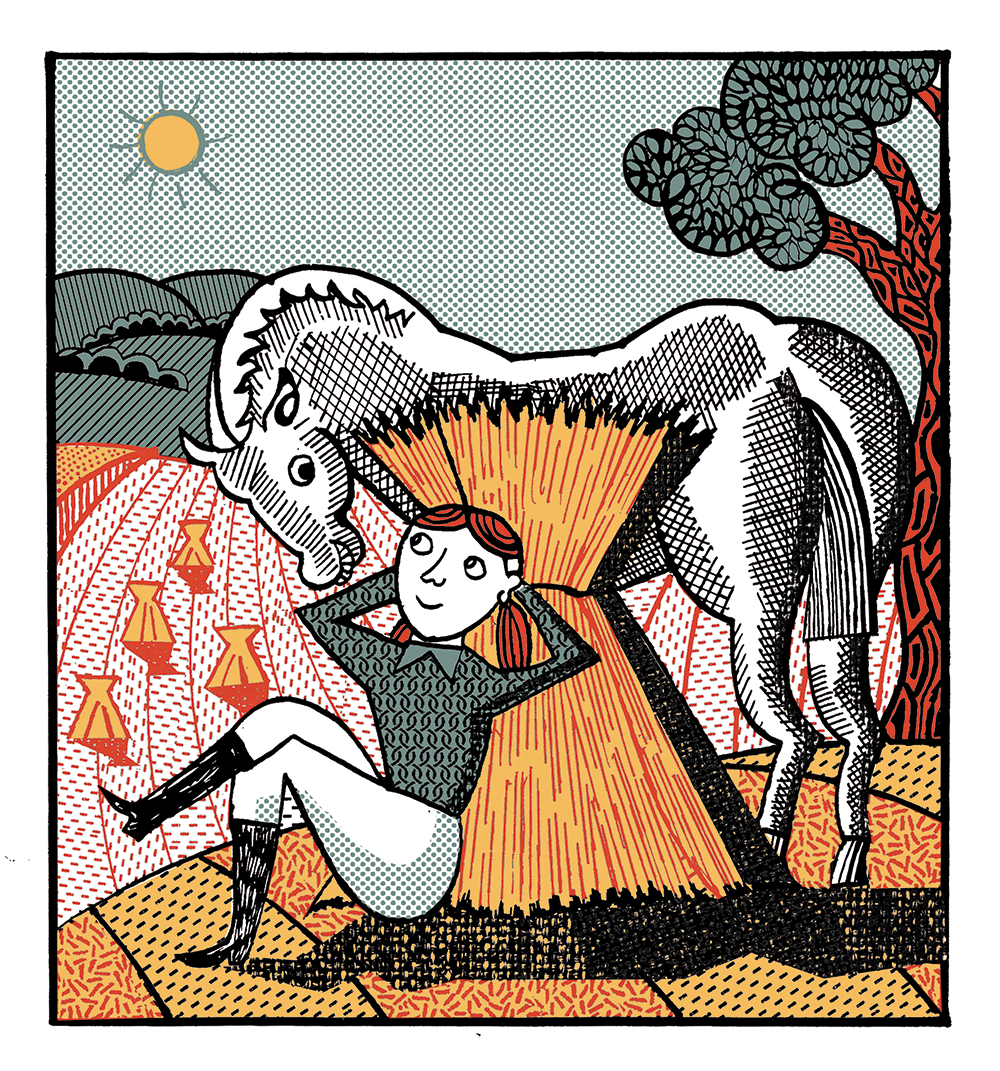
For the connoisseur, pushing your nose into a bale of new-season hay is one of life’s small but glorious pleasures. As the peasant poet John Clare wrote in 1835, the ‘breath of flowers and grass and happy cow/ Fling o’er one’s senses streams of fragrance now’.
Green and gold and sweet-smelling, first-cut hay is headier than marijuana, more complex than a Meursault. When the last bale was stored in the barn, you’d inhale deeply one last time, then close the doors with the quiet satisfaction that your horses were taken care of for the winter.

Horses and livestock used to eat grass in the summer, with hay kept for the dead months. It meant that pony-mad but impecunious girls like me, who grew up and became freelance writers, could keep a horse on a shoestring: renting a field so they live out year-round, following hounds with non-smart, but no-less sporting, smaller packs; fixing just about everything from the zip on my boots to a five-bar gate with baler twine.
But this year, there have been fewer than three months in which my old thoroughbred and my daughter’s Dartmoor pony have had enough grass to eat. After the warmest spring on record and the scorching summer (we’re entering the fourth heatwave as I write), their field resembles the Serengeti, and I’ve had to supplement with hay since early May, before this year’s hay harvest.
Ringing round trying to find hay back in the spring, I became increasingly frantic. I’d had the last of the stock from my usual supplier at Christmas. Demand was so high that he was refusing to sell to anyone but long-term customers.
I was asked by more than one person if I’d order more than I needed, then sell it on – but declined. Hay is an increasingly rare and expensive commodity.
The local feed merchants are quoting £8.50 a bale – more than double the amount I was paying two years ago – and mine go through three-quarters of a bale a day when there’s no grass. Only 15 years ago, a bale cost just £1 in north Norfolk, where we live.
I was down to my last few slices when I finally procured some – from an enterprising friend who’d bought an entire articulated lorry-load from ‘somewhere in Ireland’ at huge expense. However, this may not be a long-term solution. Though Ireland has not traditionally had a rain problem, this year has seen its longest heatwave since 1976.
Haymaking here in East Anglia ‘is not a difficult art’, wrote the Suffolk countryman Adrian Bell in one of his Eastern Daily Press columns of 1950, ‘where we have good expectation of sun’. Nevertheless, his summer musings – and those of Ronald Blythe, who lived in the Stour Valley on the Essex-Suffolk border – are preoccupied as to whether rain will spoil the hay harvest.
When I catch up with one of my farmer friends, Buffy Wilcox, he’s driving a tractor overlooking The Wash, having long finished his own harvest, a good three weeks earlier than usual, and is working to get other people’s in. He reckons his hay yield is 40 per cent down ‘and there’s no re-growth for a second cut, so it’s not looking good at all’. He adds: ‘I think it’s pretty much the same picture nationwide.’
Wilcox has long since diversified into Christmas trees, peonies, asparagus, a campsite and DIY livery yard. Most of his hay goes to his liveries (I’ve tried – and failed – to get him to sell me some). He thinks the hay shortage will have a ‘big impact on horsey people – they’re going to have to reduce their numbers’.
Whenever I doomscroll through Facebook, it’s full of posts offering horses for loan because people just can’t do it any more – and, heartbreakingly, those of parents of children with complex needs who are now unable to afford the Riding for the Disabled lessons that are so beneficial because they’ve risen up to £40 a month.
A farmer friend reckons his yield is down 40 per cent this year – and it’s the same picture throughout the land
This is the reason I’ll always hang on to my daughter’s pony. While my horse might be an indulgence, riding has been crucial in giving a child with cerebral palsy the core strength to walk, run and swim and manipulate her weak left hand to hold the reins lightly and correctly.
When we ride out, the corn – usually as high as, if not an elephant’s, then a Dartmoor pony’s eye – barely brushes his knees. It is ineffably sad.
Haymaking remains deeply embedded in the collective unconscious of country and city dweller alike, from a time when daily life was entwined with the slow turn of the agricultural year. Think of all the idioms involving hay and the nation’s favourite painting, ‘The Hay Wain’ by John Constable, another son of Suffolk.
The swains and maids leaning on rakes in John Clare’s poems may sound bucolic, but it was a cumbersome, back-breaking task using scythes dating to the time of Christ and producing a very low output. Before the invention of the horse-drawn sickle-bar mower in the mid-19th century, many beasts would be slaughtered in the autumn, as there was no winter feed to keep them alive.
‘To make hay is to make merry and also to make metaphors for our own impermanence,’ wrote Blythe. Well, there’s been nothing merry about the recent hay harvest, and boozy ‘harvest homes’ thrown by the likes of Sergeant Troy in Far from the Madding Crowd are a thing of the past.
But feeling deeply gloomy in the dog days of late summer, Blythe’s words about our own impermanence are starting to feel horribly prophetic.




Comments