
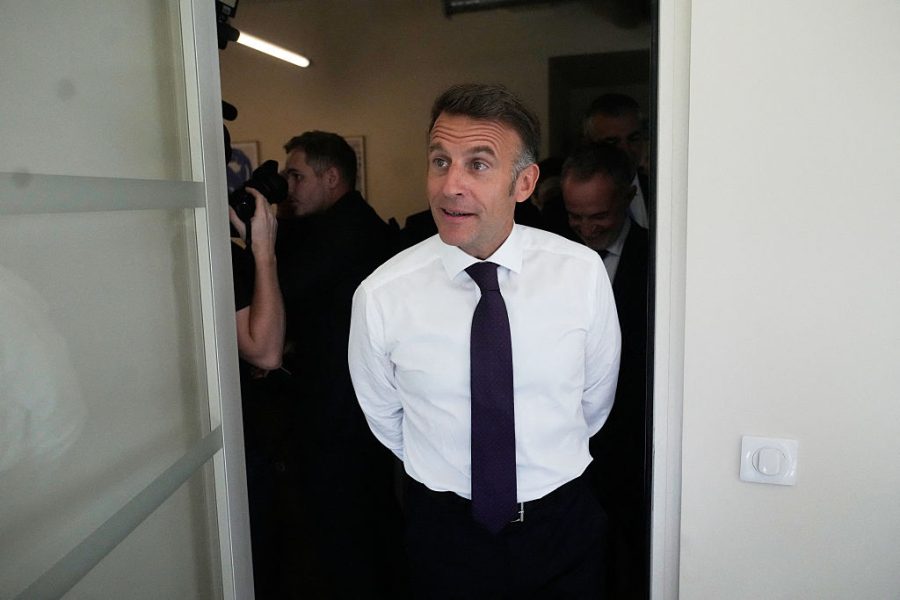
France has become the first EU country to ban social media access for under 15s. The National Assembly passed a Bill on Tuesday evening that will prevent children using platforms such as TikTok and snapchat. The Bill also bans the use of mobile phones in high schools.
In a message on X, a jubilant President Emmanuel Macron hailed the legislation and expressed his gratitude to MPs, who approved it by 279 votes to 81. ‘It’s up to the Constitutional Council to rule, then on to action to make this measure concrete and protect our children online,’ he said.
Macron would like the legislation to take effect from September, the start of the new school year, but first the Bill will be examined by the Constitutional Council, the highest constitutional authority in the Republic.
The addiction of French teenagers to their smartphones was laid bare by a recent study that found that 50 per cent spend between two and five hours a day on them. Ninety per cent of teenagers use their smartphones to access the internet.
When the President boasts that ‘we will keep on going’ he means it
In passing the Bill, France’s lawmakers are following Australia, who introduced a social media ban for under 16s last year. Similar legislation has also been mooted in Spain, Denmark, Greece and Britain. Keir Starmer outlined plans for a ban last month but that was before he was forced from power. His successor as prime minister, Andy Burnham, will have to decide how such legislation would be implemented.
The fact that France is ahead of the pack on this issue was a cause for Macron to crow. ‘France is leading the way in Europe in protecting our children and our teenagers,’ he declared, before adding: ‘We will keep on going.’
This is what concerns many in France. What will Macron do next in his war against what he calls ‘fake news’?
Since he was elected president in 2017, he has called for stronger regulation of the internet. In 2018, parliament passed a Bill that gave judges the power to remove ‘false information’ during election campaigns. The legislation was criticised by Marine Le Pen’s National Rally, who warned that the State ‘finally has a monopoly on truth and mass diffusion. It can legally censor anything it doesn’t like’.
That hasn’t happened – yet – but last week three centrist Senators published a report entitled ‘The regulation of information in the digital sphere’. In presenting the report, Senator Laurent Lafon explained that its 56 recommendations were aimed at combatting ‘internal interference’. Among the pressing recommendations is the establishment of an ‘independent disinformation observatory’ before next year’s presidential election. It would be composed of researchers, organisations, and experts who would ‘identify information manipulation campaigns and alert platforms as well as the relevant authorities’.
Would the observatory be truly independent? Marine Le Pen was sceptical. She accused the senators of attempting to introduce ‘French-style thought crime’. Eric Zemmour, the leader of Reconquest, likened the idea to ‘resurrecting Pravda!’
There was little criticism from the left. The Communist senator Pierre Ouzoulias welcomed the prospect of a disinformation observatory, claiming that ‘there are media outlets today that promote a political agenda and advance it at the expense of journalistic ethics’.
A ‘disinformation observatory’ is a continuation of an idea put forward last year by Macron. He envisaged labelling media outlets according to their levels of trustworthiness.
According to Cyrille Dalmont, the head of the conservative think tank the Thomas More Institute, last week’s senate report is the culmination of an ‘ideological process’ that has been underway since the day Macron was elected to office. ‘Freedom of expression, long at the heart of the identity of liberal democracies, now seems to be gradually being excluded from the democratic sphere by the very people who claim to defend it in the name of new values,’ he wrote in an op-ed in Le Figaro.
When the President boasts that ‘we will keep on going’ he means it. New values require new laws and the ban for under 15s is unlikely to be the last digital media restriction in France.


Comments