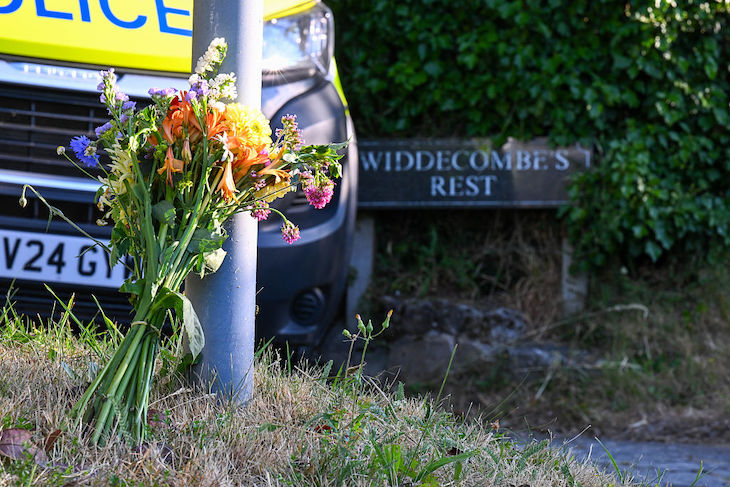
Ann Widdecombe represented British politics at its best: she was deeply principled and sincere, yet warm and dignified. But in the response to her death, over this weekend, we saw some of the worst of British political culture: the absolute gutter of the left-wing Twitterati gloating, based on the views she held with which they disagreed.
Among their ranks was Peter Tatchell, who initially took to X to announce the death in a celebratory tone, pointing out her long-held disapproval of same sex marriage and calling her a “BIGOT”. After a severe backlash, he deleted the tweet and apologised.
British society has never looked so classless
Yet BlueSky – and indeed, parts of X – is crawling with deranged Tatchell-sympathisers practically singing “Ding Dong the Witch is Dead”. British society has never looked so classless. Whatever one thought of her politics, whatever one thought of her views, the death of a public figure – particularly one who appears to have been the victim of a violent crime – should provoke a basic human response of sympathy and respect. Did their mothers never tell them that if you have nothing nice to say, say nothing at all?
But beneath the outrage lies a question that Britain has not actually settled as neatly as some imagine: in 2026, are people still allowed to believe that marriage is the union of a man and a woman?
The answer, in a genuinely liberal society, should obviously be yes.
Widdecombe was one of the most prominent defenders of traditional marriage during the early 2010s debates over the Marriage (Same Sex Couples) Act. She argued that marriage was not simply a legal recognition of adult relationships, but an institution with a deeper social purpose. It existed not merely because two people loved each other, but because children enter the world through the union of a mother and a father – and society has an interest in protecting that bond.

Many disagreed with her. Parliament disagreed with her. The law changed.
But disagreement is not the same thing as hatred.
For much of human history, and across cultures and religions, marriage was understood as the union of male and female. It was not a fringe belief held only by extremists. It was the majority view in Britain until remarkably recently, and it remains the conviction of a significant minority today. According to polling by YouGov, around one in six Britons continue to hold the traditional view of marriage. They include Christians, Muslims and people with no religious faith at all.
Indeed, many of the arguments surrounding marriage have not disappeared, but have taken new forms.
The growing prominence of surrogacy, for example, has prompted some to revisit questions they thought had been settled. Increasingly, people are confronted with situations where a child is deliberately separated from the woman who carried and gave birth to them in order to be paid for and raised by others, including male same-sex couples.
For many, that raises difficult ethical questions. These are not questions about whether those adults can love a child. Of course they can. The question is whether there is something unique about the relationship between a child and the mother and father who brought them into existence.
A hundred excellent dads don’t have what it takes to replace one mother. Neither can 100 wonderful mothers compensate for one dad. The parenting skillsets of each gender are different and complementarian. If we overhear one parent throwing a giggling child in the air, and another warning “careful honey, not so high!” – we all know instinctively which parent is which.
Doesn’t every child, where possible, have a right to know and be raised by both a mother and father? Is motherhood simply a role that can be replaced by a substitute man, or is it something deeper?
These questions are not motivated by hostility. They are questions about the rights and interests of children.
Even beyond the impact on children, the redefinition of marriage in 2014 also ushered in a broader cultural shift that we are still seeing unfold in real time: away from seeing sex as a meaningful biological reality and towards viewing identity as something entirely self-defined.
Undeniably, Britain’s debate about marriage was followed almost immediately by wider debates about sex and gender – including questions around gender self-identification, a growing notion that boys and girls may be born in the “wrong body” and need puberty blockers, hormones and scalpels to “fix themselves”; and of course, the future of single-sex spaces. If men can completely fill the shoes of mothers and wives – if it is “bigoted” to suggest that they can’t – how can we argue that they cannot replace women in any other sphere of life?
For many people, those debates have raised concerns about whether society has moved too quickly in dismissing the significance of biological sex.
Again, people can disagree. But disagreement is not bigotry.
The tragedy of modern politics is that we increasingly confuse opposing an idea with opposing a person. That is especially important when it comes to questions as fundamental as marriage, family and human identity.
Ann Widdecombe did not hide her beliefs. She argued for them publicly, through robust yet respectful, dignified democratic debate. That is what citizens in a civilised society are supposed to do – not revel in each other’s deaths.
Those who celebrated her death, or used it as an opportunity to declare her beyond the bounds of respectability, did not demonstrate tolerance, but demonstrated the very intolerance they claimed to oppose.
Inclusion is a two-way street. Stonewall used to proudly argue, Some people are gay, get over it! Yet, by the very same turn of the coin, their supporters should accept the reverse in any free society.
Some people oppose gay marriage. Get over it.





Comments