
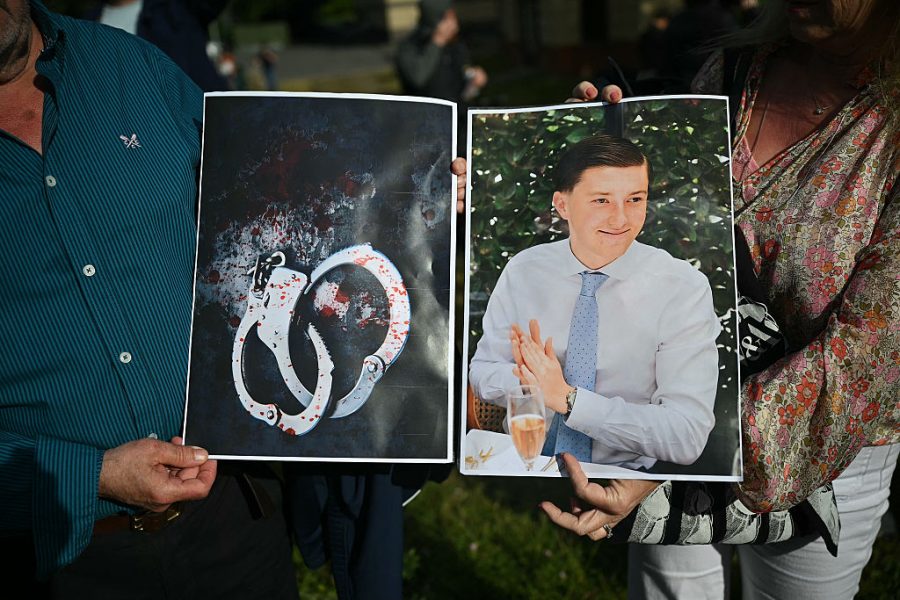
Henry Nowak died in handcuffs on a cold December night. In his university room, his advent calendar still hung on the wall, only the first three doors opened. He was 18 years old, a university student, a beloved son and a friend. In the final minutes of his life, the officers who found him treated him as a problem to be managed rather than a victim in mortal distress.
There is something almost unbearable about that small detail from his bedroom. It places Henry back where he belongs: not in the language of policy, race management or ham-fisted institutional self-protection, but in the ordinary life of a teenager in early December, marking the days to Christmas.
By the end of that same day he was lying in the road in Southampton, bleeding to death, repeatedly telling police officers that he had been stabbed and that he could not breathe. Between those two polarities sits the real scandal of this case: the charge that not only did officers get it wrong, but that they allowed an instant assumption to override the plain evidence in front of them.
Police recruits are taught, explicitly and implicitly, that allegations of racism are uniquely charged
When officers arrived, they made an immediate judgement about who mattered and who did not. They chose to believe the man who had stabbed Henry, who claimed he was the victim of a drunken, racially aggravated assault. They chose to doubt the teenager on the ground who said he had been stabbed and was struggling for breath. That judgement, made in seconds, framed everything that followed.
In that instant, Henry was recast from victim to suspect. The handcuffs applied to hands drained of blood were not just a restraint. They signalled that the officers had already decided where credibility lay, and it was not with the boy bleeding in front of them. The person in the road ceased to be treated primarily as someone in desperate need. He became a risk, a possible perpetrator, an administrative problem to be controlled rather than comforted.

The medical evidence may show that Henry could not have been saved. That matters. But it is not the point at issue here. The point is that he was denied the most basic dignity owed to anyone in mortal distress: to be believed about his own suffering and to be treated first as a human being rather than as an allegation in human form.
What makes this worse is the chilling banality of the officers’ responses to Henry’s words. ‘I’ve been stabbed.’ ‘I can’t breathe.’ He said them repeatedly before he lost consciousness. These were not vague or confusing claims. They were plain statements of fatal terror. Yet they were met with flat procedural detachment: stock instructions, routine control, an obvious reluctance to let what Henry was saying disturb the version of events already taking shape in the officers’ minds. That is what lingers. Not melodrama, not theatrical cruelty, but the deadening normality of officials hearing the truth and declining to recognise it.
This is the context in which ministerial slogans about equality should be judged. Every time ministers insist that everyone is equal under the law, they are making a serious claim, not offering a decorative phrase. Equality under the law is not proved by speeches, nor by race-action plans, nor by public relations campaigns. It is proved in moments of pressure and confusion, when officers have to decide whose account counts, whose distress is credible and whose rights are fully recognised.
On that night in Southampton, the slogan failed its test. When a young white student lay in the street saying that he had been stabbed, his words were weighed against the deceitful account of a man from an ethnic minority claiming to be the victim of racist abuse. It was Henry’s account that was treated as secondary. That is the reality ministers ought to confront. One narrative was understood to carry greater institutional danger than the other. One allegation pulled harder on police judgement than the immediate evidence in front of them. That is not equality under the law in any meaningful sense. It is the operation of a hierarchy of institutional fear.
Hampshire Police’s anti-racism posture did not cause Henry’s murder. But it plainly forms part of the atmosphere in which officers now operate: an atmosphere in which the fear of being accused of racism can overwhelm the obligation to assess a scene clearly and act with ordinary judgement. Recruits are taught, explicitly and implicitly, that allegations of racism are uniquely charged, professionally dangerous and morally defining. Presented as enlightened practice, that can in reality produce officers who are less capable of seeing what is directly in front of them if doing so cuts across the script they have been trained to fear violating.
That is what gives the case its wider force. No one has to tell officers to ignore a wounded boy. It is enough to create a culture in which the greater anxiety is not failing him but mishandling an allegation with racial content. Under those conditions, truth becomes harder to hear, obvious facts become easier to explain away, and plain signs of human distress are displaced by reputational calculations masquerading as professional sensitivity.
Henry’s death will now be used by competing factions to prove whatever they already believed about policing, race and institutional culture. But one fact should remain central because it is so stark. In his final conscious moments, a dying teenager repeatedly told police officers exactly what had happened to him, and they preferred the lie told by the man who had just stabbed him.
That is the proper payoff in this case. Not that police ministers have chosen the wrong words, though they have. Not even that the officers made a terrible mistake, though they did. It is that a public institution confronted with the clearest possible evidence of suffering allowed ideology, fear and assumption to speak louder than the victim himself. Any minister who still says everyone is equal under the law should first explain why, on a Southampton street, Henry Nowak’s own words counted for so little.





Comments