When the Iranian ambassador to the United Kingdom, Seyed Ali Mousavi, said RAF Fairford was a ‘legitimate target’ on Times Radio this Tuesday, this wasn’t diplomatic bluster. The ballistic missiles fired by Iran at the UK-US military base on Diego Garcia travelled roughly 3,800 kilometres – the exact range needed to hit Gloucestershire from Iranian soil.
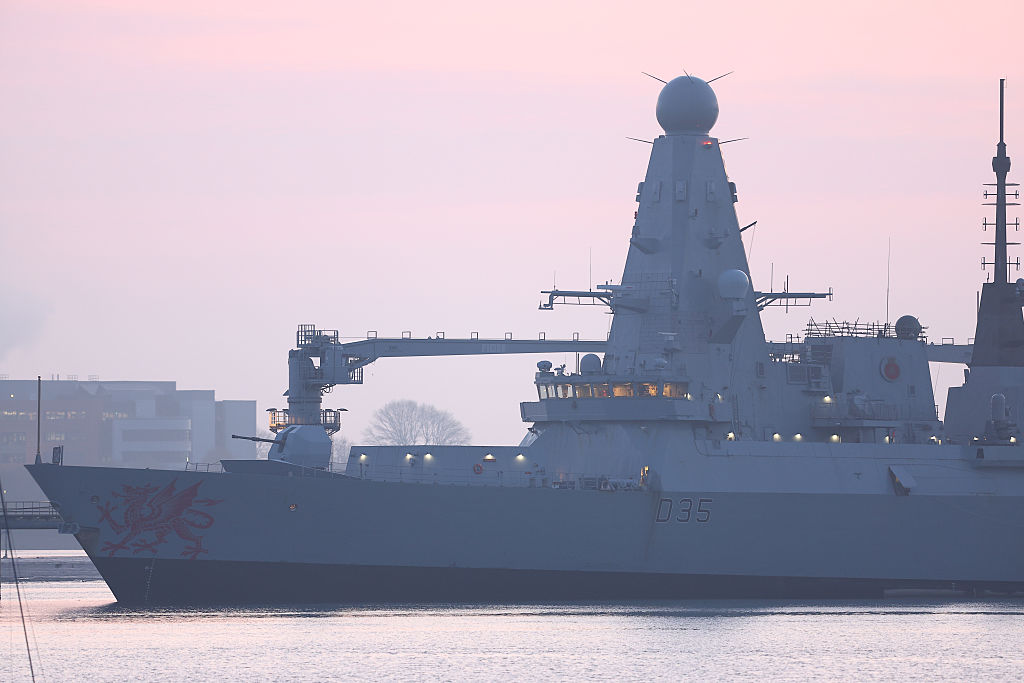
The UK only has six Type 45s (of which only two or three will be available on a good day), and only a handful of SkySabre missile defence batteries
In a sense, Mousavi has done us a favour: he has exposed the glaring hole at the centre of British national security. Since the end of the Cold War there has been a belief that war happens ‘over there’ and not here. As a result, Britain has seriously underinvested in its missile defences.
Westminster has not kept up with the pace nor scale of the challenge. For years two things have been clear. The first is that the geopolitical environment is deteriorating. Direct state-on-state conflicts, especially prolonged and large-scale wars, were seen as a thing of the past in the neoliberal era of intervention. They are now back with a vengeance. We cannot assume that we will have the luxury of choosing to join the next one.
The second is that the threat has changed considerably. A complex mix of weapons has been used to bombard Ukraine and the Middle East. Massed numbers of cheap drones, low-flying cruise missiles and fast-moving ballistic missiles must all be contended with.
The UK armed forces have a long list of problems at the moment, but one of the worst is its Integrated Air and Missile Defences (IAMD), both in terms of depth and breadth.

As we have seen, Britain is not entirely defenceless. Aircraft from the Royal Air Force have been very active in downing drones over the Middle East. The Royal Navy has sent a Type 45 destroyer – one of the world’s most capable air defence ships – and on the ground anti-drone teams have been scoring some impressive results. But while this might be fine for helping out local allies in a regional conflict, it is far from sufficient when it comes to protecting our own country.
For a start there is almost no depth to our force. The UK only has six Type 45s (of which only two or three will be available on a good day), and only a handful of SkySabre missile defence batteries. To make matters worse there is the financial asymmetry to contend with. If the UK has to swat down a £20,000 Shahed drone with a £1 million Aster missile that took a year to build, we will lose the numerical and financial war of attrition. And perhaps most concerningly, the UK has almost no Ballistic Missile Defences (BMD) to speak of. The Type 45s have a limited BMD capability, but this is only for short-range ballistic missiles. A couple of Nato missile defence facilities in Europe would be able to defend the UK against longer-range ballistic missiles. But while they are very capable, this is an awfully thin level of protection.
To its credit, the recent UK Strategic Defence Review did identify investment in missile defence as a clear priority. But then it also identified a litany of other priorities. It suggested an additional £1 billion funding for missile defence on the British Isles, but this is small change in this area. For reference, this is roughly the cost of a single Patriot battery – arguably the world’s premiere terminal (final stage)defence against ballistic missiles. £1 billion is enough perhaps to provide some coverage to a couple of military sites, or London, but not much else. Poland is a useful counterpoint; Warsaw has spent more than ten times this on its own missile defences and will soon field 23 Narew batteries (a ‘Polonised’ version of SkySabre) as well as eight Patriot batteries.
This does not mean Britain should attempt to cover the entire country with an impenetrable, ruinously expensive bubble. Instead, the UK approach must be tailored, cost-effective and ruthlessly prioritised.
The first priority is the defence of critical military infrastructure. Bases such as RAF Fairford and Lossiemouth and the naval bases in Faslane and Portsmouth are essential. If these sites are hit in the opening hours of a conflict, Britain’s ability to defend itself against further attacks would diminish rapidly, leaving not much else but the (literal) nuclear option. These specific high-value sites need an umbrella over them. If an adversary knows they cannot deliver a knockout blow to our ability to function and fight back, the strategic incentive to launch a strike diminishes.
Second, the true value of missile defence lies in its ‘integrated’ nature. We need a truly integrated command-and-control network capable of connecting any sensor to any interceptor. This is important not just to maximise detection, but to ensure the most appropriate interceptor is used against each threat. This has been talked about for years and is a real challenge to do in practice; it requires both countries and companies to share sensitive information with each other.
Finally, we must urgently expand our interceptor stockpiles. The conflicts in the Middle East and Eastern Europe have proven that without deep magazines, even the most advanced defensive systems will run dry in days. Expanding domestic missile production will not only reduce unit costs but ensure we have the endurance to fight.
The MoD can achieve this by abandoning its short-termism and signing multi-year procurement contracts, giving the defence industry the financial certainty it needs to increase production. Simultaneously, we must aggressively accelerate the deployment of Directed Energy Weapons (DEW) – or lasers. Systems such as the British-designed DragonFire laser – which costs roughly £10 per shot to operate – as well as gun-based drone defences similar to the ‘flak’ artillery of the second world war are the only viable long-term solution to reversing the brutal cost asymmetry of drone warfare.
Relying on the largesse of our allies and the forbearance of our adversaries to keep us safe is no longer a viable defence policy. This will require increased investment, which the Treasury will loathe, especially given the MoD’s questionable track-record of getting ‘bang for its buck’. But it is many orders of magnitude more cost-effective than being on the receiving end of a missile bombardment.





Comments