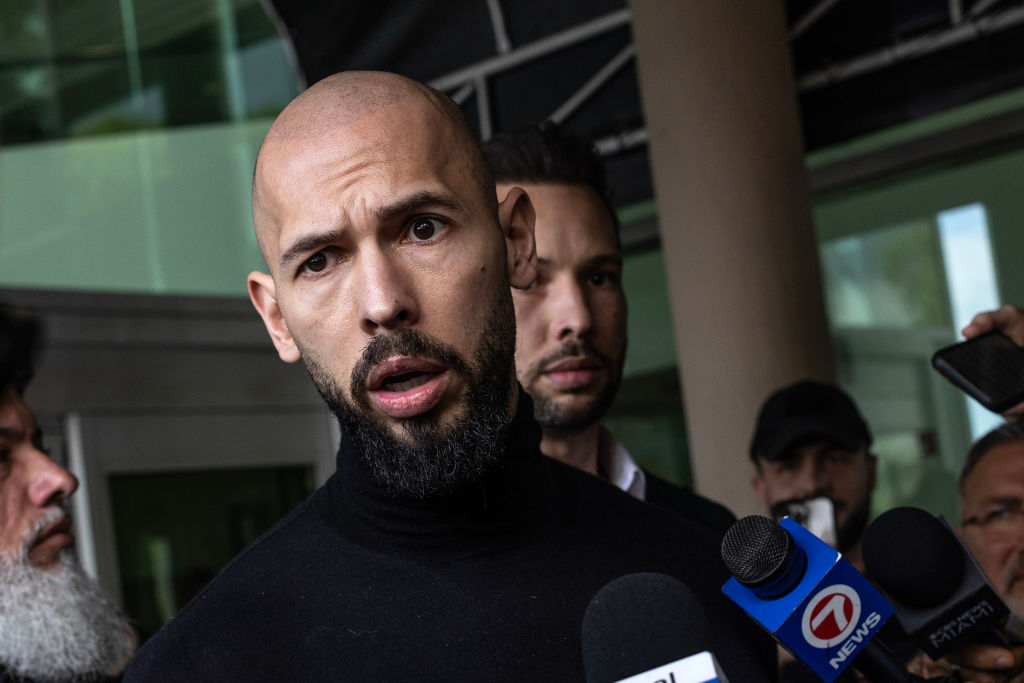
There’s a moment in Louis Theroux: Inside the Manosphere where Theroux asks one of Andrew Tate’s protégés a simple question: why doesn’t he just try being a good person? Harrison Sullivan, known as HS, pauses. For the first time in the documentary, he’s thinking, not performing. ‘It’s a good question,’ he says. ‘If I’d just done good things, I’d never have blown up on social media…’ HS understands that he is in a world which rewards clout, not virtue. And that is exactly what the documentary fails to examine.
Both the manosphere and therapy culture are selling the same individualistic values: be your best self, live your truth, prioritise your needs and don’t compromise
Theroux looks at the manosphere through the lens of psychology, drawing the loose conclusion that the extreme views of these men results from childhood trauma, absent fathers and wounded masculinity. He applies a popular psychodynamic approach to understanding their behaviour: trace it back to childhood, then find something specific in their upbringing that explains why they didn’t turn out right. That may be true, but it’s simplistic. Not least, the manosphere seems to be a cultural phenomenon. There must be something in society at large influencing these men.
I think the answer may lie in the rise of therapy culture. In the last decade, psychotherapy has become increasingly popular. In 2023, the Financial Times called it ‘The profession of the century,’ and technology companies like BetterHelp have expanded the practiceby offering more affordable online therapy. But despite the growth, demand for the talking cure continues to exceed therapist supply, and many have turned to social media accounts offering therapeutic platitudes. This is therapy culture.
Therapy culture is therapeutic language without therapeutic values. It is when we talk about boundaries, trauma and nervous systems outside of actual therapy. This kind of language justifies people’s self-interest (‘protecting my energy’), pathologises disagreement (‘that’s toxic’), and makes relationships transactional (‘does this serve me?’). It is the vocabulary of introspection without any actual introspection. And the manosphere speaks this language fluently.
Andrew Tate talks about ‘healing ancestral masculine trauma’. Myron Gaines, of the popular manosphere podcast ‘Fresh and Fit’, tells men they need to ‘heal from female manipulation.’ While their use of ‘healing’ sounds therapeutic, it’s really about justifying control.
Gaines advises: ‘Women will waste your time if you let them. Key words: if you let them.’ ‘Protect your energy from low-value females.’ While women are told by therapy culture to ‘set boundaries’ and ‘cut toxic men’ out of their lives, the manosphere tells men to do the same to ‘low-value women’. It’s the same logic with a different aesthetic.
The manosphere is particularly interested in ‘authenticity’. Tate claims he’s ‘living authentically as a man; society wants me to suppress this.’ This mirrors therapy culture’s call for you to ‘live your truth’, only redirected towards the dominance of others.
Crucially this kind of language sells well. HS offers to ‘coach boys to be fucking boys.’ Tate’s Hustlers University promises ‘cheat codes to win at life.’ The manosphere is monetising therapy-light self-help repackaged as masculine empowerment.
Therapy culture is typically coded as female. We think of women raising their standards, protecting their boundaries and choosing themselves first. ‘Know your worth. Don’t settle. He’s not good enough.’ But despite the red pill community rejecting exactly this kind of empowering feminist rhetoric, they are responding with a near identical approach when it comes to relationships. The manosphere tells men: ‘Focus on yourself, cut dead weight, maximise SMV [Sexual Market Value]. Is she high-value?’
Both the manosphere and therapy culture are selling the same individualistic values: be your best self, live your truth, prioritise your needs and don’t compromise. But this fosters detachment and causes relationships to be transactional. Therapy culture promises self-actualisation but delivers isolation. The manosphere is its masculine form, dividing us further under the guise of male empowerment.
Our grandparents’ generation understood that partnership requires shared values, complementary roles and working toward something other than the self. Without this framework – no religion, no stable community, no tradition of service to something larger – these young men have nothing to anchor them. They remain boys because therapy culture gave them the language of growth without maturity.
There’s a telling moment when HS is with his mother. ‘All the women I know aren’t like you,’ he says, almost wistfully. Of course they aren’t, he’s 23, socialising with OnlyFans creators who work in the same attention economy as him. His mother is the only adult woman in his life.
It’s a boyish moment that reveals what therapy culture can’t address: HS is profoundly immature. One of psychotherapy’s core aims is helping people become fully formed adults who no longer idealise their parents. But therapy culture uses the language of healing without requiring anyone to actually ‘do the work’ and grow up. Men remain boys, stuck in an Oedipal loop, chasing clout because they lack the emotional development to build anything real.
This is key to understanding why the message of the manosphere resonates. The manosphere is therapy culture’s shadow: individualism without introspection, self-optimisation without empathy and boundaries without connection. It’s the same culture we are currently all trapped inside. The problem is not just the boys.




Comments