
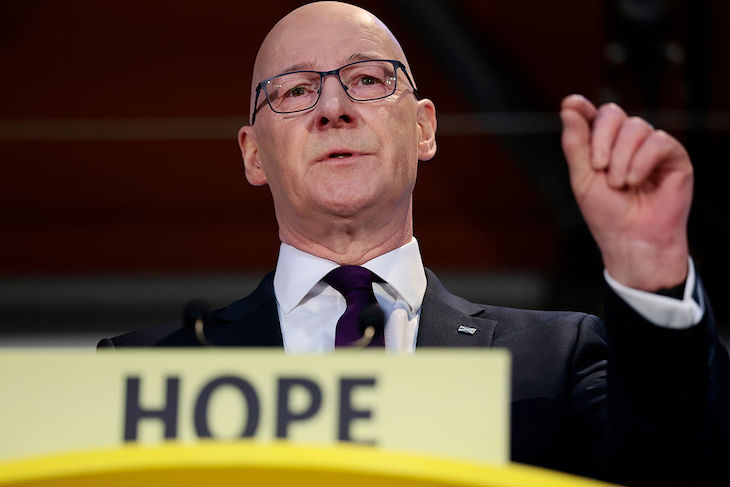
Has there ever been a more dishonest Holyrood election campaign than the one John Swinney is currently running? I don’t believe there has been.
Break away from Britain’s integrated electricity market and you smash the model that has led to Scotland being a ‘leader’ in wind energy in the first place
A look at Swinney or the SNP’s X or Instagram feeds appears to show a steady stream of misinformation in recent months. Of course, we anticipate that politicians will at times stretch the truth – or, at the very least, not be completely open with us. It would be naive to think otherwise. But the consistency and brazenness of SNP lies during this campaign takes misinformation in our politics to a new level.
The latest example came this week in the form of Swinney promoting his newly published column in the Daily Record. Referring to the high costs of energy, Swinney claimed on X that ‘Independence is how we can lower our bills…’. In the column itself he stated: ‘With full control of our energy resources, we can use that to bring down energy bills. That only comes with the fresh start of independence – and that is what I am offering to the people of Scotland at this election.’
The constitutional point in the final sentence is obviously misleading. The UK’s Supreme Court has clarified that any unilateral move to implement a referendum on secession would be illegal. Scotland has the same power to secede as any other nation within a nation in a modern democracy – i.e, no unilateral right. Swinney might claim that an SNP majority government will place sufficient political pressure on the UK government to deliver on his wishes, but if that is the situation after the Holyrood election then it will have come about largely thanks to the rise of Reform UK in Scotland. An SNP-majority government delivered on 30-odd per cent of the vote – with polling showing independence is way down people’s list of priorities – makes for neither a political nor moral mandate for change.

Swinney’s pitch that he is ‘offering’ independence therefore carries about as much credibility as the leader of Quebec’s Parti Québécois offering separation from Canada at the province’s next general election, which is also due later this year. Misleading the people of Scotland in this way might be an effective core vote strategy, but it comes at the expense of degrading trust in the democratic system.
The other, and most egregious, way Swinney appears to be misleading voters is on energy. Swinney and his colleagues continuously tell voters that independence will lead to lower energy bills even though there is no evidential or logical reason to be making such a claim. In fact they go further and specifically state that separating from the UK will lead to electricity bills falling by at least a third.
That number first appeared in a paper the SNP put out in December. It seems to be based on a fantastical scenario whereby an independent Scotland will decouple from Britain’s integrated electricity market leading to vast savings with no new costs while monetising the benefits of commercially unproven technology such as green hydrogen. In other words, it’s complete nonsense.
The reality of splitting from the GB electricity market would be to cut off the supply of subsidies that wind developers in Scotland rely on to build their projects. Those subsidies come from tens of millions of bill payers across Britain underpinning credible price guarantees to renewable power developers such that they will commit to building large-scale wind energy infrastructure. Break away from Britain’s integrated electricity market and you smash the model that has led to Scotland being a ‘leader’ in wind energy in the first place.
So rather than lower electricity bills by a third, the negative impact of independence on the renewables sector would almost certainly lead to higher energy costs for Scottish consumers.
And the idea that Scotland is being deprived of a second energy bonanza is also absurd. The UK government’s latest renewables allocation auction set the price for Scottish offshore wind at just under £90/MWh, and for floating offshore wind specifically (the bulk of the landmark ScotWind project) at around £216/MWh. This compares with an average UK wholesale price in 2025 of £80/MWh. Wind energy might be green, but it is certainly not cheap.
There are sensible conversations to be had around policy changes that could lead to lower energy bills for British consumers, but in recent months John Swinney’s SNP has shown itself to be uninterested or incapable of engaging seriously with the topic. The First Minister’s Holyrood campaign seems to centre instead on grudge and grievance underpinned by the ubiquitous use of misinformation. It is a tawdry way to win power, and Scots should be wise to it.





Comments