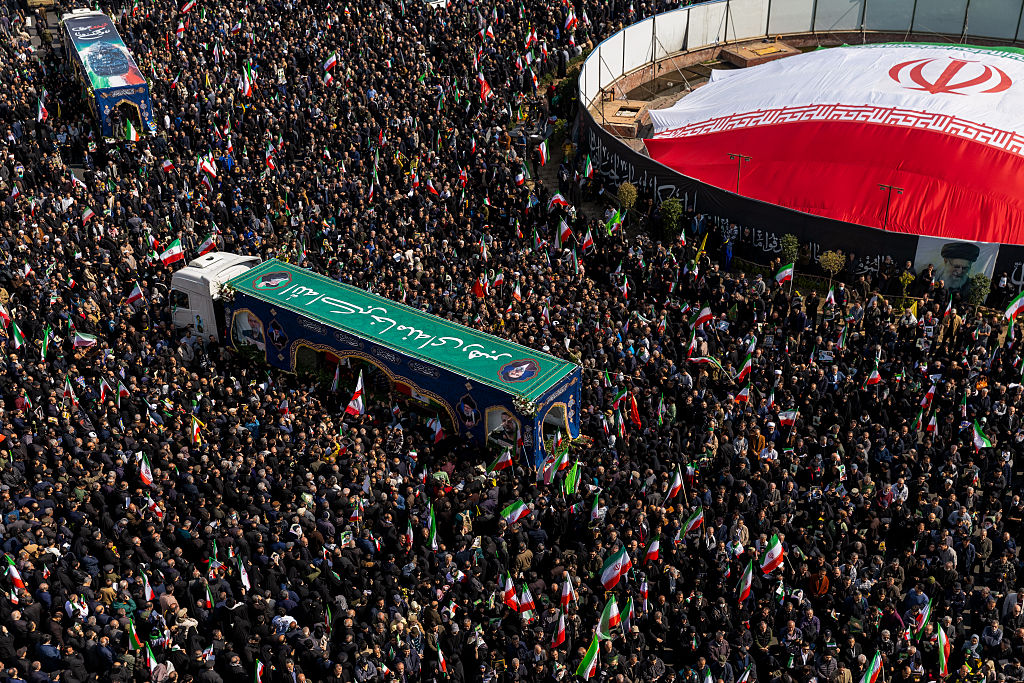
The killing of the Iranian senior security official Ali Larijani this week is the most significant “targeted assassination” undertaken since Israel’s killing (in cooperation with the US) of supreme leader Ali Khamenei on the opening day of the war.
These two very high-level hits have been accompanied by a long list of killings of less well-known senior Iranian officials. These have included Islamic Revolutionary Guards (IRGC) commander Mohammad Pakpour, intelligence minister Esmail Khatib, armed forces chief of staff Abdolrahim Mousavi, defense minister Aziz Nasirzadeh, military intelligence chief Saleh Asadi and many others. Around 30 officials in all have met their deaths at the hands of this campaign.
The borders between conventional war and insurgency appear to be disappearing
Targeted killings have a long history for Israel in its efforts to defeat its enemies. Yet the current campaign is without real precedent and is likely to be regarded as a watershed moment in the employment of irregular methods in conventional warfare. Specifically, what we are currently witnessing involves the use of a familiar tactic in an unfamiliar setting. Israel’s use of its intelligence and its air supremacy to wipe out leaders of hostile entities is not new. But this is the first time that Israel or anyone else has pursued an ongoing and systematic campaign of targeted assassinations of senior enemy officials against a state at a time of war.
Israel’s use of targeted assassinations dates back to before it achieved sovereignty. The first assassination by the modern Zionist movement against a perceived enemy took place in Jerusalem in 1924. Jacob de Haan, a prominent and active Ultra-Orthodox Jewish opponent of the Zionist project was killed outside the Shaare Zedek hospital in that city. Assassinations formed a notable element in the Jewish insurgency against British rule in Mandatory Palestine in the 1930s and 1940s. In the 1950s, Israel targeted German scientists working to help develop the Egyptian and Syrian missile programs.

Targeted killings, notably, played no significant role during the high days of the Arab-Israel conflict, when Israel faced a coalition of Arab states led by Egypt. That contest, involving four high intensity wars in 1948, 1956, 1967 and 1973, as well as state sponsored insurgencies and periodic artillery duels, was fought along the lines of conventional 20th century industrial war.
Assassinations returned to significance when irregular warfare replaced state to state conflict as the main challenge facing Israel. The tactic was used to telling effect against the leadership of the PLO in the 70s and 80s.
The first systematic use of assassinations during a period of open conflict came during the Palestinian insurgency usually referred to as the “Second Intifada” of 2000 to 2004. At that time, Israel wiped out much of the senior and mid-level leadership of the Islamist Hamas organisation, even as that group sought to pursue a campaign of indiscriminate slaughter of Israeli civilians by suicide bombing.
A similar use of the tactic was adopted with considerable success by Israel against both Hamas and Hizballah in the 2023-25 period. In that period, Israel removed the senior and much of the mid-level leaderships of both organisations.
Now, for the first time, Israel is applying the same tool kit against a state enemy, the Islamic Republic of Iran.
An interesting trajectory may be observed. Targeted killings were first introduced when the political movements which would establish Israel were themselves insurgent, non-state actors. When the conflict between Arabs and Jews moved to the state vs state level, the practice declined, at least as a tool to be employed against senior leaders.
When Israel’s main enemies became non-state insurgent forces deemed outside of the protection generally afforded to the leaders of states, the tactic of targeted killings of top leaders was once more re-adopted. The Islamic Republic of Iran from the 1980s on sought to develop a hybrid form of warfare in which the tools and advantages of irregular and non-state formations were wedded to the power and the interests of a state. This is the Iranian doctrine of “muqawama” (resistance) which has seen Tehran establishing and sponsoring a variety of non-state militia groups throughout the region. These have been used as key tools in the long Iranian war intended to result in the destruction of Israel.
As it turns out, the Iranians are not the only ones who can blur the boundaries between state and non-state actors and norms. Israel is now applying the methods and practices it honed during the decades in which it fought mainly non-state forces, against a state enemy. This is something new, and perhaps revolutionary, and perhaps a harbinger. Will it work?
It has certainly produced a panicked and fascinating series of reactions among supporters and partisans of the Iranian regime. A rumor has been spread that Israeli Prime Minister Benjamin Netanyahu himself has been killed in an Iranian raid, with his apparent subsequent appearances produced with the aid of artificial intelligence. A prominent UK-based supporter of the regime and its Lebanese proxies rapidly produced a theory of “strategic martyrdom” according to which the Iranian regime in fact cunningly gained advantage by having its most senior officials assassinated.
The regime won’t be destroyed by this tactic
Back in reality, it’s obvious that the systematic removal of experienced and well-connected officials will have a negative effect on the performance of any system. Most observers of the Israeli-Palestinian conflict would concur, for example, that the Palestinian Islamic Jihad movement has never fully recovered from the assassination of its leader, Fathi Shaqaqi, by Israel in 1995. The killing by the US of IRGC Qods Force leader Qassem Soleimani similarly hampered the subsequent performance of Iran’s militia network.
In these cases, however, the result was the damaging or decline of a structure, not its complete eclipse. There is no example in modern history of the complete destruction of a regime or of an organization by the systematic assassination of its leaders. In this regard, we might do well to remember Bertolt Brecht’s observation that, “If the indispensable man frowns, two empires quake. If the indispensable man dies, the world looks around like a mother without milk for her child – and if the indispensable man were to come back a week after his death, in the entire country there wouldn’t be a job for him as a hall-porter.”
The assassination of senior officials shouldn’t be likened to the decapitation of a living organism. The regime won’t be destroyed by this tactic. On the other hand, as one tool in a well-stocked toolbox, Israel has used the tactic to telling effect in the past and is doing so now. The application of this tactic signals that the state conflicts in future won’t resemble those of the past. Rather, the borders between regular and irregular warfare, and between “conventional” war and insurgency, appear to be disappearing. Tehran sowed that wind. It is now reaping that whirlwind.



Comments