
When the Scottish Liberal Democrat MSP, Liam McArthur, first tabled his Assisted Dying for Terminally Ill Adults (Scotland) Bill two years ago, the result seemed almost a foregone conclusion. Nearly all of the party leaders supported it, at least in principle, along with a clear majority their elected members. Around 80 per cent of Scottish voters approved the principle of ‘dignity in dying’. They still do.
By no means all jurisdictions which passed ‘right to die’ laws have progressed down the infamous slippery slope to perdition, but enough have
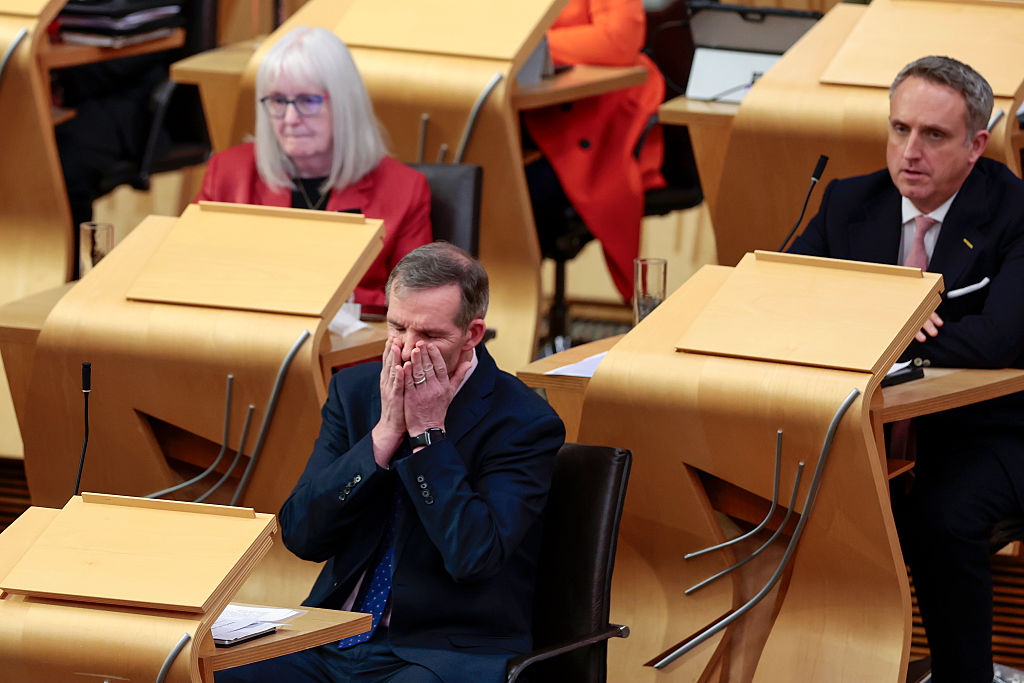
But as the day of decision drew near, MSPs of all parties began to reassess the simplistic argument for individual choice. Last night Holyrood staged a dignified and well informed debate – though it was highly emotional at times, with a number of MPs, McArthur included, breaking down. The majority against his private members’ bill, 69 to 57 was far greater than many had expected. But it should not have been. For in reality the moral case for assisted dying, as it is called, had crumbled long since.
You can trace the change in sentiment to the moment last year when the former first minister, Nicola Sturgeon, said she was ‘veering away’ from supporting the Bill. ‘It will be impossible,’ said the influential nationalist politician, ‘to guarantee that no one at the end of their life will feel a degree of pressure [to seek assisted suicide]’.
The party leaders all started veering in the same direction. The First Minister, John Swinney, finally came out against assisted dying earlier this year. The Scottish Conservative leader, Russell Findlay, dropped his support for the McArthur Bill only last week, saying the risk of ‘coercion’ is just too great. The Scottish Labour leader, Anas Sarwar, is also in the No lobby. Only the Liberal Democrats and the Greens leaders stood firm

Disabled rights groups, psychiatric professionals and many individual clinicians like the former Chief Medical Officer for Scotland, Sir Harry Burns, began expressing severe doubts about McArthur’s ‘pathway to death’ as Burns called it. And while there were safeguards built into the Bill – which required the patient to be of sound mind and for two physicians to agree that their condition was terminal – MSPs inevitably started to reflect on the experience of other countries where assisted dying has been introduced.
By no means all jurisdictions which passed ‘right to die’ laws have progressed down the infamous slippery slope to perdition, but enough have. In the Netherlands, the first country to introduce euthanasia two decades ago, similar safeguards were applied. They didn’t stick. Now people with mental health problems are granted elective euthanasia. Even healthy young women such as Zoraya ter Beek, 29, have been given the freedom to end their lives – in her case because of depression and against the pleas of her family.
McArthur is appalled by that and similar stories from Canada, where disabled people have been allowed to access euthanasia essentially on grounds of economic hardship. He insisted that it couldn’t happen here. But once the genie of state-sanctioned suicide is out of the bottle there is little hope of controlling its afterlife. In the Netherlands and Belgium, euthanasia has been extended to children as young as 12.
Supporters of assisted dying insist that the slippery slope is a bogus trope of the Christian right. But there are sound reasons for believing that in Britain, with our entrenched human rights culture, we are particularly vulnerable to slippage.
First off, some people with incurable diseases would say: what does ‘terminal’ mean anyway? It is hard to define, as many people with such conditions can live for many years. Why limit it to six months? Then they, or more likely their lawyers, will argue that it should be everyone’s human right, as in other countries, to end their lives if they have intolerable suffering with no prospect of recovery.
And why should it only be people with physical, observable conditions that are allowed this right to die? Mental conditions can often make life just as unbearable as physical ones.
Lawyers will argue that all people, of sound mind, should have the right to choose when and how they die. It’s a matter of individual freedom. That’s what happened in Canada where the Supreme Court eventually ruled that it was unconstitutional to exclude people whose natural death was not reasonably foreseeable from accessing medical assistance in dying (Maid).
And this right will apply naturally to the elderly. For what is old age if not an incurable condition? McArthur’s Bill outlaws coercion, but old people don’t need to be actively coerced into feeling that they are a ‘burden’ or ‘in the way’ or consuming scarce resources in the NHS. They just do. The row about old people bed-blocking in hospital wards is already weighing on their minds.
Then there is the housing crisis. Young families who can’t afford homes of their own are often quietly waiting for the older generation to pass on so that they can get on the housing ladder. They needn’t say anything at all for granny to start feeling that she is, as it were, ‘house-blocking’.
If the choice is to go into care and sell the family home to pay for it, many might consider it their moral duty to go sooner rather than later. Many old people have a compulsion to help their children even when they don’t need it and haven’t asked for it.
The dire state of social care could also be a factor in euthanasia creep. Assisted dying was always a misnomer, a euphemism. The true meaning of ‘assisted dying’ is palliative care and this is notoriously under-resourced. We are talking here about state-sponsored suicide. It is not hard to conjure a dystopian future in which euthanasia becomes the final solution to the social care crisis.
At any rate, most MSPs were satisfied after what was widely regarded as one of the best debates heard in the Scottish parliament, that the risk was just too great. With Kim Leadbeater’s similar bill currently stalled in the Lords, it looks like the UK will not go down the road of accelerated mortality.





Comments