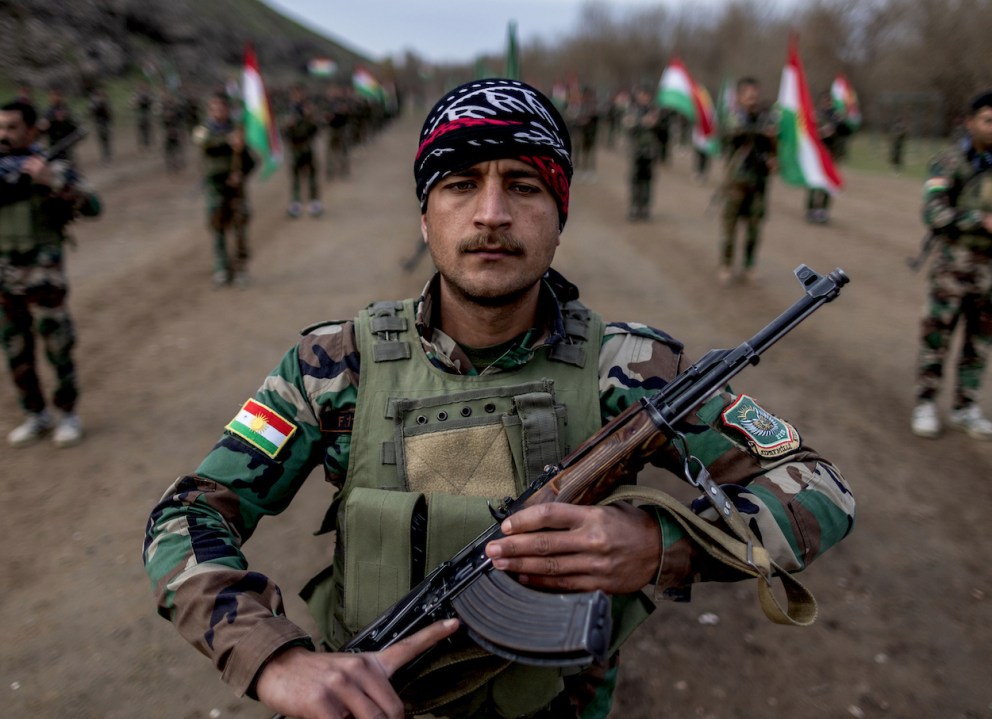
The Kurdish region along the Iran-Iraq border is an imposing landscape of sublime beauty this time of year. The snow-capped Zagros Mountains tower above high valleys lush with cherry and almond blossom, budding walnut and pistachio trees. Spring lambs graze alpine meadows speckled with iris and fritillaries, thyme and sage. Rivers – gorged with the first snow-melt – carve deep canyons through which run spurs of the Silk Road. The area is studded with ancient Assyrian and Achaemenid sites.
It is also a Jurassic Park of lost causes. Every valley seems to hold another Iranian-Kurdish separatist group; a couple of valleys hold several factions of the same group. Everyone speaks the Kurdish dialect of Sorani on both sides of this border, but these groups rarely talk to each other. Most have been here for decades and – largely ignored and under-funded – have turned to farming and smuggling cigarettes, domestic goods, and auto-parts. These are part-time soldiers at best: the same men who carry a rifle on Monday carry 75 kilos of contraband across the mountains as kolbars – back-carriers – on Tuesday. Human Rights Watch estimates 300,000 kolbars work these routes; more than 50 die every year, shot by Iranian border guards or frozen in the passes.
At a personal level it is very hard not to be charmed by these groups. I’ve got to know some of them over the last decade researching the looting and smuggling of antiquities. Like most mountain people, they are fantastic hosts, and I have spent many late evenings around the campfire drinking tea and listening to the war-stories of men and women far braver than myself. Those lambs I mentioned? Grilled on apple-wood they are the best kebabs in the world. Sometimes they drink whiskey too, for they are an irreligious lot. Some subscribe to a low-key 1970s-style Marxism, and they can be a little dull.
The Kurdish parties themselves have been negotiating a possible coalition for over eight months, but American and Israeli pressure to finalise such a coalition intensified recently. One week before the bombing started, they managed to get five groups into a room together to form ‘The Coalition of Political Forces of Iranian Kurdistan’.
The main groups are as follows:
Kurdistan Freedom Party (PAK), led by Hussein Yazdanpanah, is a centrist nationalist group that worked closely with the US in the fight against Isis. Yazdanpanah is a gifted and charismatic commander with a small but highly competent group around him – perhaps a thousand fighters. PAK was trained by the US military and fought on the frontlines at Kirkuk and Bashiqa in Iraq. It is probably the most natural American partner: no terrorist designations, proven in battle.
Democratic Party of Iranian Kurdistan (PDKI) has been fighting the Iranian regime since 1945. It is the granddaddy of Iranian Kurdish politics: a democratic socialist party, member of the Socialist International, with diplomatic offices across Europe. PDKI wants a federal Iran where Kurds, Azeris, Baluchs, Turkmens and Arab minorities are all represented fairly. The Iranians take them seriously enough to routinely assassinate their leaders: Ghassemlou in Vienna in 1989, Sharafkandi in Berlin in 1992. Trump reportedly spoke with PDKI’s leader Mustafa Hijri on 4 March.
Kurdistan Free Life Party (PJAK) is the most militarily active, accounting for over two-thirds of Kurdish attacks on Iranian forces between 2014 and 2025. PJAK follows a socialist/anarchist/feminist model derived from the imprisoned Kurdistan Workers Party (PKK) leader Abdullah Ocalan’s democratic confederalism, and over half its fighters are women. With perhaps 1,000 to 3,000 fighters, it is the coalition’s most potent force, but also its most politically toxic. PJAK is designated a terrorist organisation by the US Treasury and is part of the PKK’s umbrella structure, which is designated by the US, EU and Turkey. There is an awkward irony here: the coalition’s most effective fighting force is also the one Washington cannot legally arm.
Organisation of the Iranian Kurdistan Struggle (or Khabat) is the only primarily religiously motivated group, and the smallest. Its significance is political: it broadens the coalition’s base to include conservative Kurdish constituencies the secularists cannot reach.
And finally, the Komala of the Toilers of Kurdistan (Reform Faction), a splinter of the larger Komala movement, whose various branches range from soft-socialist through to hardcore communist. On 4 March, the Komala Party of Iranian Kurdistan – the unreformed, Marxist faction led by Abdullah Mohtadi – also joined as the sixth member, saying the situation demanded ‘unity, coordination and joint action.’ When Kurds use these words – duck.
Generous estimates put the coalition’s total fighting strength at between 5,000 and 10,000. But experts at Rusi suggest the actual combat-effective force may be as low as 1,500. A coalition official speaking to i24News was more candid still: aside from PJAK’s several thousand, the other groups together have only a few hundred militants. These are not the numbers you want before picking a fight with the Islamic Republic.
The coalition’s staging area is Iraqi Kurdistan, which is ruled by two political parties and their respective families: in the west, the Kurdistan Democratic Party (KDP) and the Barzani family based in Erbil; in the east, the Patriotic Union of Kurdistan (PUK) and the Talabani family in Sulaymaniyah. Erbil, with its glittering Gulf-style skyline around a 6,000-year-old tell and citadel, is the more conservative of the two. Sulaymaniyah, nestled in a valley near the Iranian border, is sleepier: men play chess in parks, women go about uncovered, there are bookstores on every block. Iraqi Kurdistan is the Switzerland of the region.
The leaders of both parties are caught between the Scylla and Charybdis of nationalism and international realpolitik: they must be seen to support their Kurdish cousins in Syria, Turkey and Iran, but without angering the governments of those much larger countries. It is a dance they’ve done very well for several decades. Trump is threatening that. He spoke to the KDP and PUK leaders recently, and neither wants to get involved in a conflict with Iran. The Kurdish President Nechirvan Barzani called Iran’s foreign minister to assure him that his region ‘will not be part of conflicts’ targeting Tehran. That doesn’t mean Trump won’t cajole and bully his way to getting what he wants, but he won’t get their trust.
American confidence in arming Kurds is based on experience in Syria. US and UK special forces fought an incredibly successful campaign against Isis alongside the Syrian Democratic Forces (SDF). It was a brilliant model: a small number of western special operators advising and enabling a large local force, backed by overwhelming air power. But the numbers and terrain in this current conflict are radically different, and anyone who thinks this will be a re-run hasn’t looked at the map.
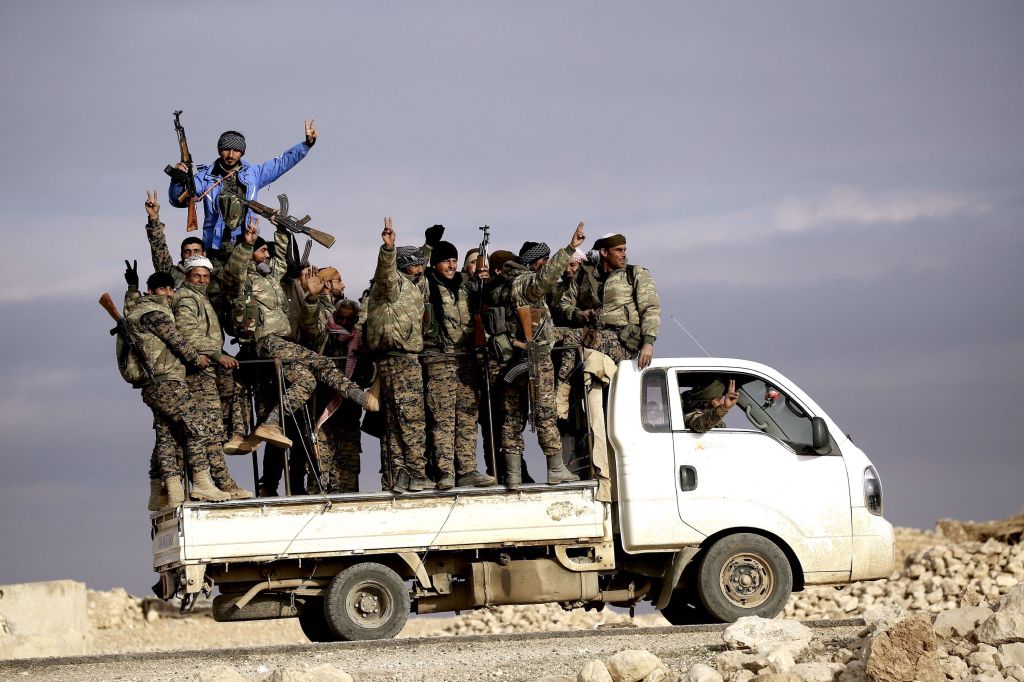
In Syria, there were several thousand western soldiers and support personnel on the ground alongside approximately 70,000 SDF fighters against an estimated 30,000 from Isis. That’s a comfortable 2:1 numerical advantage against a non-state actor fielding a light infantry force with no air power, no air defences, no intelligence apparatus and no industrial base. The Jazira plain, the Euphrates valley, the steppe around Raqqa – it is essentially flat. Isis had nowhere to hide and the SDF could advance across open ground with air cover.
In Iran, the Kurdish coalition could field perhaps 5,000 fighters – at a generous estimate – against 350,000 in the Iranian regular army, 150,000 in the Revolutionary Guards, and the Basij militia, which Tehran claims has men in the millions (though its combat-effective strength is far lower). Even taking a conservative view, the ratio has been inverted from 2:1 in your favour to perhaps 100:1 against. This is the armed wing of a state with 90 million people, a domestic arms industry, ballistic missiles, integrated air defences, drones and deep institutional experience in counter-insurgency going back to the Iran-Iraq War. The Islamic Revolutionary Guards Corps (IRGC) has been waging a successful campaign against Kurdish insurgents in the Zagros for decades; they know every goat-track.
Then there is the terrain. Northeast Syria is flat and open – ideal for air power. The Zagros Mountains are the opposite: peaks to 4,000 metres, deep valleys, heavy snow cover, dense oak forests at lower elevations. This is terrain that swallows armies and degrades air power. You cannot see fighters under tree canopy; caves are everywhere; valleys create radar shadows; precision munitions are less effective against dispersed infantry in mountainous terrain. Trump has promised air-cover but this is only effective when coordinated by embedded western special forces on the ground. Trump doesn’t appreciate that air supremacy over Tehran is not the same as close air support in the Zagros.
And there is the lack of support structure. In Syria we had established bases, logistics chains, airfields at Kobani, Hasakah, Rmeilan and others, and our SF teams were embedded with communications equipment, medevac capability and Intelligence, Surveillance, Reconnaissance (ISR) overhead continuously. The SDF controlled territory with a functional government – the Autonomous Administration – which provided recruitment, taxation, food supply and medical care. There was a secure rear area.
There is nothing comparable for a Kurdish coalition. Their bases in Iraqi Kurdistan are being actively hit by Iranian missiles and drones. There is no established logistics chain, no secure rear, no governed territory inside Iran and no population base from which to absorb casualties. The SDF lost 12,000 fighters over the course of the anti-Isis campaign but could sustain those losses because it was recruiting from a population of several million in territory it controlled. The Kurdish coalition has no such depth. When they take casualties, those fighters are not coming back.
But the deepest problem is not military. It is trust. The Kurds remember their fight against Isis with the US, but they also remember that Trump has abandoned them three times.
The first withdrawal was announced via Twitter in December 2018, with Trump declaring Isis defeated, even though the final battle at Baghuz did not happen until March 2019. His defence secretary, James Mattis, resigned in protest within 24 hours. Trump’s officials quietly walked the decision back over the following months, but the message was received.
The Kurdish coalition is getting wall-to-wall coverage because it is part of the war that journalists can physically reach
The second withdrawal was catastrophic. In October 2019, after a single phone call with Turkish Prime Minister Recep Tayyip Erdogan, Trump pulled US troops from the Turkish-Syrian border. Three days later the Turks and their proxy forces swept across SDF territory, killing hundreds of Kurdish fighters and displacing 200,000 people. The SDF – who had lost 11,000 dead fighting alongside Americans – were forced to cut a deal with Assad and the Russians for protection. Trump’s response was to tweet that the Kurds ‘didn’t help us in the second world war, they didn’t help us with Normandy.’
And most recently, when the new post-Assad order emerged in Syria, Trump did not back the Syrian Kurds in their effort to negotiate a place within it. His special envoy, Tom Barrack, declared that the SDF’s anti-Isis role had ‘largely expired’. After a decade of partnership and 12,000 dead, the Americans packed up and left.
The Iranian Kurdish coalition knows all of this. Their charter – adopted the week before the bombs fell – demands the recognition of Kurdish self-determination as a non-negotiable precondition for cooperation with any outside power. That demand is not ideological, but the product of bitter experience codified into a document. They watched the Syrian Kurds fight and die for a democratic project and then be told their role had ‘expired’. They watched the Iraqi Kurds help topple Saddam and then be denied the independence they voted for. The charter is an attempt to get commitments on paper before the shooting starts, rather than relying on verbal promises from a president whose word has a documented half-life of one phone call.
There is one other factor worth bearing in mind. This is a hard war to cover: an air campaign at 40,000 feet, a naval standoff in the Gulf, journalists competing with influencers for shots of burning hotels. Iraqi Kurdistan offers something different – a chance for a ‘good war’. It is one of the safest areas in the Middle East. Journalists can get close to the border without threat of kidnapping. There are great fixers, decent hotels and alcohol is readily available. Add to this photogenic fighters, those gorgeous mountains, women with rifles, the legend of the Peshmerga. It is visually irresistible.
The danger is that accessibility gets mistaken for importance. The Kurdish coalition is getting wall-to-wall coverage not because it is the decisive factor in this war, but because it is the part of the war that journalists can physically reach and tell a compelling narrative about. This creates a feedback loop: editors see Kurdish coverage and commission more; think tanks interpret the volume as significance; congressional staffers brief their bosses using clips from Erbil. And suddenly a force of perhaps 1,500 combat-effective fighters occupies the same media bandwidth as the entire US-Israeli air campaign. Such off-centre reporting is a risk in any conflict, but in none more so than one in which the commander-in-chief gets most of his briefings from television. Editors be warned.


Comments