

The crowded market place emerging on Britain’s right is bewildering. Nigel Farage and Reform UK appeared to have successfully colonised the space for positions more robust than those offered by the current Tory party. They have been ahead in the national opinion polls for months now. But the launch of Restore Britain, a new party founded by the former Reform MP Rupert Lowe, suggests that Farage himself now faces a threat on his exposed flank.
No party to the right of Farage has posed a substantive electoral threat since the British National Party virtually disappeared in 2015. But that could be about to change. Restore claims to have 90,000 members. Lowe has a significant social media presence and the backing of Elon Musk. He has also set out in some detail how he plans to change the country.
Restore Britain argues it intends not just to steal Reform votes but to win a majority at the next election
Restore Britain also hopes to sweep up disaffected supporters of existing outfits which have identified space in the territory where Farage fears to tread.
Another former Farage friend, Ben Habib, leads Advance UK. Habib has been nurturing the movement since he quit Reform in November 2024 after losing his job as deputy leader. He has made overtures to Lowe, but Lowe is refusing to allow Advance to merge with Restore. All personal issues aside, Advance UK is a controversial outfit because Tommy Robinson is a member.
Even further on the fringes is the Homeland party, which describes itself as the ‘most vibrant nationalist party’ in Britain. The party attracted publicity early in 2025 but lost momentum after its regional organiser in Belfast was accused of being a ‘femboy’ and of holding exclusive sexual interest in non-white men.
Homeland is another party born of a split. It was actually founded as an escape pod from the nationalist movement Patriotic Alternative, which itself was formed after a split with the BNP – which is still a registered political party. The BNP’s leader is a former soldier and teacher, Adam Walker, who has been in post since July 2015. His strong and stable leadership has survived five prime ministers, an international pandemic, a European land war and a referendum. The last time he stood in a general election he secured 991 votes in Bishop Auckland.
The BNP is not the only outfit out there on the right soldiering on, as it were. Farage’s old party Ukip is still going, now led by Nick Tenconi, a former personal trainer who recently declared a ‘crusade’ in Whitechapel. He has refreshed the party’s image, updating the old purple and yellow pound logo to a black and white iron cross with a horizontal spear running through it. Ukip has branded the suggestion that its logo resembles a Nazi symbol ‘offensive’, saying it is instead intended to resemble the Victoria Cross. Tenconi has also been criticised for making a salute with his right arm at a rally in Portsmouth, hoisting a purple armband in the air. An ally of his called the accusation that this resembled a Hitler salute a ‘ridiculous smear’. It’s quite the incidental faux pas.
Against this chaotic backdrop, Restore Britain believes it can actually assemble a credible challenge to Farage from the right. Indeed, Rupert Lowe has stated that he intends not just to steal Reform votes but to win a majority at the next election. To that end, they insist they reject criminality and violent extremism. In any case, if Restore’s claim to have 90,000 members is true, it would mean it has more than the rest of the small parties combined.
So far, Restore’s policies do not appear to be significantly to the right of Reform’s – not yet anyway. Both parties are in favour of deporting all illegal immigrants using an agency similar to Immigration and Customs Enforcement (ICE) in the US. Apart from some ecumenical divergences about what constitutes ‘integration’, it is not yet clear what differentiates the two organisations. Both Lowe and Farage have backgrounds in finance and believe it’s time businessmen ran the country.
But Lowe has a steep hill to climb. Polling by JL Partners suggests that he is recognised by only 8 per cent of the public. For Farage that figure is 76 per cent. In response to these numbers, Restore Britain supporters have filmed themselves asking members of the public if they know who Rupert Lowe is. Strangely enough, everyone they meet is a strong supporter.
It’s tempting for Reform strategists to dismiss Restore as a grudge machine, but polling experts believe the party could have a real impact on the next election. One Tory strategist suggested to the Guardian that if Restore manages to win even 3 per cent of the vote, it could prevent Reform from winning. The backing of Elon Musk, who can bend the X algorithm to boost the party in the three years before the next election, is a potent weapon.
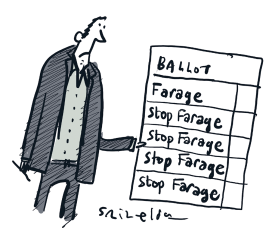
And Scarlett Maguire, director of polling company Merlin Strategy, tells me that the dominance of Restore supporters on social media could pressure Reform into adopting positions to retain its core vote that are less palatable to the swing voters it wants to win over. She cites Monday’s announcement that Reform would ‘restore Britain’s Christian heritage’, a possible turn towards the sort of religious politics that does well in the United States and even continental Europe but has hitherto been largely absent in Britain.
Some in Reform may want to tack further right to see off Restore, but Farage himself is alive to the dangers. On Monday, he criticised ethno-nationalism and repeated his boast that one of his proudest accomplishments in politics was destroying the BNP. Laila Cunningham, Reform’s candidate for mayor of London, has gone further, directly branding Restore’s supporters neo-Nazis. Restore has threatened libel action and asserted that Cunningham is inciting violence.
It is hackneyed to refer to Monty Python’s Life of Brian when discussing political factionalism. A better metaphor for Farage’s right flank until now would be the Warring States of ancient China: permanently in conflict, but to outsiders indistinguishable from one another. Time will tell if Lowe is a latter-day Qin Shi Huang, the first emperor of a united China, or just another bitter howl into a dismal wind.





Comments