
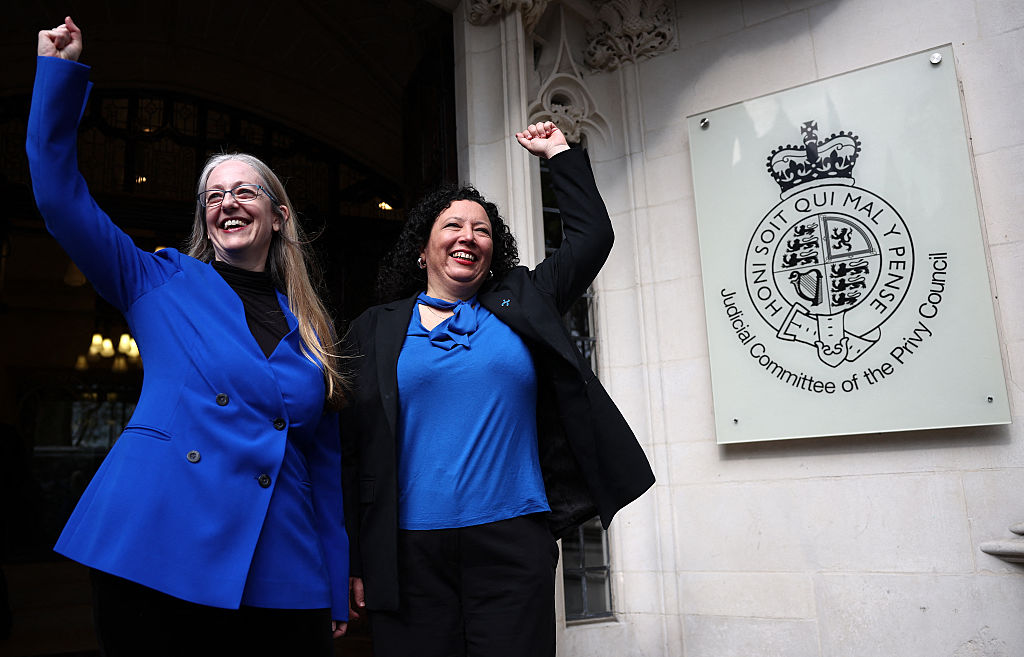
The women are at it again. For Women Scotland (FWS), specifically. They’re the pressure group who took on the Scottish government, which believes men are women if they say so, and secured a Supreme Court judgment that ‘sex’ in the Equality Act refers to biological rather than ‘certificated’ sex. Now they’re back in court taking on the same government over its policy of allowing some male prisoners who identify as trans to be held in the female estate.
Aidan O’Neill KC, who is representing FWS, suggested to the Court of Session on Tuesday morning that the Scottish government was doubling down as ‘a political calculation’ and that women locked up with men were being ‘used by the Scottish government in this case to be traded as pawns for political gain’. The government, for its part, contends that a blanket rule for accommodating inmates by sex ‘would violate the rights of some prisoners’, and says its policy allows flexibility to bar violent or dangerous male prisoners from entry to the female estate.
O’Neill flipped this on its head, asking the court: ‘Why do women have to be human shields to protect the nice trans-identifying male prisoners against the risk of violence against them if they were in the male estate?’ He went on to accuse Scottish ministers of ‘institutional neglect of and contempt for women’s rights’ and drew parallels between their prison policy and Animal Farm: ‘All women are equal, but men identifying as women are more equal than others.’
Robust stuff, but necessary to get across the injustice of imprisoning men alongside women. There are, per the 2025 figures, 19 transgender prisoners in Scotland, which represents less than one-quarter of 1 per cent of the incarcerated population. Yet the Scottish Prison Service’s policy has been drawn up with these prisoners in mind, only changing from a gender-affirming approach to a case-by-case stance as a result of the Isla Bryson scandal. (Male double rapist, briefly held in women’s estate, public uproar, Scottish government refused to say he was a man, Nicola Sturgeon resigned as first minister not long after.) This point should not be overlooked: the transgender prisoner policy is not a policy for transgender prisoners only; all prisoners, but especially women, feel its effects.
Women make up 4 per cent of the Scottish prison population and the women who end up in prison come from exactly the backgrounds you would think. A 2021 Glasgow University study found 78 per cent of Scottish women prisoners had suffered head injuries, with nine in ten of them having sustained the injury as a result of domestic violence. In 69 per cent of cases, their first head trauma was inflicted before they reached the age of 15. More than half of women in Scottish prisons were sexually abused as children and 46 per cent as adults. This is an acutely vulnerable population in need of safe conditions.
Gender-based prison placement is a useful illustration of a point gender activists try to elide: that there is a conflict at law and in policy between trans rights and women’s rights. Placing trans-identifying men in women’s prisons advances the interests of trans-identifying men (e.g. gender affirmation, safety) but does so by undermining the interests of women prisoners (e.g. dignity, safety). If the interests of women prisoners are rooted in single-sex custodial spaces – and they are – then rendering these spaces mixed-sex attacks those interests at the root.
None of the foregoing should be misinterpreted – or misrepresented – as callousness towards transgender prisoners. For those wishing to check my priors, this list of Coffee House pieces on criminal justice and prisons confirms me as a whiny liberal who wants to see many fewer people in prison and for those prisons to be safe, sanitary, appropriately staffed and geared towards the eventual reintegration of offenders into law-abiding society. Custody should be a place of safety for those confined and those employed there, and any prison which cannot guarantee minimally safe conditions has no business being in operation.
In the case of transgender prisoners, safety surely requires distinct facilities designed to serve their needs. The E-wing of HMP Downview, a women’s prison in Surrey, is set aside to house men who identify as women, though this is an imperfect solution in that it uses up the resources of a women’s prison to house male prisoners. Ministers north and south of the border should consider the case for a small number of bespoke prisons for transgender convicts, reflecting their size relative to the general prison population and their highly specialised healthcare and other needs.
Wanting transgender prisoners confined safely and with dignity is not an ignoble cause but it cannot be pursued within the women’s estate without diminishing the safety and dignity of women. Women prisoners are not political pawns. They are abused, battered, impoverished, drugged, exploited and ill-treated. They should not be forced on top of it all to play background parts in someone else’s ideological morality play.






Comments