Verification submitted
Thank you for providing your details. Please allow 3-5 days for your information to update.
A new industrial revolution
bluebird bio is aiming to be one of the first companies to launch a gene therapy in the UK. Often mistakenly seen as a treatment of the future, gene therapy has come of age, primed and ready to go with bluebird bio a leader in the field. Gene therapy’s arrival on the scene is very timely as it has been swept up in Boris Johnson’s ‘new industrial revolution’ that includes a wider UK policy agenda to foster an eco-system and lattice-work of cutting-edge technological and life science innovation. The vision positions the UK as a world-leader in clinical, scientific and industrial transformation — to remain at the vanguard of pioneering science and healthcare. bluebird bio is part of that scientific and medical revolution.
Gene therapy’s potential could soon be fulfilled at last
Gene therapy has been promising to transform healthcare for half a century, and still we have only around ten treatments approved for use. But that is going to change dramatically over the next five to ten years, according to Nicola Redfern, UK general manager of bluebird bio, as many treatments for rare genetic diseases are brought forward. In her introductory remarks for a digital round-table, hosted by The Spectator, Redfern laid out the challenges for the NHS and wider healthcare sector. ‘Have we got enough beds for transplant services?’ she says. ‘Can fertility services cope as patients may want eggs and sperm harvested?’ A major issue is the sheer cost of gene therapy.
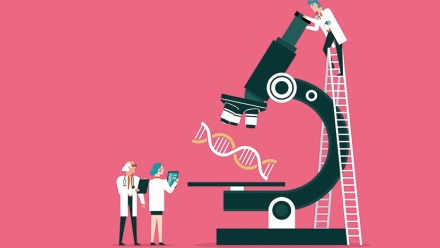

How gene therapy works
Gene therapy aims to repair, replace or add functional genes in individuals suffering from specific genetic diseases Gene therapy has traditionally been in the form of ‘gene addition’ which commonly utilises a ‘viral vector’ to introduce functional genes into the cells of eligible patients [1].
How can the NHS speed up adoption of new technologies?
The treatments provided by the National Health Service of 2020 would seem alien to the Nye Bevan of 1948, although the key principle of free healthcare to all at point of need remains intact. It is tempting to believe that the latest advances in technology are revolutionising healthcare both in the UK and around the globe, but the truth is far more prosaic. As someone who has worked as a doctor at the rock face of the NHS for 35 years, the view that it is a clunky, unwieldy and highly bureaucratic organisation that is chronically underfunded and often relies on the goodwill of dedicated staff to prevent it from failing can be difficult to argue against — and that’s before adding Covid-19 into the mix.

Gene therapy has the potential to transform a terminal diagnosis – including my son’s
It was nine years ago, in a windowless room in Great Ormond Street Hospital, that I first heard the words: ‘I think your son has something called Duchenne muscular dystrophy.’ I tried to comprehend what the consultant was telling me: the terminal diagnosis of my child. My son Eli, who looked like any other healthy three-year-old, had a broken gene inside him, the dystrophin gene. It meant that his muscles would stop working during his short lifetime. By 12 or 13 he could be in a wheelchair. In his late teens, in what should be the prime of his life, he would lose the use of his arms and hands. And sometime in his twenties, his heart and lungs would fail. His mind — his beautiful, inquisitive mind — was not affected.

Are ministers right to back gene therapy?
It isn’t for government to ‘pick winners’, according to the ruling philosophy of Conservative industrial policy over the past three decades. Yet ministers have made an exception in the field of gene therapy. Three years ago, the government’s Life Sciences: Industrial Strategy identified it as an area in which public investment might reap rich rewards for UK plc. This summer, No. 10 announced an additional £100 million to its Cell and Gene Therapy Catapult — a state-backed research resource which since 2012 has spent £2.5 billion backing private companies. As well as providing research support, it also offers practical help to scientists who want to commercialise their ideas.

Will the pandemic put gene therapy advancement at risk?
When Boris Johnson delivered his first speech as Prime Minister on the steps of Downing Street, we were living in a different world: Brexit and a looming general election were the issues of the day, and a pandemic that would come to dominate every aspect of public policy was still six months off our radar. The Prime Minister was far more comfortable in last year’s territory — negotiating with Brussels and wooing voters — and is loath to give up the agenda crafted before Covid. But even as vaccine updates bring some hope that we could be at the ‘beginning of the end’ of this pandemic, there’s no doubt that Johnson’s plans have been thrown off course — and it’s unlikely every big idea will get back on track before the next election.