If you like this…
If you’re enjoying Coffee House, I do hope you’ll take a look at Stephen Pollard’s new blog and Clive Davis’s—which come complete with a photograph by PooterGeek.
If you’re enjoying Coffee House, I do hope you’ll take a look at Stephen Pollard’s new blog and Clive Davis’s—which come complete with a photograph by PooterGeek.

Good news from Paris. No, not the capital of France which, it seems likely, will tomorrow crown Sarkozy its President. I mean the Hilton heiress, who was sent to jail yesterday for 45 days for driving while disqualified. There are so many cheap jokes one could make about the new Los Angeles Hilton and the standard of the rooms. But since this is an interactive site I shall leave it to others to crack them. Suffice it to say that the news of Paris's imprisonment shows that, after 24 hours of spin and counter-spin, Friday was definitely, beyond a shadow of a doubt, a very good day.
It is bleakly symmetrical that Tony Blair’s tenth anniversary as Prime Minister should have fallen in the same week as the Scottish, Welsh and local elections. But it was no less apt that the PM should have passed this milestone the day after the conviction of five British Islamists who plotted to blow up a crowded nightclub or shopping centre: the fruits of Operation ‘Crevice’ by the police and security services in 2004. The contrast between the sunlit expectations of 2 May 1997 and the angry mood of the electorate this week could scarcely be sharper. The Blair decade has been one of dashed expectations. But it has also been a period of geopolitical and cultural transformation.
The situation about to unfold in Scotland is why I can’t stand PR. First of all, not one voter will get the government they actually voted for. Instead, politicians will disappear off into the modern equivalent of smoke-filled rooms and thrash out a deal while the public desperately tries to see in the window. Also, the Greens—despite only having two MSPs, down from seven last time, and a miniscule percentage of the vote—will hold the balance of power if the Lib Dems and the SNP can come to an agreement. It is a truly perverse system that makes a party that lost 70 percent of its seats into the kingmakers.
A couple of months ago I had never heard of Facebook. Now, I place internal bets with myself at every social gathering I go to about how long it will be before someone mentions it. My boyfriend and I had a dinner party on Wednesday which managed to run to almost forty minutes (surely a record) before a fellow guest brought it up; last night my cocktail date had been going for about forty seconds before the dreaded thing reared its ugly head. 'He’s going away this weekend with his new girlfriend!' My friend Chloe wailed as she stormed into Soho House. 'His new GIRLFRIEND! How can he have a new girlfriend? He only broke up with me a month ago!

It’s a pity that the elections yesterday coincided with Molly Dineen’s documentary ‘The Lie of the Land’ because I imagine that the minister of agriculture (or minister of Naff, Maff, Defra or whatever it’s called now) was too busy with politics to be watching Channel 4 last night. Shame. The film looked at a way of life — farming — that is facing extinction. ‘They [the government] want the land as a playground for people in the towns,’ said one Cornish farmer. We have become ‘unreal about animals…treating meat as something that comes in cellophane’, as another put it. We spent a third of our income on food in the Seventies; now it’s 8 to 9 per cent.
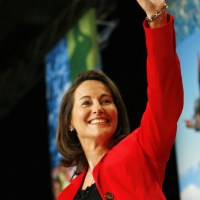
To shift focus in our election coverage to across the Channel, Nicolas Sarkozy’s lead is widening. Two new polls out today put him at 54% and 54.5% respectively, a comfortable lead over Ségolène Royal. Also, it looks like the debate was more of a win for Sarkozy than most commentators thought. A post-debate survey found that viewers took Sarkozy to be the more credible candidate by the whooping great margin of 51% to 31%. Sarkozy’ll be further encouraged by the fact that 51% of Bayrou backers who tuned in thought he’d make a good president compared to only 22% for Royal. Her aggressive tactics also seem to have backfired, with her likeability rating dropping by 13 points among debate watchers.
What is the peculiar magic of string quartets? Ian McEwan posed this question when I interviewed him recently. It came to mind again during an enchanting evening at the Spectator’s Westminster offices last night, as the Bridge Quartet gave a sublime performance of Elgar’s music, including the String Quartet in E minor. The event renewed the historic link between 22 Old Queen Street, once the home of Frank Schuster (1852-1927), and Elgar, the composer whom this great patron of the arts revered more than any other. Listening to the music in the panelled board-room, one was transported back to those evenings that Schuster held in honour of his musical hero, often with a magnificent dinner for the stars of London society.
Our indefatigable political editor Fraser Nelson will be blogging the election results as they come in. He’s also one of the analysts on tonight’s BBC election special. So check back in through the night for Fraser's thoughts and tips.
We've had had some problems earlier today with the comments but that's now fixed--apologies if you tried to post earlier. So please do fire away, just click on the comment button to do so.
From our US edition
Shot in the dark Sir: Just a thought. Has anyone ever considered the possibility that, if all citizens were armed, the Columbine and Virginia Tech perpetrators would have been shot long before they killed so many (Leading article, 21 April)? Moreover, the 9/11 perpetrators would also have been shot before taking control of the aircraft — 130 armed passengers must trump four armed terrorists. Are proposed gun laws not just a vain attempt at treating an effect rather than stopping the cause? If a murderer knows he will be shot if he steps out of line, he will think twice.
An Englishman’s home is his castle, but his wheelie bin is not far behind as a symbol of domestic independence. So it is no surprise that the spread of fortnightly, rather than weekly, rubbish collection has stirred such strong emotions. In the midst of soaring April temperatures, the prospect of stinking piles of black bags, pecked at by rats and birds, is vile indeed. A government that lectures the electorate about ‘respect’ and antisocial behaviour cannot be complacent about a trend that risks bringing the hygiene standards of the shanty town to thousands of streets. Jim Callaghan never actually said ‘Crisis? What crisis?’, but the headline captured his jovial detachment from the collapse of basic amenities in Britain.
US and them Sir: David Selbourne seems to suffer from tunnel vision in his analysis of failing US imperial ambitions (‘No more Pax Americana’, 14 April). He seems to believe that Islamism is its undoing and makes no mention of nationalism — a far more potent force. American imperialism is being resisted in Latin America as well as in the Middle East, and the common thread is nationalism, not Islamism. Paranoia about Islam is as widespread throughout the West as it once was about communism, but viewing either of these phenomena as monolithic is much too simplistic. The vast majority of Muslims around the world are concerned with local problems and have no interest in coercively spreading Islam.
In her book on the Eichmann trial, Hannah Arendt famously, and controversially, wrote of the ‘banality of evil’. The contemporary variant is the awesome banality of much of the analysis and soul-searching that evil provokes. Since the horrific murder of 32 people at Virginia Tech on Monday, there has been a spree of such commentary. The rest of the world treats America like a dominant but dysfunctional family. So great is the cultural reach and ‘soft power’ of the United States that an atrocity of this kind quickly assumes almost global significance and is treated, quite inappropriately, as a metaphor for all manner of modern pathologies.
Monday was ‘National Nuclear Day’ in Iran. In Britain, with the paid appearance of Leading Seaman Faye Turney on television, it was national humiliation day. The abduction three weeks ago of 15 British sailors and marines by a hostile regime was, at best, a misfortune; the decision of Ms Turney and Operator Mechanic Arthur Batchelor to profit from their experience was a disgrace. That the Royal Navy and the Ministry of Defence thought it appropriate — even for a day — for the sailors to sell their stories demonstrates just how deeply British society has been corrupted by the twin cults of celebrity and victimhood. That’s not to say that the whole episode reflects poorly on the sailors and marines.
Brits in denial Sir: James Forsyth (‘Where is the outrage at the kidnapping of our Marines?’, 31 March) points out that the indifference the public is showing towards the seizure and humiliation of 15 British service personnel by Iran demonstrates a country deeply disconnected from its armed forces. But the disconnection goes far deeper, to a radical disassociation of people from the country itself. The spirit and identity of the British has been broken by endless propaganda traducing their history and through mass immigration. Unfortunately, there is nothing to replace it with. The idea that a society can survive solely by reference to ‘shared values’, such as fairness, the rule of law, etc., flies in the face of everything we know about human nature.
A stealth tax, by definition, is one in which political pain is deferred in return for immediate gain. The Chancellor who imposes such a tax effectively mortgages his credibility and the public’s trust in him. But, sooner or later, as Gordon Brown is discovering, the day of reckoning arrives — in Mr Brown’s case, at the worst possible moment, as he prepares to enter No. 10, and to fend off a serious challenge for the Labour leadership. Thanks to dogged Freedom of Information inquiries by the Times, we now know that Mr Brown was warned by his Treasury officials in 1997 that his decision to abolish dividend tax credits for pension funds would provoke ‘clamour and public consternation.... Ministers’ postbags will be pretty full.
Christian unity Sir: I am sorry that Piers Paul Read (‘The Pope’s anti-liberal revolution’, 24 March) assumes that the English and Welsh bishops have not welcomed the Papal Exhortation Sacramentum Caritatis. It is not always customary for bishops to issue immediate comments on Papal documents. I was, in fact, part of the drafting committee and thus closely involved in its preparation. My own statement expressed my admiration for the document and my wish for it to be promulgated widely among the Catholics of this country. I have no doubt my fellow bishops will be doing the same. Nor should it be assumed that the ecumenical movement is over or that we should cease to strive for deeper unity with the Anglican Communion.