Spectator Editorial

Immigration control has been the bright spot of Trump’s second term

From our US edition

Parts of the MAGA movement are unhappy with President Trump’s migration strategy. The administration has softened its policy on deportations following a public uproar over the ICE killings in January, it is said. The focus has been on removing only the most violent offenders. “The truth is the first year was not a year of mass deportation,” says Mike Howell of the Mass Deportation Coalition. “A conscious decision was made to go after the worst first, which was, we’ll call it a deviation, from the central campaign promise of mass deportations.” Such criticisms miss the point. The Trump administration has tackled the worst offenders to shore up support for its wider migration crackdown. And that crackdown has been wildly successful.

immigration

How will Trump solve the Iran problem?

From our US edition

Has President Trump discovered his “off-ramp” from the war in Iran? His administration insists that Iran’s military power has been crushed, that its already broken economy is now all but dead, and that the Islamic Republic is on its last legs, desperate to make a deal. Yet Tehran, or the Islamic Revolutionary Guard deep state that effectively calls the shots, still shows little willingness to accept defeat. Indeed, if anything, the official noises and propaganda emanating from Iranian channels suggest a regime that feels Trump has committed a huge strategic blunder. Trump has, on Truth Social at least, extended his ceasefire “indefinitely” while negotiations continue.

Trump Iran

How Trump loses friends and alienates people

From our US edition

It is a long haul until the midterm elections in November. Many threats and deadlines will have been issued to Iran in that time, many cycles of optimism and pessimism will have been completed. The war may be over, or Donald Trump may be bogged down in an intractable conflict which he privately wishes he had never started. Regardless, his administration must start preparing for what looks to be an increasing certainty: that the Republicans will suffer a heavy electoral reversal. That was looking likely even before Iran and its effect on oil prices. The President’s tariff wars have protected some, but the overall effect on blue- collar jobs has been negative. Moreover, at 3.3 percent, consumer inflation is back at the sort of levels which helped stop Kamala Harris from winning.

trump

Operation Epic Fury is costing Trump his coalition

From our US edition

As US troops flock to danger, Donald Trump seeks ways to disentangle himself from the war on Iran. “We are on track to complete all of America’s military objectives shortly, very shortly,” he said in a 19-minute address at the start of the month. “It’s very important that we keep this conflict in perspective.” What’s increasingly clear is that, despite its tactical successes, Operation Epic Fury is turning into a strategic quagmire and a political miscalculation. The President’s approval rating has sunk to -18 percent, the lowest in his second term. Among independents, Trump is on -45 percent, the worst recorded score of any second-term president. That is the perspective concerning the White House.

epic fury

Why Iran will hasten MAGA’s demise

From our US edition

Readers may disagree with the cover line of this issue. Pronouncing “the end of Trumpism” feels somewhat similar to declaring “the end of history” – a provocative, albeit less grandiose, statement that risks being mocked in the near future. We should start by saying we hope that we are wrong. Trumpism, as this magazine understands it, has been a boon to America. As Christopher Caldwell argues, the rise of Donald Trump was a healthy democratic response to a fetid political system. On many fronts, the Trump administration, now in its second and more dynamic term, has made great progress. It has fought illegal immigration with vigor.

The Iran war has exacerbated the failure of European energy policies

From our US edition

The history of the global trading system is a story of narrow and vulnerable waterways: the Suez and Panama Canals, the St. Lawrence Seaway, the Straits of Dover and the Skagerrak, which defends the entrance to the Baltic. But none has the power to seize up the global economy as much as the Strait of Hormuz. Barely 30 miles wide at the narrowest point and bounded on one side by the state of Iran, this passage is used for a quarter of the world’s oil supplies and a fifth of its liquified natural gas (LNG).

energy

Trump’s worrying appetite for war

From our US edition

As The Spectator goes to press, a great fleet of American war machines is whirring through the skies toward the Middle East. More than 50 fighter jets, plus stealth bombers and support aircraft, are joining what Donald Trump called an “armada” of US naval forces in the Arabian seas. The White House continues to say that it is pursuing a diplomatic solution with Iran. It’s possible that this latest military escalation is another of President Trump’s elaborate bluffs, designed to pressure the Iranian regime into accepting American and Israeli demands. But the President has been unusually mute about the situation on Truth Social.

war

Epstein, the Clintons and the death of trust

From our US edition

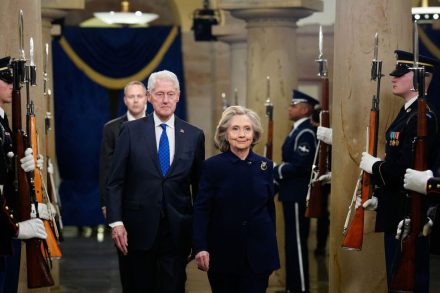
Bill and Hillary Clinton had a choice: face criminal contempt charges or come clean about their friendship with Jeffrey Epstein. After months of resisting, the former president and his wife have now agreed to testify before the House. Clinton will be the first former president to appear before Congress since 1983, when Gerald Ford discussed bicentenary celebrations for the enactment of the Constitution. An appearance of this gravity, however, is unprecedented; it may well mark the start of a true Epstein reckoning in America. The Epstein scandal has become a strange monster, hell-bent on devouring the old elite In typical Clintonian style, the couple presented their initial refusal as a principled stand.

epstein clinton

Are you long on America?

From our US edition

Donald Trump has completed the first year of his second presidency – and remains a truly divisive figure. He may have pulled back, after an absurd escalation, from his apparent threat to annex Greenland by force. But European leaders continue to berate him for his turbulent behavior in international affairs, and a growing number of Republicans are turning against his erratic foreign policy. Last week, the cry on global markets was “Sell America,” after the President ratcheted up trade hostilities with long-standing US allies by announcing yet another round of punitive tariffs on several European countries for refusing to agree that America should own Greenland outright.

How far can bravado take the US?

From our US edition

Operation Absolute Resolve, Donald Trump’s rendition of Nicolás Maduro in Venezuela, was a brilliantly executed coup. The audacious raid did not undermine international law, as many European and Democratic politicians have said. But it did expose the weakness and pomposity of the world’s multilateral bodies. Maduro traded oil for loans with China while helping Moscow avoid sanctions. He permitted the terrorist group Hezbollah and Iran to operate and build drones within his jurisdiction. He rigged elections and had opposition activists shot in the street. He allowed and enabled weapons, fentanyl and illegal migrants to flood towards America’s southern border. Yet it wasn’t the International Criminal Court that arrested Maduro to bring him to justice in a New York court.

global sheriff

Trump’s brave new world

From our US edition

No one ever tucked themselves up in bed to read a government document – at least not in the expectation of enjoying it. The standard format is one of hundreds of pages of impenetrable jargon yielding no more than nuggets of significant ideas. The Trump administration has admirably cut through that tendency to produce a National Security Strategy (NSS) that is worth reading: a coherent outlining of America’s strategic intentions on the world stage. Originally composed by Michael Anton, a brilliant mind who is sadly leaving the State Department, the document concisely lays out a Trumpian vision of America’s role in the 21st century.

Why America must lead on artificial intelligence

From our US edition

As stock markets wobble over fears of AI hype and the overvaluation of tech shares, it seems an unfortunate time for Donald Trump to launch an initiative boosting America’s artificial intelligence capabilities. But the White House sees matters differently. Its new “Genesis Mission,” which commits government departments to make sure adequate energy and computing power are available, has been purposely launched to remind the world that AI is not all froth – or “slop” to use the popular term. Team Trump likens Genesis to the Manhattan Project to develop a nuclear bomb during World War Two faster than the other side. For all the typically Trumpian bombast, that’s not a foolish way of thinking about the subject.

fraud

Can Trump control inflation?

From our US edition

Notionally, Americans have never been better off. The ructions in tech stocks over the past few weeks cannot detract from the fact that the US economy has been outgunning other developed economies all century. The overall graph of real disposable income for Americans continues to trend upward, almost as if the sharp dip during the pandemic had not happened. That is certainly not true everywhere: in many countries, Covid has been followed by stagnation in GDP and wages. Yet, for all the wealth generated, many Americans simply do not feel that they are living in a thriving country. On the things that really matter, such as basic living costs, citizens at the lower end of the income scale feel their wages are increasingly inadequate. They are not imagining it.

cost

Bill Gates and the rightward shift of the billionaires

From our US edition

To his fellow high priests of the church of climate change, Bill Gates has just committed the ultimate heresy. He has told us that we are not all going to die from scorching temperatures, despite in the past having said “we are setting ourselves up for a humanitarian and geopolitical disaster.” In a new essay posted on his personal website, he has attacked the “doomsday view” that “in a few decades, cataclysmic climate change will decimate civilization.” He writes: “Fortunately for all of us, this view is wrong. Although climate change will have serious consequences… it will not lead to humanity’s demise.” His rejection of catastrophism is no small matter.

bill gates

Trump’s border policy is beginning to bear fruit

From our US edition

The second Trump administration tends to characterize those who have illegally crossed the southern US border as drug dealers, criminals and rapists. That is, of course, exaggeration, but it is no more a fiction than is the alternative belief, common among liberals, that all migrants are desperate people fleeing for their lives, who cannot possibly be expected to live in their home countries and are utterly dependent on making it to America in order to survive. If that were true, illegal migration would be little to worry about and good for the soul – and indeed the economic well-being – of America.

Trump

Make Peace Great Again

From our US edition

With typical assertiveness, Defense Secretary Pete Hegseth gave his marching orders to the US military at the end of September. No more “fat troops” or “fat generals and admirals in the halls of the Pentagon.” No more woke. Make War Great Again. At the same time, with typical modesty, Donald Trump said of his proposed peace deal between Israel and Gaza, “This is a big, big day, a beautiful day, potentially one of the greatest days ever in civilization.” No more starvation, no more senseless death. Make Peace Great Again. In Trumpworld, these two agendas are not contradictory. A strong army at home guarentees peace abroad – or that’s the hope, anyway. But what happens when America’s enemies don’t play ball?

Trump

Go to church

From our US edition

It’s often noted that American society is becoming ever more politicized and polarized. Those who once imagined themselves uninterested in politics find themselves dragged into America’s culture wars. Small children now carry placards and attend political marches. Max Horder and Danit Sara Finkelstein explain the extent to which social media has played a part in this growing radicalism, not just because of the ideological echo chambers we now inhabit, but due to the mindset online algorithms create: rewarding outrage, encouraging extremism. Nuance and balance are anathema; shock and division set each day’s tone.

spiritual

Magnificent – but is it war?

From our US edition

When Donald Trump made building a “big, beautiful” wall along the southern US border a priority in his first term, he was widely derided. There wasn’t enough concrete or steel to build such a structure. Anyway, it was futile because migrants would find some way over or around it. It was a heartless and evil project being promoted to distract from other failures. When shutting off immigration from Mexico became an unrealized project from that first term, Trump’s critics enjoyed themselves. Campaigning for his second term, Trump hardly mentioned the wall. Yet something remarkable has happened. Undocumented migration across the border has all but ceased.

Trump

The real threat of AI is spiritual

From our US edition

Peter Thiel is one of the world’s most powerful men. He was an early investor in companies such as Facebook, SpaceX, Airbnb and an early backer of Donald Trump, as a leading donor to his 2016 campaign. He is a friend and mentor to the man who would be president in 2028: J.D. Vance. Thiel, a multi-billionaire, is also one of the few individuals who clearly have a hand in shaping the future of humanity, so it was disturbing to learn recently that he’s unsure whether humans are worth preserving at all. In conversation with the journalist Ross Douthat, Thiel was asked whether he wanted the human race to endure. He seemed unsure. “I don’t know,” he said, after a long pause. “I would, I would… there’s so many questions implicit in this.

ai

Can anyone balance America’s books?

From our US edition

Donald Trump’s Big, Beautiful Bill was supposed to slash government waste and inefficiency. So why is it going to result in an even bigger, uglier deficit? The legislation was still being picked over in the Senate as this magazine went to press. But the Committee for a Responsible Federal Budget has calculated that the bill will add $2.5 trillion to the deficit over the next decade – and that estimate is far more likely to go up than down. The President’s opponents have characterized the Big, Beautiful Bill as a swindle that steals from the poor to give to the rich. That may be true to some extent, in that it could become harder for some people to qualify for Medicaid, while wealthy Americans will enjoy the extension of lower tax rates.

elon musk bill debt books