The anti-Semitism algorithm
From our US edition
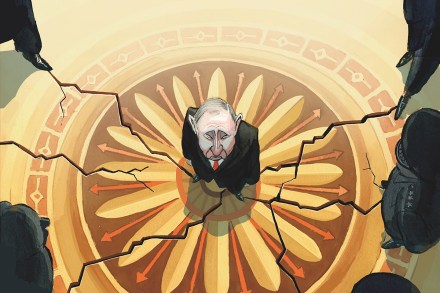
China, Russia and Iran are fanning hatred online to undermine America
Peter Pomerantsev is senior fellow at Johns Hopkins University. His books include Nothing is True and Everything is Possible: Adventures in Modern Russia.
From our US edition
China, Russia and Iran are fanning hatred online to undermine America
From our US edition
How worshipers persist in the occupied territories
From our US edition
Moscow yearns to carve up the world. But it will be a world where everybody’s knives come out
48 min listen
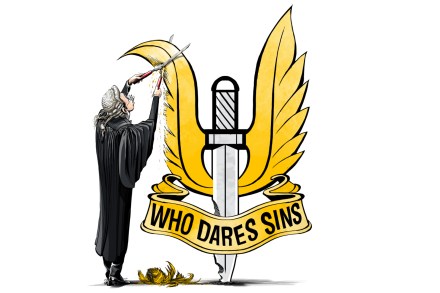
This week: SAS SOS The enemy that most concerns Britain’s elite military unit isn’t the IRA, the Taliban or Isis, but a phalanx of lawyers armed with the European Convention on Human Rights (ECHR), writes Paul Wood in The Spectator. Many SAS soldiers now believe that if they kill a terrorist during an operation, they’ll spend
How can you break the mental manacles of an empire that has occupied not only your physical world but also your education, publishing, media, high culture and popular entertainment? In his endearing memoir of Odesa, Undefeatable, Julian Evans quotes the Ukrainian author Viktoria Amelina, who describes growing up in post-Soviet Ukraine surrounded by all things
44 min listen
My guest on this week’s Book Club podcast is Peter Pomerantsev. Peter’s new book How To Win An Information War: The Propagandist Who Outwitted Hitler tells the story of Sefton Delmer, the great genius of twentieth-century propaganda. Peter tells me about Delmer’s remarkable life, compromised ethics, and the lessons he still has to offer us.
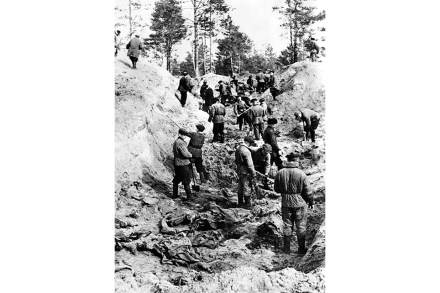
On 5 March 1940, as the USSR stamped its authority on a Poland it had partitioned with Hitler, Stalin signed a decree to murder 14,700 Polish officers in the woods by Katyn. These ‘hardened, irremediable enemies of Soviet power’ were not informed of their sentence and simply shot in the back of the head, a
Lviv My favourite hotels in Lviv were all booked out over the weekend. The world’s justice elite were in town for a gathering on how to hold Russia accountable for its crimes. The US Attorney General and the Chief Prosecutor from The Hague, as well as President Volodymyr Zelensky, were there. It was an apposite
40 min listen
In this week’s episode: How are the people of both Russia and Ukraine processing the war? Our Russia correspondent Owen Matthews writes in this week’s Spectator that he has been stunned at how easily some of his Russian friends have accepted the Kremlin’s propaganda. He joins the podcast to explain why he thinks this is, followed
Palm Sunday in Perugia. Umbrians were scuttling around with twigs and leaves, but I was in town to celebrate another faith. It was the annual International Journalism Festival, which hasn’t been ‘annual’ for the past two years due to Covid. Happy reunions were applauded with the sound of countless clinking glasses, but the mood was
When two post-Soviet supermodels committed suicide in the noughties, both throwing themselves off high buildings in New York and Kiev, the trail into what made them so depressed led to a ‘personality development’ organisation in Moscow that offered ‘trainings’ that would help ‘find your truer self’. The moment you entered the dark Stalinist gothic theatre,
Perhaps the secret to understanding Russian history lies in its grammar: it lacks a pluperfect tense. In Latin, English and German the pluperfect describes actions completely completed at a definite point in the past… Early Russian had such a tense, but it was erased. This grammatical lack costs its speakers dear. Russian history never becomes
On 27 November 1960 African and Indian diplomats visiting the UN in New York opened their mail to find a leaflet from the Ku Klux Clan: A foul stench spreads out from the East River and hangs over New York like a pall — the greasy sweat of the Black Races and the Yellow Races
What makes for meaningful political protest? In regimes where ideology was taken seriously (such as the Soviet Union or America during the Cold War), dissidents and dissenters could target rulers’ political ideas, whether communist or capitalist. But in regimes where ideology is used more to distract than indoctrinate (such as Putin’s Russia or Trump’s America),