Peter Hitchens

Peter Hitchens lived in Moscow from June 1990 to October 1992. He is a columnist for the Mail on Sunday.

Why I believe Lucy Letby’s trial was unfair

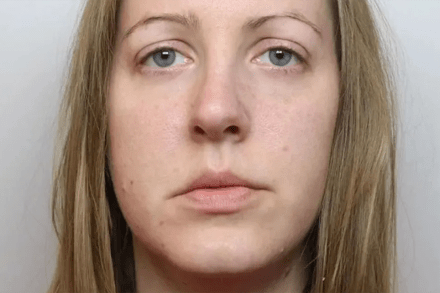
Even Horace Rumpole could not have secured an acquittal for Lucy Letby. The more I look at this case, the more I suspect that there could never have been any other outcome than a conviction. I think a great cloud of emotion hung over that courtroom during the whole trial. I think that cloud spread outwards into the public mind before and during the long months of the trial. In my view, the actual prosecution of Ms Letby began on Thursday 5 July 2018, two days after she was arrested for the first time, and more than four years before she finally sat in the dock. The prosecution knew throughout that they had no objective proof of their case, large or small On that day, police officers dug up her tiny garden in a Chester suburb.

Tried and tested by the Common Entrance Exam

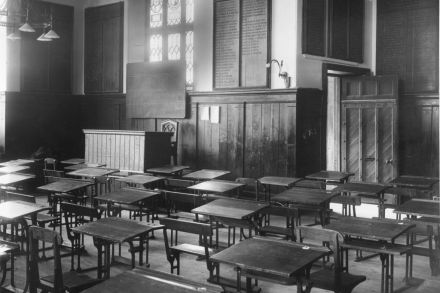
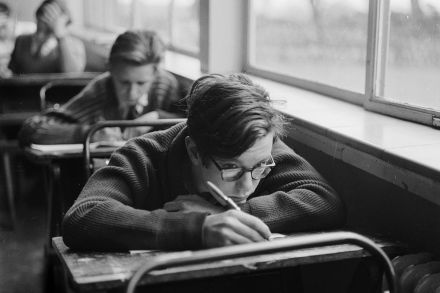
This is about something that did not happen to me at school, an exam I dreaded, but never had to take. It was the only examination that ever really worried me, and it was called Common Entrance. Do not confuse it with modern imitations bearing the same name. In those days, preparing for it involved (for me, anyway) translating English into Latin and French (a proper knowledge of irregular verbs and a wide vocabulary in both those languages was required). It also demanded thorny and tricky types of mathematics, an astounding grasp of largely Imperial geography – and a full knowledge of English history since the Conquest. I actually understood the jokes in 1066 and All That, for which modern children would need a decoder.

Peter Hitchens, Lionel Shriver, Mary Wellesley and more

31 min listen

On this week's episode, Peter Hitchens remembers a Christmas in Bucharest, Lionel Shriver says people don't care about Ukraine anymore, Ed West wonders if you can ‘meme’ yourself into believing in God, Mary Wellesley reads her ‘Notes On’ St Nicholas, and Melissa Kite says she had to move to Ireland to escape the EU‘s rules.

The last Noël in the USSR

It was on Christmas morning in Moscow in 1990 that my daughter, then aged seven, realised that Santa Claus was not to be trusted. She had made the usual elaborate suggestions to him in a letter to Lapland (perhaps hoping that, being posted from a frozen region, it would get through more readily). But when she came to rip open her gifts, the parcels did not contain the things she had hoped for. Instead, they were full of pale, oddly coloured and sometimes faintly dangerous Soviet products, breathing the last enchantments of the 1930s. Mrs Hitchens had queued fiercely to buy these delights in the colossal ‘Children’s World’ department store which stood just across the road from KGB headquarters. Christmas in the Evil Empire was different, you see, though not always worse.

My Christmas in Bucharest as Ceausescu fell

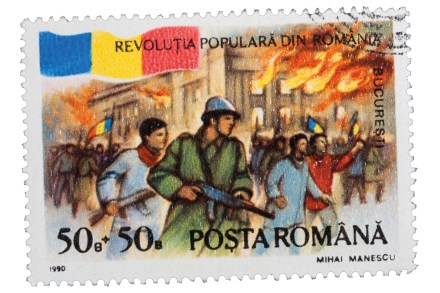
I never intended to spend Christmas 1989 on a short break in Bucharest. I had enjoyed a long, thrilling autumn in dark, sad cities in eastern Europe, running and marching with ecstatic crowds as they overthrew communism. But this had all been in the calmer, less exotic regions of the Warsaw Pact, where dumplings were on the menu, passions were equally stodgy, and both rebels and governments would rather hold press conferences than open fire on each other. I was in lovely but dreary Dresden when news came that Nicolae Ceausescu’s baroque dictatorship was tottering, and my foreign desk urged me to head to Hungary and on into Romania as soon as the border opened, if it did. Air travel was impossible. It had to be by land.

What prison taught me

I confess I never expected to see myself going to the lavatory on prime-time national TV. In fact, the expedition was a failure. Sharing a cell, especially with a young man with a record for GBH, is a very constipating experience. But when I accepted Shine TV’s proposal that I should submit to living alongside a large number of former prisoners, in a real but decommissioned jail, I had agreed to almost anything that might happen. Including that. Dozens of cameras covered us the whole time from every angle. We wore microphones around our necks. It is impossible to guard your tongue the whole time, and so my exclamation of ‘at last!’ slipped out. And I can see why they used it.

You should read Simon Raven

It is high summer but in the early mornings you can already sense the first thrilling signs of autumn, the perfect reading season. What a good moment to revisit the enjoyably cruel England of Simon Raven, as described in his matchless series of novels Alms for Oblivion. It is pagan, unjust, beautiful, funny and evocative. It encompasses the melancholy era of national decline, from the last trumpets of empire to the seedy, garish concrete and glass squalor of Ted Heath’s fevered age. It is funny, bitter and full of a surprisingly uninhibited love of this country. It is interested in history, patriotism, courage, money, food, drink and sex, not necessarily in that order. Much (though not all) of the sex takes the form of unadorned lust.

Katy Balls, Peter Hitchens and Anthony Horowitz

25 min listen

This episode of Spectator Out Loud features Katy Balls on the new divisions within the Labour Party and what Jeremy Corbyn might run for next (01:08); Peter Hitchens describes the joys of cycling and his dislike of e-bikes and scooters (07:40); and Anthony Horowitz joins us from Crete where he ponders the end of the world, becoming a grandfather and travel limitations after Brexit (13:11) Produced and presented by Linden Kemkaran.

Real cyclists don’t use e-bikes

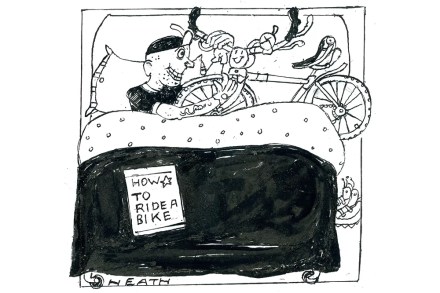
An impossible 45 years ago, I decided the moment had come to get back on my pushbike. I had long hated the way the motor car was taking over the world and wanted to play my part in changing this. I also had a more selfish reason. After two years on the Fleet Street diet of lunchtime excess, I could already see my first heart attack was not far off. I was in my late twenties and getting almost no exercise. I knew of people in the newspaper business who did so little walking that the uppers of their shoes wore out before the soles did. Something had to be done. In those days, bikes had not moved on since my childhood days, pedalling my heavy green Hercules over the Sussex Downs on summer afternoons. The brakes were as feeble, especially in the wet.

Is it time to stop changing the clocks?

15 min listen

On this special Saturday edition of Coffee House Shots, The Spectator's James Heale, journalist Peter Hitchens and the IEA's Christopher Snowdon argue the cases for and against daylight saving time. Are we all being needlessly robbed of an hour in bed? Or should we lighten up and embrace the longer days?  Produced by Natasha Feroze and Oscar Edmondson.

Christmas Special

65 min listen

Welcome to the special Christmas episode of The Edition! Up first: What a year in politics it has been. 2022 has seen five education secretaries, four chancellors, three prime ministers and two monarchs. But there is only one political team that can make sense of it all. The Spectator's editor Fraser Nelson, deputy political editor Katy Balls and assistant editor Isabel Hardman discuss what has surely been one of the most dramatic years in British political history (01:13). Then: Christmas is a time to spare a thought for our neighbours. While in the UK we have our own hardships, families in Ukraine are facing a Christmas under siege.

The conspiracy against grammar schools

I love a good hard debate, especially at a university. I can’t recall how many such clashes I have had, on God, free speech, marijuana, and Russia. But on the subject I really want to talk about, the destruction of the grammar schools, I find it harder and harder to get anyone to debate against me. Your guess is as good as mine about why the comprehensive school enthusiasts won’t argue with me anymore (they used to). It is certainly not that nobody cares about this ancient controversy. They do. A few years ago one university society tried for months to find me an opponent, and couldn’t – yet hundreds still turned up to the one-sided meeting we eventually decided to hold.

Make rail travel great again

Since I took the Golden Arrow to Paris and back in 1965, I have always thought of that train journey as one of the great joys of life. I cannot remember how many pre--tunnel trips to the City of Light I made, via Dover and Calais, Folkestone and Boulogne or (best of all) Newhaven and Dieppe. My great regret is that I never took the old Night Ferry, a special set of blue and gold sleeping cars designed to run on both French and British railways, on which you could (in theory at least) slumber your way between the two capitals – though perhaps not while it was actually being shunted on and off the boat.

Why was a brilliant BBC serial kept in its most secret vaults?

BBC Four announced this morning that 'The Roads to Freedom' will play on the BBC for the first time since the 1970s on Wednesday 27 July. In May, Peter Hitchens asked why the BBC had kept it in the archive...  If someone had managed to bottle the essence of the 1960s – the exciting, adventurous bits – wouldn’t you want to take at least one deep draught? I certainly would. I sometimes long for the power to recreate that odd, dangerous, thrilling time, if only to see if I have got it right in my memory. In fact, they did bottle it. But nobody is allowed to taste the vintage. Well, almost nobody, as we shall see. The BBC possesses, beyond doubt, a full recording of its 13-part 1970 dramatisation of Jean-Paul Sartre’s The Roads to Freedom trilogy.

No screens, shared bathwater and ugly food: my life in a 1960s prep school

We were allowed one phone call, faint and crackling along the many miles of copper wire which connected Hampshire with Dartmoor. In those days (this was the early 1960s) the operator had to connect it. I had watched those wires, swooping alongside the train which had borne me all that way, wisps of smoke and steam drifting past the window. Now, with the September evening coming on, there was time for a few stilted words in the headmaster’s study with my parents. It would in many ways have been better not to bother, as it only emphasised the distance and the separation. Then it was term. I don’t want to complain about this. I had begged to go to boarding school because my brother was already there and I would have felt utterly left out and left behind if I had not gone too.

Lara Prendergast, Christopher Howse, Lionel Shriver, Peter Hitchens, Joanna Lumley and Caroline Moore

55 min listen

On this week's very special Christmas episode, we'll hear from Lara Prendergast on why she’s planning to party hard this Christmas. (00:57)Next, Christopher Howse on those helping to preserve the UK’s medieval churches. (06:31)Then it's, Lionel Shriver on the Covid heretics she admires most. (16:41)Followed by, Peter Hitchens on Christmas in Russia during the last days of the Soviet Union. (25:23)Penultimately, we have Joanna Lumley on getting the key to the Sistine Chapel. (35:69)And finally, Caroline Moore on how ghost stories became a British Christmas tradition.(41:51)Produced and presented by Sam HolmesSubscribe to The Spectator magazine this Christmas and get the next 12 issues – in print and online – for just £12.

Douglas Murray, Mary Wakefield, Peter Hitchens

22 min listen

On this week's episode, we’ll hear from Douglas Murray on the political fate of US vice president Kamala Harris. (00:58)Next, Mary Wakefield on her experience during storm Arwen and subsequent media coverage. (09:39)And finally, Peter Hitchens on his fears regarding the future of the city of Oxford. (15:58)Produced and presented by Sam HolmesSubscribe to The Spectator today and get a £20 Amazon gift voucher: spectator.

Only a benevolent dictator can save Oxford

Only a dictator can save Oxford now. Local government simply cannot grasp how precious this marvellous, unrivalled city is, and how easy it will be to erode it into bare, dispiriting bleakness and ugliness. Any fool can see that the ancient colleges of the university must be preserved, but the setting in which they stand has no reliable defenders. It is true that a plan to put a bypass through the ancient pastures of Christ Church meadow was defeated in 1968. But that was after 27 years of wrangling, during which this hideous megalo-maniac scheme was actually described as ‘indispensable’. In the half century during which I have lived in Oxford, with a few breaks, the nibbling of developers and expanders has continued without cease.

The link between drugs, terrorism and mental illness

Rod Liddle once actually said to me the immortal words ‘You were right and I was wrong’ at a Spectator summer party. This is a moment I shall treasure till the hour of my death. But even so, I was disappointed. For the subject was only Theresa May. I had predicted she would be a terrible premier. Rod had believed she would be good at the job. A year later, it was obvious who was correct. For one brief shining moment I had hoped that Rod had changed his mind about something much more important. I wish he and a lot of conservatives would shift their opinions about the role of mental illness in rampage killing all over the world. And, once they have done that, I wish they would be willing to examine the role of certain illegal and legal drugs in creating such mental illness.