Noel Malcolm

Daniel Chandler aims to bring new values to British politics – so how will that work out?

As this country stumbles towards a Labour victory at the next election, the mood on the left remains subdued. The problem is not Keir Starmer’s personal charisma, achingly absent though that may be. No, it lies much deeper than that, in what Tony Benn liked to call the ishoos. The cry goes up from focus groups across the land: what does Labour really stand for? What are its Big Ideas? Does anyone know? Well, perhaps they will quite soon. Step forward Daniel Chandler, a Cambridge-educated policy adviser and think-tanker who is now completing a doctorate at the LSE.
The lady vanishes

41 min listen

On this week's podcast: After the markets saw off Kwarteng, Trussonomics and now Truss herself, James Forsyth writes in The Spectator that the markets will be driving British politics for the foreseeable future. He is joined by Britain economics editor at the Economist Soumaya Keynes to discuss the institutions now dictating government policy (00:56).Also this week:Looking ahead to the American midterms next month, are we heading for a 'red wave'? Freddy Gray says in his piece for the magazine that the Democrats could be in for a shellacking come November. He is joined by Washington editor at Spectator World, Amber Athey (13:41).And finally:Should the Parthenon Marbles be returned to Athens?

Will The Parthenon Project seize the Elgin Marbles?

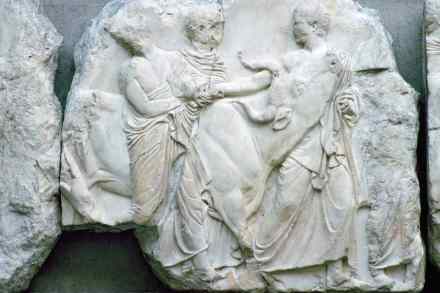
Thirty-five years ago, the late Christopher Hitchens published a book about the Elgin Marbles. Unsurprisingly, it was a polemical work; he was passionately campaigning for the return of the sculptures to Athens. But that was not the reason why I wrote a scathing review of it for The Spectator. Parts of it were plagiarised, as I showed, from the classic book by William St Clair; and in some places Hitchens dealt with the awkward fact that the evidence did not fit his claims by abbreviating the quotations, filtering out the unwanted bits. Hitchens replied with a thunderously disdainful attack on me in the letters page. I said to the then editor, Charles Moore, that I feared that if I met Hitchens at a Spectator party he would punch me on the nose.

The power trap

Soon after the date for the EU referendum was set, Timothy Garton Ash published a piece in this magazine under the title ‘A conservative case for staying in’. He was followed by Ian Buruma, attacking the idea that, having left the EU, the British would be more free. And then, after the Obama visit to London, there was Anne Applebaum, assuring us that the US had ‘excellent reasons’ for being opposed to Brexit. Like the little boy at the back of the street brawl in the old Punch cartoon, I want to ask: ‘Is this a private fight, or can any former foreign editor of The Spectator join in?’ Tim Garton Ash was succeeded in that role by Ian Buruma; I came next, and was followed by Anne Applebaum.

Taste and passion — with a dash of luck

Available from Heywood Hill, 10 Curzon Street, London W1J 5HH Producers of ‘period dramas’, on film or television, go to tremendous trouble to create the right ‘period look’. In the late Victorian town house, everything is late Victorian; in the Regency rectory, everything is Regency; and so on. All of which is, of course, absurd — not as absurd as having late Victorian things in the Regency house, admittedly, but absurd nonetheless. For most well-stocked houses — except those of the mail-ordering nouveaux riches —have always contained a mixture of styles, an accumulation of objects from earlier periods.

Some things never change: the Euro-enthusiasts are still avoiding serious debate

If a week is a long time in politics, how long is 12 years? The last time I wrote this column was in September 1991. Tony Blair was just a front-bench spokesman on employment; Gordon Brown ditto on trade and industry. These I had at least seen and heard. But if anyone had said to me, 'Geoff Hoon', I would have had to answer, 'Geoff Hoo?' He was not even an MP, just a Derbyshire MEP with an improbably large moustache. The biggest recent political excitement was the fall of Mrs Thatcher in 1990.