Nicholas Lezard

An unconventional orphan: Queen Esther, by John Irving, reviewed

Back in the 1980s and 1990s everyone read John Irving, or so it seemed. You had to have a copy of A Prayer for Owen Meany, The World According to Garp, The Hotel New Hampshire and The Cider House Rules. After a while even the most obtuse reader realised that a novel by John Irving was very likely to contain elements that had appeared in other John Irving novels. In fact, a friend of mine invented John Irving Bingo: cross off a box every time one of the following is mentioned: an orphanage; bears; Vienna; sex that is in some kind of way weird; and sudden acts of violence, usually brought about by ill luck or something worse.

Sebastian Faulks looks back on youth and lost idealism

I must say, calling a book Fires Which Burned Brightly promises much. At best, from the jaded reviewer’s point of view, an autobiography of delusional self-aggrandisement; at worst, a wild mismatch between the, well, incendiary language of the title and the potentially humdrum contents. It might have been dreamed up by a master satirist intending to inflict maximum damage to the reputation of that noted gentleman of letters, Sebastian Faulks. I once invented a novelist named Julian Sensitive, whose only claim to fame was an autobiographical novel called, after T.S. Eliot’s Prufrock, ‘My Trousers Rolled’. That was a crude joke compared with the hilarity inspired byFaulks’s title.

Lives upended: TonyInterruptor, by Nicola Barker, reviewed

‘Is it any good?’ a friend asked when he saw I was reading this book. ‘Yes,’ I said, ‘but it’s full of wankers.’ By that stage I was only up to page 24, but the remaining 184 pages did nothing to fundamentally alter my view. There is nothing intrinsically wrong with this. The works of, say, Geoffrey Chaucer and Jane Austen, not to mention thousands of others, would be considerably poorer if all the tiresome people were filtered out. But it does make it hard to read TonyInterruptor for more than 30 pages at a stretch. One has to pinch the bridge of the nose and go for a little walk.

The benign republic of Julian Barnes

Not long into this essay I found myself wondering if it would have been published if the author were not Julian Barnes. I also wondered: would I have guessed the author’s identity if it had been withheld from me? Actually, it’s really five little essays, whose subjects are ‘Memories’, ‘Words’, ‘Politics’, ‘Books’, and ‘Age and Time’.

The pursuit of love letters: My Search for Warren Harding, by Robert Plunket, reviewed

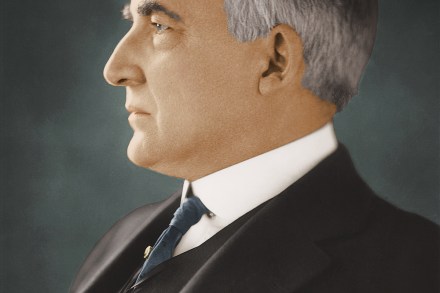
There is something wonderful about a novel being rescued from obscurity. Robert Plunket’s My Search for Warren Harding was first published in 1983, given a few decent reviews and then disappeared. Occasionally admirers – including rather influential ones like Amy Sedaris and Larry David – would lend a weathered copy to friends, insisting they read it. And so here we are. Elliot Weiner, a third-rate academic (in fact the word ‘academic’ barely seems to apply), hears that Rebekah Kinney, a former mistress of Warren G. Harding, president of the United States from 1921 to 1923, is living in a decrepit mansion in Los Angeles.

The next best thing to visiting a really clever friend in New York

I was on the phone to a friend recently, who asked me what I was reviewing. ‘It’s a book by a lady intellectual,’ I began. ‘Oh my God,’ she said, ‘I hope you don’t put that in your review.’ ‘I’m not that stupid,’ I replied, ‘but it is very important that she’s a woman.’ A self-described radical feminist in the 1960s and 1970s, Vivian Gornick says that that flame has died down a bit now (she was 79 when this book was first published ten years ago). Her perspective in this meandering, delightful memoir-cum-essay is still, obviously, feminine – yet there is a kind of detachment; and from what she says about her past life, and her experiences with men, and with love, there always was, in a way. Hence the ‘odd’ in the title.

The contagions of the modern world

Nearly a quarter of a century ago, Malcolm Gladwell wrote The Tipping Point in which he explained how little things could suddenly add up to cause huge change, in phenomena as diverse as the popularity of Hush Puppies and the reduction of crime in New York City. The book achieved its own tipping point and became a bestseller. It was followed by Outliers, which proposed among other things that in order to be really good at something you had to have practised at it for 10,000 hours. This is my first shot at reviewing a book by Gladwell, so I am several thousand hours short of practice. The phrase ‘tipping point’ was first coined to describe the proportion of black families it took to drive white families from a neighbourhood, so its roots are somewhat ugly.

Two young men in flight: Partita and A Winter in Zürau, by Gabriel Josipovici reviewed

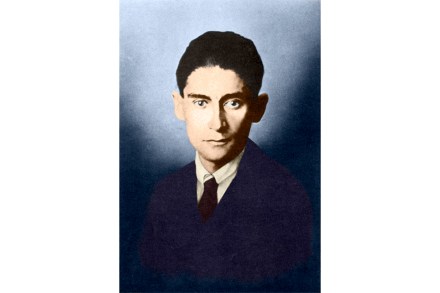
Two books in one: you flip it over, and it becomes the other. A Winter in Zürau is about Franz Kafka’s stay in a small Bohemian village with his sister Ottla after being diagnosed with tuberculosis. Or, as Gabriel Josipovici arrestingly puts it in the preface: ‘One day in the summer of 1917 the writer Franz Kafka woke up to find his mouth full of blood.’ (The echo of the opening line of Metamorphosis is surely deliberate.) Here, in isolation, he recuperated, or tried to. He wrote to Max Brod: ‘I’m not writing. What’s more, my will is not directed towards writing. If I could save myself... by digging holes, I would dig holes.’ Josipovici quotes this, and adds that there is a photograph of Samuel Beckett ‘doing just that’ in the second volume of his Collected Letters.

Shalom Auslander vents his disgust – on his ‘grotesque, vile, foul, ignominious self’

The word is Yiddish, and is an expression of disgust. A decent translation of it into vernacular English would be ‘yuck’. Shalom Auslander has been feeling feh about himself for pretty much as long as he has been conscious. Born into a strictly religious family, with a mother given to quoting Jeremaiah and a father whose violence and cruelty were almost literally biblical, or at least strongly evocative of the Old Testament, Auslander grew up to be the kind of Jew who, when visiting the Wailing Wall in Jerusalem, writes ‘fuck you’ on a piece of paper and shoves it in a crack. It is more traditional for the pious to write a prayer. But that is Auslander’s prayer.

Peter Parker, Wayne Hunt, Nicholas Lezard, Mark Mason and Nicholas Farrell

33 min listen

On this week’s Spectator Out Loud: Peter Parker takes us through the history of guardsmen and homosexuality (1:12); Prof. Wayne Hunt explains what the Conservatives could learn from the 1993 Canadian election (9:10); Nicholas Lezard reflects on the diaries of Franz Kafka, on the eve of his centenary (16:06); Mark Mason provides his notes on Horse Guards (22:52); and, Nicholas Farrell ponders his wife’s potential suitors, once he’s died (26:01). Presented and produced by Patrick Gibbons.

The wry humour of Franz Kafka

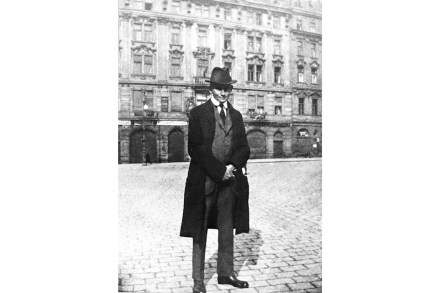
How do you see Franz Kafka? That is, how do you picture him in your mind’s eye? If you are Nicolas Mahler, the writer and illustrator of a short but engaging graphic biography of the man, you’d see him as a sort of blob of hair and eyebrows on a stick. The illustrations of Completely Kafka may look rudimentary, but they work. In fact they’re similar in style to the doodles Kafka himself would make in his notebooks. If you were Kafka, you’d see yourself as a spindly man, head on desk, leaning on your hands, arms bent, in a posture of defeat and exhaustion. That image is chosen for the cover of a translation by Mark Harman of Selected Stories.

Music was always Anthony Burgess’s first love

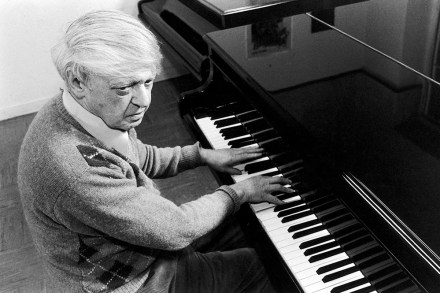
Anthony Burgess, a professional to his finger- tips, knew how to write an arresting first sentence. The locus classicus is his opening to Earthly Powers. But try this for size, a lapel-grabbing start of a piece about William Walton in The Listener: Waking crapulous and apothaneintheloish, as I do most mornings these days, I find a little loud British gramophone music over the (a) bloody mary and (b) raspberry yoghurt helps me adjust to the daily damnation of writing. Apo-what? I have just enough Greek to know that it’s something to do with death; a helpful footnote reminds us that ‘άπο ϴανεΐν ϴέλω’, or ‘I want to die’ are the closing words of The Waste Land’s epigraph.

Dark days in Wales: Of Talons and Teeth, by Niall Griffiths, reviewed

This book has taken me far too long to read, and not for the usual reasons (that it’s too long, it’s rubbish, idleness, I lost it, etc.) but because I could only manage ten pages a day before getting a kind of mental nosebleed. And that is because it is so good, so different. There is a note at the back from the publishers, of whom I had not heard: ‘Repeater Books is dedicated to the creation of a new reality.’ There follows some invective about capitalist realism in historical fiction and ends: ‘We are alive and we don’t agree.’ I would say that this book fulfils their brief admirably. We are in Wales at the dawn of the Industrial Revolution.

The real problem with ChatGPT is that it can never make a joke

I have been reviewing books for nearly four decades – starting in this very magazine – and over the years I have encountered some real stinkers. But this is the first time I can recall being reluctant to pick up the book because of actual physical nausea. Intellectual nausea I’ve had plenty of times. Give me a 900-page book of magical realism and that’s what I’ll get. But this time it metastasised into real queasiness. I’ll explain why. (Well, that is my job.) The odd thing is, Benny the Blue Whale starts amusingly enough.

Unfinished business in Berlin: The Secret Hours, by Mick Herron, reviewed

During the summer, I noticed a new noise coming from the crowd whenever Ben Stokes or another English player bashed or stroked the ball to the boundary. It wasn’t quite the cheer you’d expect; more an ahhhh of appreciation, as you would deliver to someone who is offering a masterclass in how to win a game when it has, to all intents and purposes, already been won. By the time I was about halfway through The Secret Hours, that was the noise I was making in my head, as new twists kept unfolding. And they did keep unfolding, if twists can be said to unfold, right up until the last page. Never has a work of popular fiction delighted me more.

Another tragic case involving medical incompetence and cover-up

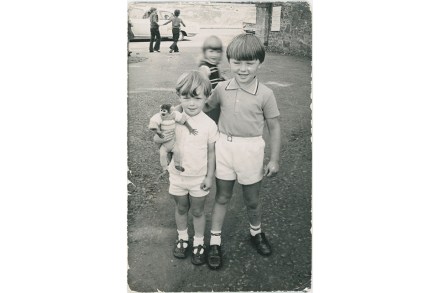
It was only eight lines into O Brother that I realised I was in the hands of a good writer. John Niven’s landline phone has rung. His partner hands it to him. ‘I take the phone from her as she watches me in the intense, quizzical way we monitor people who are about to receive Very Bad News.’ I can’t recall a writer noticing that before (I presume a few have), but we have noticed it ourselves. And the narrative masterstroke is that now the reader is looking at the page in an intense, quizzical way, for we want to know what the Very Bad News is. The VBN is that Niven’s younger brother Gary is in a coma, following a suicide attempt.

Tales of the unexpected: The Complete Short Stories, by Patrick O’Brian, reviewed

The publishers of this handsome volume hint at high adventure – and period adventure at that. In the blot left by an antique quill pen swirls a breaking wave. Ah, the high seas! And here we are again with Aubrey and Maturin picking weevils out of ship’s biscuits and foiling Napoleon’s naval plans. So I had better warn readers that this isn’t really representative. The first story in the collection, ‘The Return’, is about a man returning to childhood haunts and fishing for trout. The second, ‘The Last Pool’, is different in that this time the fish are salmon (although the protagonist starts out looking for trout).

M. John Harrison’s ‘anti-memoir’ is a masterpiece

It would be hard to categorise M. John Harrison as a novelist, and that is just the way he would like it. He may definitely have a foot in the camps of science fiction and fantasy – with fans including Neil Gaiman and the late Iain Banks – but he is not one for being pinned down, whether he steps outside those genres or not. Of his 1989 novel Climbers, he said: It isn’t about somebody who ‘finds himself’ through climbing, or who ‘becomes a climber’. It’s precisely the opposite of that: it’s about someone who in failing to become a climber also fails to find a self. And so we have now the self-declared ‘anti-memoir’, Wish I Was Here, whose splendid title tells us we are not in the territory of conventional memoir. The writing confirms this.

Judge Dredd: the prescience of a 45-year-old comic strip

In 1977, an enduring character was created for the pages of the IPC comic 2000 AD: Judge Dredd, lawman of the future, the most visible symbol of police procedure – a helmeted, black-clad, motorbike-riding policeman patrolling the streets of Mega-City One, a vast metropolis stretching along the eastern coast of the US, whose remit also allows him – as his honorific implies – to be an on-the-spot judge, jury and, when the occasion demands, executioner. The occasion often demands it. It is interesting that the two longest- running human cartoon characters in Great Britain represent opposite poles of the psyche. Their names both begin with D, for some reason or none. Dennis the Menace is all about anarchy; Dredd very much not so.

How hardboiled detective fiction saved James Ellroy

Public readings by James Ellroy would tend to begin like this: Good evening, peepers, prowlers, pederasts, panty sniffers, punks and pimps. I’m James Ellroy, demon dog of American literature, the foul owl with the death growl, the white night of the far right, and the slick trick with the donkey dick. My books are written in blood, seminal fluid and napalm. Etcetera. This is his ‘demon dog’ persona, adopted many years before as a way of overcoming his native insecurities. At school, Ellroy adopted a persona whose main shtick was expressing a fondness for far-right politics He is quoted in this biography as saying that this persona is ‘about 3 per cent’ of who he is. I would say, and I choose the adjective carefully, this is a conservative estimate.