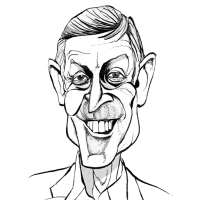
Matthew Parris

Matthew Parris

Matthew Parris is a columnist for The Spectator and The Times.

Another Voice | 30 August 2008

For five years I served on the Broadcasting Standards Council, and there I encountered a riddle whose resolution has eluded me. The BSC has passed into history. Its function was really just to exist, and by existing to provide politicians and broadcasters with a plausible answer to complaints of the kind made by the late Mary Whitehouse — a responsibility now assumed by other regulators. Our job was to censure rather than censor. We took it seriously. The required monitoring was hard work. But not always dull work.

Another Voice | 16 August 2008

If you or your chatmate are looking for a nilogism or mislexis, don’t wait till an earar At the beginning of the year I devoted this column to words that don’t exist. By that I meant things for which there ought to be a word, but there isn’t. This is itself, of course, one of them: we have no English word for the absence of what would be a useful word, should anyone care to coin one. Or, rather, we didn’t. We do now, because among the many suggestions sent in subsequently by readers of that column, there have been two proposals for ways of filling precisely this gap. The first is my own favourite: nilogism. There will be objections to this from purists, however, because it mixes Latin and Greek. A viable alternative comes from another reader: mislexis.

Another Voice | 2 August 2008

Until recently I never realised that triangulation had entered theology as well as politics. But listening to Thought for the Day on BBC radio the other day, it struck me that modern churchmen, too, are triangulating the deepest question of all in religion: the question of faith. Faith is now advanced as the triangulation between disbelief and certainty. An idea which has been developing for more than a century is close to becoming the accepted wisdom on faith. The idea is that not only is faith perfectly reconcilable with doubt, but that in some sense doubt is at the core of faith. Doubters are thus encouraged to believe that they have already reached first base in their journey, and their doubt has qualified them. They can see the chasm. Faith is the leap.

My A to Z of scare stories, from Anthrax to Zion (Protocols of the Elders of)

Matthew Parris provides an A to Z of things that at one point scared us rigid but the dangers of which now appear to have been greatly exaggerated.    Britain, says the poet Kate Fox, quoted on Radio 4’s Saturday Live last week, is a country ‘eternally poised between a hosepipe ban and a flood’. Or between fearsome, knife-wielding youth gangs and a teen generation of obese couch-potatoes. Knife crime is a horrible thing; and for offering the list of comparable scares which follows you may call me flippant. But in every case it was for a while true that what would have been thought flippant would have been to question the scale of each threat.

Another Voice | 5 July 2008

‘How the Guardianistas changed their tune,’ was the heading to a Sunday Times factbox published in the paper last weekend. The intention was to mock those Fleet Street columnists, erstwhile fans of Gordon Brown, who have turned against their former hero. ‘Only five more dreaming days until Gordon Brown’s coronation,’ the famously independent-minded and fiercely left-of-centre Brown loyalist, Polly Toynbee, was quoted as having written a year ago. ‘Brown’s first month looks like a striking success,’ Jonathan Freedland, always a thoughtful and progressive voice, had written a month later. Hopeful, trusting voices, both. No longer. ‘On current evidence he is simply not up to the job,’ thought Mr Freedland on 18 June this year.

Another Voice | 21 June 2008

It’s all too easy to leave Top Secret papers lying around — I should know News last week that police are investigating a ‘serious’ security breach after a civil servant lost top-secret documents containing the latest intelligence on al-Qa’eda sent a shiver of alarmed reminiscence down my spine. The unnamed Cabinet Office employee apparently breached strict security rules when he left the papers, in an orange cardboard folder, on the seat of a train bound for Surrey. It just would be Surrey. Apparently the papers were classified Top Secret. Mine were more secret than that. Top Secret isn’t the top secret classification — or wasn’t in 1976. There were (to the best of my recollection) two more secret grades above Top Secret.

Another Voice | 7 June 2008

There are no ‘good’ teachers: the teacher who is good for you may wreck another’s prospects The funny thing is that I’m not sure I ever knew her Christian name. No doubt she had one, and for no reason at all I think it might have been Jean, but to us she was so much, and so completely, Mrs McLeod that as a boy I probably imagined her husband called her Mrs McLeod at breakfast. Come to think of it, I’m not sure I even knew about a husband — but her title was ‘Mrs’ and there was a daughter, so I suppose she must have had one.

Another Voice | 24 May 2008

‘I’ll tell you, Janet, if I was 23 an’ ’ad a nice, good-lookin’ young man, I’d not be here on ’oliday with you. Don’t get me wrong — it’s been a lovely holiday — but let’s be honest. If I was your age and ’ad the chance, I’d be walkin’ along the beach, alone with my young man.’ I often wish I were Alan Bennett — or at least that I had his talent for overhearing real English spoken by real people, then stitching together what he has remembered into sustained prose, with weight, shape and a story.

Another Voice | 10 May 2008

‘You have reminded me, Mr Speaker, that for a minister resigning, permission to make a Personal Statement to the House is granted entirely at your discretion and should be of an explanatory nature. With the speech of the Noble Lord, Lord Howe, in mind, I too will keep mine short: to a thousand words. Members opposite will forgive me if the burden of what I have to say is addressed to my own party even if the implications are perhaps of interest to a wider audience. ‘I can no longer serve as a minister in this Cabinet. I have come to doubt I should have accepted office in the first place. I was unsure my party was doing the right thing last year in effectively replacing one prime minister with another without a contest either within our party or at the polls.

Another Voice | 26 April 2008

My heart bleeds for cold-callers — it must be the most depressing job in the world It’s always happening. It happened again last Friday. I had finished my Times column for Saturday and, taking advantage of the two hours left of daylight, fetched the wheelbarrow, pick and spade and set to work finishing the construction of a stone table outside our house in Derbyshire. But hardly had I started work than from inside the house I heard the telephone ring. Downing tools, running up from the garden, shedding gloves and kicking off boots I reached it, breathless but just in time. ‘Good afternoon, have you thought about a new kitchen? Our company would be happy to visit free of charge and give you a quote...’.

Another Voice | 12 April 2008

Boris must bore for Britain till he wins — and then shine like Tennyson’s dragonfly Boris Johnson is doing as well as I hoped and better than I expected. On this page at the beginning of August last year I was presumptuous enough to offer some advice for the man who looked certain to be the Conservative candidate for Mayor of London, but less likely than he does today to get the job. Not that he will have lost any sleep over such advice. Boris isn’t the type to pore over comment pages, thank God. He doesn’t give two hoots what people like me think. Besides, what I recommended was hardly original. But it was right, and reflected advice from many other quarters, including inside his team. Most importantly, it probably reflected advice from inside his own head.

Another Voice | 29 March 2008

Rather less than two years ago, bored and with time to kill at a Conservative party conference, I decided to do what is for a British journalist a rather unusual thing. I decided to read a whole speech, a long speech by a politician, a speech with no particular news value. I decided to read every word. The full text happened to be lying on my bed. I had taken it from a huge pile left largely untouched on the counter of the Press Office. It was Senator John McCain’s speech to the Tory conference. I knew that it had not caused much of a stir, had said nothing new, and that fellow-journalists had reported it as ponderous, overlong and dull. So I read it. And it was ponderous, overlong and often dull. Nor did the speech say anything surprising or new.

A willingness to believe anything

As I intend to dispute the entire thesis on which this little book rests, I should say at the outset that it is one of the best short contributions to an important argument I have ever read. Cleanly and crisply written, entertaining and clear, and packed with factual ammunition, Counterknowledge makes the ideal companion for any huntsman minded to go shooting down silly ideas. And Damian Thompson bags a whole cartload of them. Idiotic 9/11 theories, religious nuttery and creationism, Da Vinci Code-style false history, and homeopathy and ‘alternative’ medicine of every sort, fall flapping to the ground: victims of Thompson’s arsenal of information, unsparing logic and clear aim.

Is it worth the worry?

I first met Simon Briscoe when, as a young MP enjoying a summer evening by the House of Commons terrace bar, I observed a youth in a Refreshment Department staff uniform pelting a group of Thames ducks with dry roasted peanuts. ‘Could you sink one?’ I asked. ‘Thanks,’ he said: ‘a pint of lager and a packet of crisps if you’d be so kind.’ We fell into conversation. Briscoe had recently landed a coveted position as a graduate trainee at the Treasury, but for light relief was moonlighting as a glass-clearer over the road at the Palace of Westminster. He went on later to an investment bank, and now writes on statistics for the Financial Times.

Another voice | 1 March 2008

The truth about the Auschwitz ‘gimmick’ row is that Labour exploited Jewish sensitivities David Cameron, said the Times last Saturday, ‘was facing intense political criticism last night after including student “trips to Auschwitz” on a list of government gimmicks.’ The Daily Mail was more shrill: ‘Pressure was piling on David Cameron last night to apologise,’ said the paper. ‘Senior figures from the Jewish community expressed dismay after an attempt by the Conservative leader to attack the Prime Minister spectacularly backfired.

Another Voice | 16 February 2008

‘How was it,’ asks George Eliot in Middlemarch, ‘that in the weeks since her marriage, Dorothea had not distinctly observ-ed but felt with a stifling depression, that the large vistas and wide fresh air which she had dreamed of finding in her husband’s mind were replaced by ante-rooms and winding passages which seemed to lead nowhither?’ I cannot reread that passage without thinking of a more modern marriage: the Church of England’s with her latest Archbishop. Given the tremendous row, we really should read Dr Rowan Williams’s recent speech on Islam and the Law properly, from start to finish.

Another Voice

This January Prometheus paid our era a call. Scientists (it was reported at the end of the month) have ‘announced the creation of a synthetic chromosome, knocking down one of the final hurdles to building the world’s first artificial life form’. In Maryland, at the institute of an American biologist and entrepreneur, Craig Venter, a team are now working on the final step to ‘create’ life. They aim to transplant into a cell the synthetic DNA they create, in the hope it will ‘boot up’ the cell and take control of its growth and reproduction. At last. The breathing-into-clay of the Promethean fire; the insertion of the ghost into the machine.

Brown, like Major, is falling prey to the media’s habit of linking unrelated stories

Before Christmas, on the BBC’s Andrew Marr show, Sir John Major gave his thoughts on politics ancient and modern. Since leaving Downing Street Sir John has been sparing with his public appearances, and because he has always commanded personal respect and has a fair-minded way of talking, these occasional interventions get attention. The moderation of his language, however, should not distract us from the sharpness of his views. What attracted the headlines this time were Major’s pointed remarks about ‘sleaze’. He said that in the case of the present government, but not (despite media impressions) his own, sleaze had become ‘systemic’.

I oppose a ‘gay-hate’ law because that is not what criminal legislation is for

Should ‘gay-hate’ be a crime? Stonewall, the gay lobbying group of which I remain a solid supporter, has just sent me a briefing paper urging members to support Jack Straw, the Justice Secretary, in his proposals to make inciting hatred of homosexuals a criminal offence. The government is proposing new amendments to its Criminal Justice and Immigration Bill, adding ‘Hatred on the Grounds of Sexual Orientation’ to the offences of incitement to hatred on the grounds of race or religion. I’m not convinced. I was equally unconvinced it was appropriate to prosecute incitement to religious hatred. My doubts about that (relatively recent) arrival on the statute book were various, but among them was the suspicion that this would prove the edge of a slippery slope.

A guide to ‘gaffes’, and why, in truth, they are always to be found in the eye of the beholder

Among the silly expressions that may one day be associated with our era — and I hope buried with it — is the little word ‘gaffe’. I ought to know, having been indicted often enough myself for the crime, and having just co-edited and published a whole book, Mission Accomplished, of so-called gaffes committed by politicians and world leaders. Yet the moment you start to examine in a thoughtful way the things we call gaffes, the concept disintegrates into a clutch of very different types of utterances, some of which are wholly commendable. All that such utterances have in common is that they are regretted. I do not even say ‘regrettable’ because in politics honesty, though often regretted, cannot be regrettable.