Some withdrawal
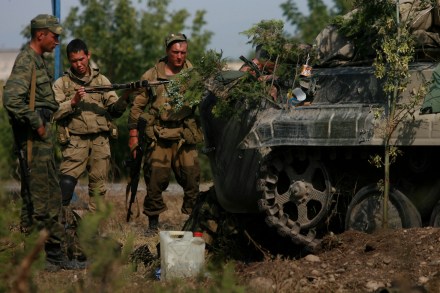
From The Washington Post this morning: Russian armored vehicles moved eastward from the town to a point about 30 miles from the capital, Tbilisi, and plowed aside Georgian police vehicles at a checkpoint.

James Forsyth is former political editor of The Spectator.
From The Washington Post this morning: Russian armored vehicles moved eastward from the town to a point about 30 miles from the capital, Tbilisi, and plowed aside Georgian police vehicles at a checkpoint.
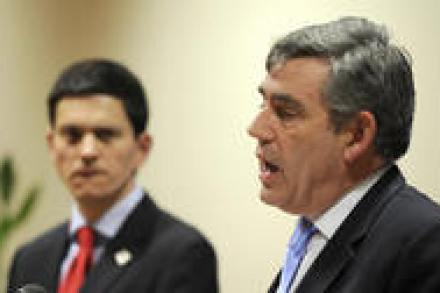
This morning’s ICM poll in The Guardian shows that David Miliband is no silver bullet for Labour’s problems: Cameron leads Miliband by the same margin, 21 points, he does Brown on the question of who would be the best Prime Minister. However, Miliband supporters will argue, as The Guardian’s editorial does, that Miliband’s ratings might improve as the public get to know him while the electorate has already made up its mind about Brown; August’s ICM poll shows that Labour under Brown has seen its support fall by 10 points compared to this time last year, while Tory support has risen by 10 points.
The latest Russian move in the conflict is to bulk up its forces in South Ossetia. The New York Times reports that the US believes that Russia has moved SS-21 missile launchers into position north of Tskhinvali, from there the Georgian capital of Tbilisi is in range. The Russians appear to be attempting not only to pave the way for incorporating South Ossetia into Russia but to exacerbate the fears of some European countries about admitting Georgia into Nato. To not let Georgia into Nato because of Russian aggression would send a disastrous signal to Moscow, encouraging Russia to believe that the West will back off in the face of Russian displays of force.

American public diplomacy is nowhere near as good as it should be. So, it is good to see Tim Montgomerie of Conservative Home fame taking on some of the myths that do so much damage to America’s reputation. The United States is neither a perfect nation nor a perfect ally but the world is a much better place for America’s involvement in it. America in the world will make that case and I’d urge you all to visit it.

Philip Webster reports in The Times this morning that Gordon Brown will begin his ‘re-launch’ tomorrow. Apparently, the Prime Minister is not inclined to reshuffle until October thinking that a reshuffle before then would not give ministers enough time to read themselves into their new brief before conference. It also appears that the Brownites will start a concerted push-back against the PM’s internal party critics emphasising how they are playing politics in a time of economic trouble, helping the Tories and are representative of a faction not the party at large. Meanwhile in The Guardian, Yvette Cooper issues the now traditional attack on David Cameron for ducking the tough questions and for the supposed contradictions in his policies.
It is heartening to see Britain doing so well at the Olympics but it is worth remembering that for all the excitement of the games, China has not abided by the commitments it made to allow a modicum of freedom of expression during the games. Take this story highlighted by Bill Keller: The pre-Olympics promises that attention would be paid to international norms of behavior went unredeemed. The New York Times’s Andrew Jacobs followed one citizen who decided to take up the government’s Olympic offer of designated protest zones for aggrieved parties who had filed the proper paperwork. Zhang Wei applied for the requisite license and was promptly arrested for “disturbing social order.

Last night, both John McCain and Barack Obama took questions from Rick Warren, the evangelical preacher, in a televised forum. The two candidates appeared separately with Obama going first. Obama’s performance was fine. He was, as Chuck Todd notes, a little rusty. At times his answers were rather ponderous and he was perhaps a touch too causal, it still seems odd to hear a presidential candidate using the phrase ‘screw-up’. He also, surprisingly, lacked a crisp answer to the question of why he wanted to be president. McCain, though, turned in one of the best performances I have seen him give. His answers were clear and he hit his political message effectively in nearly every one of them.

For obvious political reasons, David Cameron had to run a mile from Policy Exchange’s report on northern cities. But as John Rentoul argues in an excellent column in The Independent on Sunday, the report was actually right about certain things: the striking thing about the Policy Exchange report is that its analysis is broadly correct. It specifically said that Liverpool, Rochdale, Bradford and Sunderland were not "doomed". (This was reported by The Independent under the headline "Cities in North doomed, says favourite Tory think tank".) The report went on, however: "We cannot guarantee to regenerate every town and every city in Britain that has fallen behind. Just as we can't buck the market, so we can't buck economic geography either.
Barack Obama is widely expected to name his running mate in the next few days. He is now back from vacation and presumably will want to make the announcement before the Democratic convention which begins a week on Monday. The buzz is that Obama is going to go for someone with foreign policy credentials. Obama’s running mate will address the convention on Wednesday, a night billed as a Tribute to Veterans, Active Duty Military & Military Families. National security will dominate that day and it would be odd to have someone with no experience on the subject speak in primetime that evening. Yet, picking a foreign policy expert as his running mate would be a major mistake by Obama.

David Remnick, The New York editor who was the Washington Post’s Moscow correspondent during the collapse of the Soviet Union, has written a smart piece about Putin for the latest New Yorker. He concludes: “Putin is not Hitler or Stalin; he is not even Leonid Brezhnev. He is what he is, and that is bad enough. In the 2008 election, he made a joke of democratic procedure and, in effect, engineered for himself an anti-constitutional third term. The press, the parliament, the judiciary, the business élite are all in his pocket—and there is no opposition. But Putin also knows that Russia cannot bear the cost of reconstituting empire or the gulag. It depends on the West as a market. One lesson of the Soviet experience is that isolation ends in poverty.

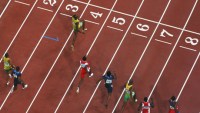
I’m not normally particularly keen on athletics, but Usain Bolt’s performance in the 100 metres final was awesome. (If you missed it, you can watch it here.) You don’t expect to see anyone coasting across the line to win the gold in the 100 metres let alone to break the world record.

A friend of Coffee House flags up an interesting post on Labour Matters which reports that as part of its autumn re-launch Labour might drop its “new Labour for Britain” slogan and replace it with “Your Labour, Your Britain”. The thinking is that this would emphasise the ‘on your side’ fairness agenda that will underpin Brown’s attempt at an autumn fight-back. It also suggests that Labour is planning a more populist strategy in an attempt to try and stoke up its base which as recent elections have shown is thoroughly disillusioned with the party. Dropping the ‘new Labour’ tag that Blair introduced would attract considerable comment. But Labour must be betting that it has got all it can out of the new Labour brand.

Gordon Brown’s team decided that they would take the Prime Minister off the airwaves over the summer. The thinking was that when Brown did return in September to roll out his economic plan the public would pay renewed attention. So, apart from an appearance at the Edinburgh books festival, Brown has kept pretty quiet. What the Brown team did not factor in or adjust for was an international crisis that would require the Prime Minister to play the part expected of a British Prime Minister on the world stage. So, Brown has ended up following not leading on the Georgia crisis both at home and abroad.
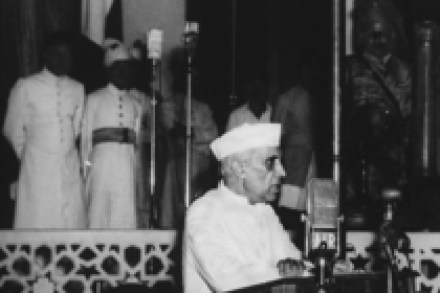
Today is the 61st anniversary of Indian independence and it comes at a time when the prospects for the country have never looked better. The country has reformed its economy and has grown, in real terms, at a rate of more than seven percent a year for the last decade. Indeed, there is a strong argument that in the medium to long term, India has better economic prospects than China. One of the issues that will shape this century is how strong the Indian-American relationship is. A strategic alliance between the world’s strongest and the world’s largest democracies would create in Asia—a continent that will grow even further in its importance in the coming decade—a phrase, a balance of power that favours freedom.
A truly significant government is one that makes changes that the other parties have to accept are part of a new settlement. That is why the Attlee and Thatcher governments are, rightly regarded as the most important governments since the war. At the moment—and it is still early days in policy terms, the only area where the Tories look like they would create a permanent shift is education where there planned supply-side reforms are truly and admirably radical. (If you haven’t, do read Fraser’s explanation of the thinking behind it). The test of the Tory’s schools policy will be whether it creates more social mobility in Britain. Michael Gove pointed out in his Evening Standard interview today that only 176 pupils on free school meals got three As at A-level.

David Cameron has stolen a further march on the government by heading out to Georgia before either the Foreign Secretary, who is going next week, or the Prime Minister. With Russian troops only 15 miles from Tbilisi, the Georgian government is keen for any signs of international solidarity and so Cameron can be assured of a warm reception. He will be there at the same time as a host of key players on the world stage—Condi Rice is in Tbilisi at the moment and several European leaders are expected there over the weekend—and his presence will highlight just how MIA Britain has been during the crisis to date. Amazingly, Miliband has yet to meet with the Georgian Ambassador to London. The trip furthers the impression of Cameron as the Prime Minister in waiting.
If Coffee Housers haven’t already read Bob Kagan’s The Return of History and the End of Dreams, I would thoroughly recommend that you do so. In only a hundred pages or so, Kagan explains why ideological competition is now a factor once again in great power politics and examines the probable consequences of Russia’s desire to reassert itself in its near abroad. Following Russia’s actions in Georgia this past week, the book seems particularly relevant. Yet another reason to read it is that Kagan is probably the most important intellectual influence on John McCain’s foreign policy thinking.
One of the trickiest decisions that Gordon Brown has to make is when to call the Glenrothes byelection. As Martin Kettle points out in The Guardian this morning, Labour can have the poll on any Thursday between September 11 and December 4—so either before conference or once the Autumn re-launch is under way. A byelection loss in Fife (and as Matt noted on Wednesday a Labour defeat is, at the moment, the most likely result) will be hugely embarrassing for Brown and will weaken his position still further, if Labour under Brown can’t win in Fife where can it win? A defeat before conference could persuade the party that however much it dislikes playing assassin it really does have to get rid of Brown.
The Policy Exchange report on northern cities has thrust the world of think-tanks into the spotlight—I’ll stand a round for any reader who can tell me when the last time the Daily Mirror devoted its lead editorial to a think-tank report was—and there has been a lot of talk about Policy Exchange’s relationship with the Tories but it is worth noting that the think tanks the Tories work with are more diverse than you might think. Jonathan Isaby pointed out yesterday that George Osborne is to deliver an agenda-setting speech at Demos, which was New Labour’s favourite think-tank back in the day. But that not’s the half of the relationship between the Tory Treasury team and Demos.

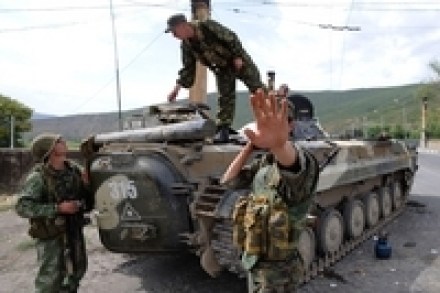
The New York Times reports that Russian troops are still in the key Georgian cities of Gori and Poti; reports about them handing over control of Gori to the Georgian police appear to have been premature. With US humanitarian aid also flowing into Georgia in US military transports, the likelihood of Georgia turning into a battle of wills between Russia and the West has increased. The New York Times, whose coverage of the crisis has been superlative, quote a senior Pentagon official describing the strategic thinking behind the Pentagon-led humanitarian mission thus: “to show to Russia that we can come to the aid of a European ally, and that we can do it at will, whenever and wherever we want.