James Forsyth

James Forsyth

James Forsyth is former political editor of The Spectator.

Dollar diplomacy

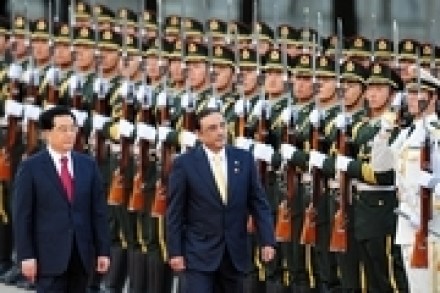
There is a fascinating story in the Washington Post today about how Pakistan is looking to China for $3 billion worth of emergency assistance. Pakistan, which is on the verge of bankruptcy, desperately needs funds but knows that in the current circumstances the United States is unlikely to come through. China with $1.9 trillion in

Brown ignored the warning signals

Some are saying that you can’t hold Brown in anyway responsible for the current situation because no one saw it coming. But as Martin Bright points out in the New Statesman this week, this simply isn’t true: “Brown’s assiduous biographer, Simon Lee of Hull University, noticed the warning signals contained in the report. He wrote

Too little, too late?

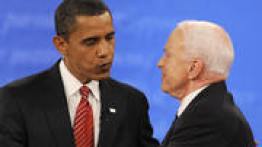
Last night, John McCain turned in his best performance of the debate season. He clearly distanced himself from President Bush, he drew contrasts with Obama on taxes and he appeared confident in his answers. In short, he did tonight what he needed to do in the first debate. (However, it should be noted that the

What should McCain do tonight?

Tonight is the last McCain-Obama debate and McCain goes into it needing a game-changer; three polls out today have him down by 14, nine and 10 respectively. To compound McCain’s problem, the economic news is so bad that it is virtually impossible for a message on any subject other than the economy to cut through.

The Canadian experience 

Tim Montgomerie, who spent a lot of time with the Canadian Conservatives during the campaign, has a good piece up on yesterday’s election in Canada which saw the Conservatives maintain their status as the largest party but fail to win an overall majority. The one issue I would take with Tim on is green taxes,

Will Brown be busted?

Daniel Finkelstein lays out the most eloquent case I have seen yet for why the current financial crisis will ultimately do for Brown: “Our view of the Brown decade is like the turkey’s view of mankind, utterly destroyed by what has now happened. The stability was a trick of the light, the lengthy period of

How Labour should behave

Sunder Katwala at Next Left, the Fabian Society’s excellent blog, has laid down some rules for how Labour supporters should act  during the current crisis: “1. Behave sensibly. At all costs, avoid triumphalism about an economic crisis, however well the Prime Minister handles it. 2. In particular, could anybody banging on about the Falklands please stop

McCain has put country first by not raising Rev. Wright

The civility cops have been giving John McCain a hard time for the tone of his campaign. But they are ignoring the fact that McCain has held back from using a political line of attack that could be highly effective because of what it could do to the country. Obama’s connection to Rev. Wright are,

Whither the euro

The financial crisis has partially revived the euro debate. Eurosceptics think that it might bring the whole thing down while those who favour British entry believe that they have found a new argument for it. To date, it has been the usual suspects making the case on either side. But today Simon Tilford and Philip

Sats for 14 year olds to be abolished

Ed Balls is making a statement to the House at 3.30 today in which it is expected that he will announce the abolition of Key Stage Three tests, those that are sat by 14 year olds. This is actually quite a canny move even if it does come in response to the whole Sats debacle

How the Tories plan to respond

Tim Montgomerie has an absolute must-read up on what the Tories are thinking about the current economic crisis and its impact on the political situation. Tim reports that the Tories believe that Brown’s weakness is that while he might have rescued the banks he has not rescued the real economy. The Tories are confident that

A good day for Gordon but the reckoning is coming

I suspect Gordon Brown let out a roar of delight on hearing that the US government has reversed course and is going to take an equity stake in nine of the banks that it is bailing out. This deviation from the Paulson plan brings the US response to the financial crisis more closely into line