Ian Sansom

Meet your makers

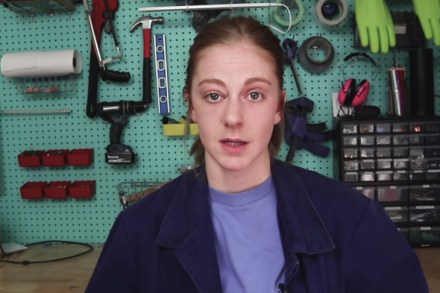
Older readers will perhaps recall the once popular Sunday evening TV programme Scrapheap Challenge, in which oily, boilersuited blokes competed to build machines out of materials scavenged from a scrapheap. Even older readers will recall The Great Egg Race, presented by Professor Heinz Wolff, in which bejumpered and bewhiskered engineers competed to build machines from materials scavenged from a BBC studio. These days, engineers and inventors call themselves makers, live and work on YouTube, are covered in tattoos and piercings, and the best of them are women. Laura Kampf posts videos about once a week. She makes bicycle sidecars and the sort of quirky furniture that probably seemed like a good idea at the time and goes down well in Cologne.

Smart, sardonic, delightful

Is there anything more depressing than the prospect of reading a writer’s collected essays, journalism and occasional pieces? Most of it is sheer dross, the work of the left hand, written under the cosh in double-quick time and for easy money. There are of course exceptions: Orwell, though even then you have to wade through a terrible lot of dreck; the late, great, much-missed Gilbert Adair; the New Yorker’s ever-so-sweet E.B. White; the definitive bouncing Czech Karel Capek (whose journalism was translated into English some years ago, published as Believe in People); and Marianne Moore, whose reviews are almost as astonishing as her poetry.

PewDiePie

The most subscribed to channel on YouTube — by far — belongs to a rather strange young Swede named Felix Arvid Ulf Kjellberg, better known as PewDiePie. Kjellberg has over 60 million subscribers, whom he refers to, alas, as the ‘Bro Army’. Most of his videos consist largely of him sniggering, putting on silly voices and making comments about other YouTubers. He is, of course, absolutely brilliant. For older readers, just imagine if Clive James on Television had been scripted by the Monty Python team, with the production values of Spike Milligan’s Q… Outside the PewDiePie cult, he’s more famous for his casual racism. When a clip of him using the N-word appeared last year many thought it should be all over for him.

Look back, face forward

You will by now doubtless be familiar with the University of Toronto academic Jordan Peterson. He’s the unlikely YouTube star and scourge of political correctness whose book 12 Rules for Life: An Antidote to Chaos has become a worldwide bestseller, beloved of serious young men seeking intellectual challenge and good old-fashioned fatherly advice. Summary: ‘Sort yourself out, bucko.’ We don’t really need the likes of Peterson here: we’ve got Ferdinand Mount. The book we should all be reading to sort ourselves out, buckos, is Prime Movers. Mount is, admittedly, an unlikely intellectual hero.

Hobbit houses and 3-D homes

Since 2006, someone called Kirsten Dirksen has been posting weekly videos on YouTube about ‘simple living, self-sufficiency, small (and tiny) homes, backyard gardens (and livestock), alternative transport, DIY, craftsmanship and philosophies of life’. But don’t let that put you off. Basically, Dirksen makes short films about people’s quirky homes: ‘Tiny Parisian rooftop terrace transforms for work and leisure’, ‘Extreme transformer home in Hong Kong’, etc. Fear not: this not some shoestring Grand Designs. There is little or no enthusing, there are no vacuous summings-up, there is no false jeopardy. The videos vary in length: some of them last for less than ten minutes, others for close to an hour. Many are in Spanish (with subtitles).

When content-creators fight

None of us is above YouTube, and nothing is beneath it. We have of course all long since submitted to a universal medium whose sole purpose appears to be the promotion of the universal below-average, but this doesn’t mean that there isn’t pleasure to be had from watching content created by so-called ‘content-creators’ whose created content is often pretty much content-free. Indeed,a large part of the obvious appeal of user-generated content is that it is generated by people who are just like you and me and who therefore make stuff that isn’t actually very good. We no longer marvel at skill. What we admire is chutzpah.

The spirits of the age

Children started knocking on my door last month wearing Donald Trump face masks and asking for money. Indeed, one enterprising group turned up as Trump, Kim Jong-un, a Disney Princess, and — I’ll admit that this had to be explained to me — a zombie Taylor Swift. Truly a quartet of contemporary horrors. Halloween, it is safe to say, is not what it once was: in my day, a gentle bit of apple bobbing, turnip carving and maybe a white sheet with holes for eyes at a fancy-dress disco was about the full extent of it. Ghosts and ghouls, it seems, change their appearance depending on time and place.

A choice of first novels | 3 August 2017

Remember Douglas Coupland? Remember Tama Janowitz? Remember Lisa St Aubin de Terán? Banana Yoshimoto? Françoise Sagan? The voice of your generation? (If you’ve forgotten the voice of your generation, the brilliant Christopher Fowler’s forthcoming The Book of Forgotten Authors will provide you with the necessary reminder. The voice of my generation, as far as I’m able to recall, was a poet called Attila the Stockbroker, who we used to go and see perform in Harlow, and who did an excellent Peel session. Whatever the hell happened to Attila the Stockbroker?) Three new debut novels might all properly be acclaimed as representing the voice of their generation — though who knows, only time will tell.

… trailing strands in all directions

Letters of Intent — letters of the intense. Keen readers of Cynthia Ozick (are there any other kind?) will of course already have copies of the books from which these often fiery essays have been selected. There’s a broad range of work represented here, from personal essays through to Ozick’s often rather profound philosophical enquiries into the meaning of art and religion — though the inclusion of no fewer than five essays on Henry James, two on Kafka, two on Virginia Woolf and two on Saul Bellow might make one wish for a little more breathing room, a little more room to roam. But this is a quibble. This is Cynthia Ozick, for goodness sake.

Dreaming of wide open spaces

On the website of the Australian National University in Canberra, emeritus professor of history Barry Higman lists his research interests as food sciences, cultural studies and historical studies, with a particular interest in The world history of food over the last 5,000 years; the global history of domestic servants in the modern world; the history of the Jamaican landscape; the history of Australia as a flat place; and the history of islands and insularity. This rather unusual breadth of interests suggests either that Professor Higman is a very curious man indeed or a complete academic fraud. Fortunately, for the sake of the future of higher education in south-eastern Australia, it’s the former. Flatness is the uneven, fascinating work of a true scholar enthusiast.

Flights of fancy | 9 February 2017

Michael Chabon’s back. He’d never gone away, of course — more than a dozen books in all — but it’s been a long time since The Amazing Adventures of Kavalier & Clay (2000), a book entirely true to its title, so amazing and adventurous, indeed, so full of pizzazz, that it seems to have taken the poor chap the best part of two decades to recover from it. Moonglow is a return to form. Nonetheless, some readers will doubtless find it easy to resist the book’s obvious charms. Chabon has described it in interviews as a ‘faux-memoir novel’. In his acknowledgements he calls it a ‘pack of lies’.

Port in any storm

Cometh the hour, cometh the book, and so Christmas brings us once again a tidal wave of titles relating to food and drink: cookbooks of seasonal dishes from around the world, never once to be consulted, and endless tomes of wine connoisseurship for all of us dedicated cheapskate consumers of Lidl and Aldi plonk. So the question is: are Thomas Tylston Greg’s Through a Glass Darkly and Henry Jeffreys’s Empire of Booze destined to last any longer than your turkey carcass and your festive case of supermarket Prosecco? Both books are undoubtedly charming.

All work, many plays

‘Krapping away here to no little avail,’ writes Beckett to the actor Patrick Magee in September 1969. To ‘no little avail’, note, not to ‘little or no’: there is a difference. It’s the difference that Beckett makes — I can’t go on, I’ll go on, and all that. This final volume of Beckett’s letters contains much krapping away to both no little and little or no avail. ‘Perhaps my best years are gone,’ remarks Krapp in the play, ‘But I wouldn’t want them back.

Smaller than life

For Jonathan Safran Foer fans and sceptics alike, Here I Am comes as a wonderful gift, a truly painful, honest book which purports to be about a lot of things but is mainly about one thing: the breakdown of a marriage between a whiny, self-obsessed Jewish novelist turned scriptwriter and his blameless wife. Whether or not Foer drew inspiration for the book from the much-publicised breakdown of his own marriage to fellow novelist Nicole Krauss I have absolutely no idea and care less. Like any fully functioning adult, good fiction outgrows its origins. Or at least it should. A large part of Here I Am concerns itself with the very question of what we owe to the past and to others.

A merry guide

If you have legs, or a bicycle, or indeed both, you are going to love this book. Chaps, no matter how old or how fat or otherwise incapacitated you are, if you haven’t already received it for Father’s Day the chances are it’s coming your way this Christmas. Ladies: if you are a fell-runner, a hill-walker or a budding Victoria Pendleton, pop this into your backpack or saddlebag with your energy bars and your old Ordnance Survey. Graham Robb — yes, that Graham Robb, the biographer and historian of all persons and all things French, and also the author of an excellent history of homosexuality, Strangers: Homosexual Love in the 19th Century (2003) — has written a book about British and Irish cols and passes. But wait: British and Irish whats?

Nothing quite adds up

Whimsy, satire and deadpan humour: welcome to the world of Andrey Kurkov. If you know Kurkov’s work, The Bickford Fuse will be no surprise and need no introduction. It’s not Death and the Penguin or A Matter of Death and Life (read them first), but it’s certainly Kurkov in welcome and familiar mode. For newcomers and to summarise: he’s really a kind of Ukrainian Kurt Vonnegut, a serious writer never more serious than when he’s being funny about unfunny things, and with a whole lifetime of unfunny things to be serious about. As the second world war was to Vonnegut, so the Soviet Union is to Kurkov. If — as Oscar Wilde believed — our duty towards history is to rewrite it, then Kurkov has long been working overtime.

The best British short stories — from Daniel Defoe to Zadie Smith

Philip Hensher, the thinking man’s Stephen Fry — novelist, critic, boisterously clever — begins his introduction to his two-volume anthology of the British short story with typical gusto. ‘The British short story is probably the richest, most varied and most historically extensive national tradition anywhere in the world.’ Take that, ye upstart Americans, with your dirty realism and your New Yorker swank! Read it and weep, ye Johnny-come-latelys! Look to your laurels, Chekhov and Carver. Jorge Luis Who? Maupassant? Bof! And there’s more — much much more.

The Marriage Plot by Jeffrey Eugenides

Jonathan Franzen. David Foster Wallace. Jeffrey Eugenides. Giant, slow-moving, serious writers, notching up about a novel per decade, all with their sights set on The Big One, The Beast, The Great American Novel. Wallace pulled it off, undoubtedly, with Infinite Jest in 1996, before ending it all by suicide in 2008 — a tragic loss. Franzen laid claim to fame — and earned himself the cover of Time magazine — with The Corrections (2001) and Freedom (2010). And now Eugenides, after The Virgin Suicides (1993) and Middlesex (2002), makes another attempt at literary immortality with The Marriage Plot. And fair play to him, he throws absolutely everything at it.

The divided states of America

A Mercy, by Toni Morrison You may or may not agree with the New York Times, which a couple of years ago voted Toni Morrison’s Beloved the greatest work of American fiction of the past quarter century. (What about Updike’s Rabbit novels, you might ask? Or Philip Roth’s American Pastoral? Or Marilynne Robinson’s Housekeeping? Or, or, or ...). And you may or not agree with the Swedish Academy’s citation, when Morrison was awarded the Nobel Prize for Literature in 1993, praising her ‘visionary force’. You may have struggled with the increasingly poetic and mystic drift of her recent novels, Jazz (1992) and Love (2003). But there is no denying that Toni Morrison is a writer to be reckoned with. Her new novel presents familiar challenges.

Another damned thick, square book

William T. Vollmann ruined my Christmas. But he also made my year. Like a fisherman scared by reports of mysterious beasts and monsters — Here be dragons! Gryphon! Basilisk! Unicorn! Serpent! — I’d been put off for a long time by Vollmann’s reputation as the great white whale of American fiction, the New Maximalists’ Maximalist, a kind of vaster, stodgier, blubberier David Foster Wallace. And Vollmann’s much discussed obsessions with prostitution, destitution, degradation — exhaustingly detailed in his many and often mega-books, from You Bright and Risen Angels (1987) right through to the seven-volume Rising Up and Rising Down: Some Thoughts on Violence, Freedom, and Urgent Means (2003) — are not my own. Frankly, I like nice.