Fraser Nelson

Fraser Nelson

Fraser Nelson is a Times columnist and a former editor of The Spectator.

Osborne accidentally makes the case for more savings

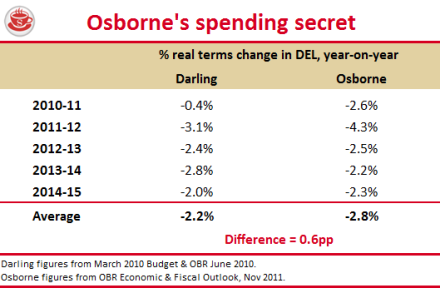
Rhetoric aside, what’s the difference between left and right in British politics? You won’t catch either party quantifying it, because the answer embarrasses both. The ever-cautious George Osborne is cutting just 0.6 percentage points a year more from government departments than Labour planned to (see table, above). The great joke is that the difference between the two parties is actually within the margin of error. Government is a gargantuan machine that just can’t be controlled to that degree of precision: a billion quid is, to Whitehall, a rounding error.   Today’s public finances have demonstrated that.

Balls the tax-cutter?

‘Balls urges tax cuts’, we’re told. Has he had a Damascene moment? Has the borrowed penny dropped? Nope, this is his longstanding and cynical campaign to cut VAT. Under the Labour years, when Balls was encouraging Brown to adopt a ‘scorched earth’ policy to the public finances, he urged against raising VAT to 20 per cent as Alistair Darling wanted. Not because he didn’t think it was necessary, but because he knew that if Darling didn’t do it, Osborne would. So VAT could be an election campaign tool, and then a stick with which to beat the wicked Tories (and the Lib Dems, who dropped the ‘VAT bombshell’ that they warned of). There is also politics: Tories prefer taxing consumption to taxing income.

Sales of The Spectator

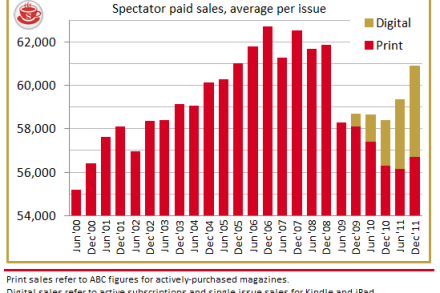
The Spectator’s figures are out today, and I’m delighted to say that they show sales growing at their fastest rate in ten years — driven by our new digital formats. The above chart shows how things are moving. I thought CoffeeHousers might like to know a bit more about how we in 22 Old Queen St see it all. The magazine industry, like the rest of print, is going through something of a revolution. Readers are migrating to digital alternatives like Kindle, as there is no waiting for delivery. Kindle addicts like having their magazines and newspapers waiting for them in their pocket, available to read any time. As our readers changed, so has The Spectator. Our Kindle edition is no.

A warning for Osborne and his economic agenda

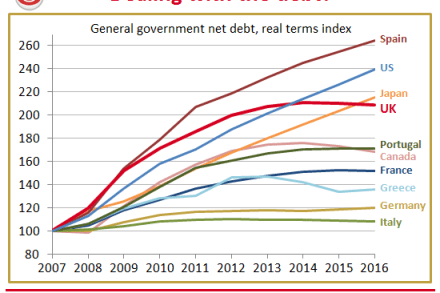
Why did Moody’s downgrade Britain to AAA with a negative outlook, but leave other countries on AAA? One crucial factor is the scale of our debt increase: 60 per cent over the parliament. You won’t find it mentioned much today. The Chancellor is talking about austerity, helped by Balls who talks about his harsh deep cuts. Osborne today swears to keep ‘dealing with the debt’ — but his definition of ‘dealing with debt’ would even make an Italian blush: As Balls said on the radio this morning, the plan isn't working. But Balls' narrative — that Osborne is cutting harsh and deep — is untrue, as Moody's knows.

Gotcha! | 13 February 2012

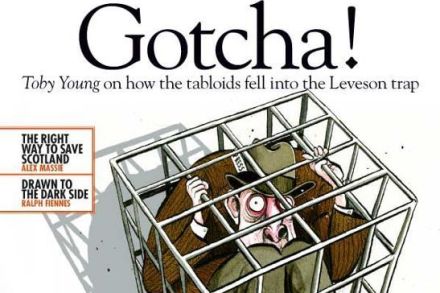
The Spectator's cover, a few weeks ago, borrowed one of The Sun's most famous headlines: ‘Gotcha’ — but, this time, with tabloid journalists caught in the trap. It was supposed to be a parody. But, this weekend, the Metropolitan Police arrested a further five journalists from The Sun using methods normally meted out to drug dealers: pulling them out of their beds, searching their houses for concealed evidence. No one has been charged, but all five are suspected of paying sources for information: i.e. ‘aiding and abetting misconduct in a public office ... and conspiracy in relation to both these offences.

Nassim Taleb: Ban Tesco bonuses

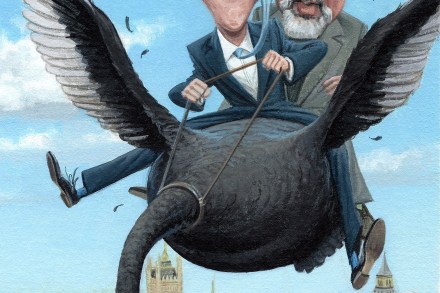
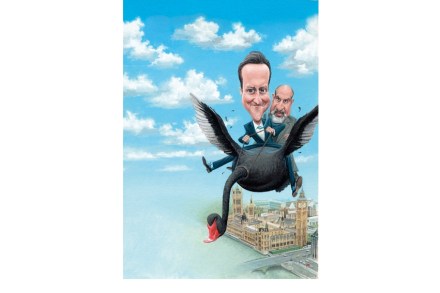
There have been precious few people able to make sense of the crash. The main commentators didn’t see it coming — and so have focused their energies stressing how no man born of woman could have predicted it. But Nassim Taleb did. He has been a voice of sense, originality and common sense throughout, and David Cameron has been listening. The respect is mutual: Taleb even described Cameron as ‘the best hope we have left on this planet’ because he understood the dangers of deficits. If CoffeeHousers haven’t come across Taleb’s books, such as Fooled by Randomness and Black Swan, I can’t recommend them enough. I met him recently, and published the interview in this week’s magazine.

Flight of the black swan

Nassim Taleb is banging a glass against a table to demonstrate his notion of ‘anti-fragility’. ‘This glass is fragile,’ he says. ‘Vulnerable to nasty surprises.’ The glass survives his test. ‘Now, what’s the opposite of fragile? Not “robust”, because robust things don’t respond to any surprise, nasty or pleasant. To survive shocks and be adaptable means being “anti-fragile”.’ He believes that David Cameron should remake the British economy with this idea in mind. Economists come up with such theories and soundbites all the time, but with Taleb there is a crucial difference. When he speaks, the Prime Minister listens.

Lansley’s battle should’ve never been fought

A small war has broken out over Lansley's NHS Bill — ConservativeHome has three Cabinet members attacking it. I find that shocking. At least a dozen want the Bill killed, and why ConHome found just three is beyond me. Politically, it's probably impossible for Cameron to drop it. But if it was torn up, I for one would shed no tears. For what it's worth, here's my take. It’s depressing to think that Alan Milburn’s NHS Plan of 2000 was both more radical and more sensible than what Andrew Lansley is serving up now. The whole debacle has shown politics at its most petty, partisan and pointless — a complete contrast to the coalition’s approach to school reform, which has been to fit rocket boosters to a very good Labour reform.

Our enemy’s enemy

It’s unusual for The Guardian and The Spectator to agree on anything, but Seamus Milne and our own John R Bradley are sceptical about these Syrian rebels whom we’re being invited to support. Bradley was alone in predicting the Egyptian revolution, and argues in today’s magazine that the conventional wisdom is once again wrong. Who’s backing the rebels? The Qataris, keen to depose the last secular regime in the Arab world. And the Saudis and Israelis, whose hatred of Iran eclipses all other considerations: this isn’t about the Syrian people, but about depriving the ayatollahs of an ally. Some in the West also take the view that the enemy’s enemy is my friend — so the rebels must be good eggs.

Lawson: Abolish DECC

Did we need to replace Chris Huhne at all? Nigel Lawson, a former editor of The Spectator (amongst other things), has an intriguing idea in a letter to today’s FT: just break up the Department for Energy and Climate Change. It has done nothing to encourage the development of shale gas, which — as we argue in a leader in tomorrow’s Spectator — could keep Britain in energy for the next 100 years without the need to build another windmill. Lord Lawson, a former energy secretary, says that Ed Davey: ‘...has the opportunity to enter the history books as the only minister to use his position to abolish it for the wider public good.

Don’t let’s be beastly to the bankers

The Twitter hashtag #BankerOutrage was launched by Radio Four yesterday summing up a very popular mood. It’s not unusual for bankers to be hated after crashes. After the South Sea Bubble burst in 1721, there were calls in the Lords for the bankers involved to be dumped in sacks filled with serpents and dropped in the Thames. But that was the immediate aftermath: what’s odd now is the timing. As we say in the leading article of this week’s Spectator, Hester had a bonus twice the size last year — and no one seemed to care. Now, it’s suddenly a crisis and Fred the Shred’s knighthood is a matter of urgency.

The strange survival of Labour England

Any CoffeeHousers with a taste for schadenfreude should read David Miliband’s article in the New Statesman. We have to move beyond big government, he declares. We need a growth strategy. I’m not sure if any Labour leader has ever argued otherwise: maybe, as Miliband implies, it has found one now. But, as I ask in my Daily Telegraph column today, what’s worse: a party that’s stuck in 1983, or a modernising movement that’s aiming for 1987? But talk to any Tory, and it’s hard to find any who think the 2015 election is in the bag. Four factors should prevent us from writing off Labour’s chances: 1) David Cameron is brilliant, but just not (yet) at winning elections.

CPS to announce tomorrow whether it’ll charge Chris Huhne

Keir Starmer, the Director of Public Prosecutions, will annouce at 10 o'clock tomorrow morning whether or not the Crown Prosecution Service will bring charges against Chris Huhne. If he is charged, it could spark a Cabinet reshuffle — the Energy Secretary is now odds on to be the next Cabinet member to leave, at 4/6 with Ladbrokes.

Sentamu for Canterbury!

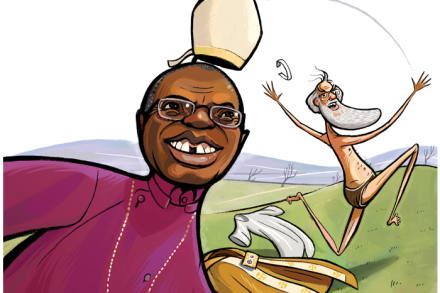
John Sentamu, the Archbishop of York, is our cover boy this week. It's the Church of England Synod next week, word is that Rowan Williams will be standing down soon, and Rod Liddle is backing Sentamu as his successor. When planning the headline, I thought about calling him the 'British Obama'. We didn't use this, as it's not a compliment — but if Britain is to have a figure who epitomises our country's inherent tolerance and open-mindedness I'd pick Sentamu above anyone else in public life. If he was made Archbishop, I really don't think there would be an uproar about the fact that he's black, or even that he came here as an Ugandan asylum seeker and still speaks with an accent.

Freedom for Shetland!

If Scotland can claim independence — and a 'geographical share' of the oil regardless of population — then why can't Orkney & Shetland? It's the Up Helly Aa festival in Lerwick tonight, where men dress up as vikings and set a longship ablaze. Not a very Scottish festival, but when your nearest city is Bergen how Scottish do you feel? Laurance Reed, a former Hebridean resident (and ex-MP), has a piece in this week's magazine pointing out that, by the Salmond doctrine, there is nothing to stop the Scottish islands breaking off, claiming the oil wealth and becoming the Dubai of the north. His piece is below. Freedom for Shetland!

A skewed response to a skewed question

‘A clear majority of people in Scotland now back independence, according to an exclusive poll for the Sunday Express. Using Alex Salmond’s preferred referendum question, the Vision Critical survey found 51 per cent would vote ‘yes’ with 39 per cent against. If such a dramatic result were repeated in the autumn of 2014, the First Minister would have an absolute mandate to negotiate an end to the Union with England.’ So runs the story. CoffeeHousers may have spotted two of the snags: the poll uses Salmond’s laughably loaded question, and seems to have been conducted by a chain of opticians.

My week in Westminster

I'm presenting Radio Four's Week in Westminster this morning, on deficit wars, London wars, welfare wars, and another set of wars which no one has really discussed yet: the directly-elected police commissioners. There will be about 40 of them elected in November, and candidates are already emerging: Nick Ross (ex-Crimewatch), Colonel Tim Collins and London mayoral hopeful Brian Paddick. I interview two names that have been thrown into the frame, both former ministers and both women: Jane Kennedy (Labour) and Ann Widdecombe (Tory). I wanted to find out just how excited we should be about these elected police commissioners.

Osborne needs to come up with radical growth policies, and soon

When it comes to defending the free market, and making the case for fiscal sanity, there's scarcely anyone better than David Cameron. He was on superb form in Davos yesterday, giving much-needed blunt advice to the continentals. ‘Eurozone countries must do everything possible to get to grips with their own debts,’ he said. And he's right. The snag, as I say in my Daily Telegraph column today, is that Cameron's definition of getting to grips with debt involves increasing it more than Labour planned to, more than France, Germany, Italy or Portugal. On the first sign of trouble, his government gave up on its deficit reduction timetable – it will now halve the deficit over five years, whereas Darling promised to do it in four.

Academies work, now let them expand

ARK Schools, one of the leading City Academy providers, has just released another amazing set of results with GCSE passes 11 percentage points higher last year than were achieved in 2010. This is staggering progress, given that these schools are serving the same neighbourhoods with the same demographics as the council-run schools which they replaced. It is also a reminder that the City Academy programme, started by Tony Blair and Andrew Adonis and expanded by Michael Gove, can claim to be the most rapidly-vindicated social experiments in recent history. The results of ARK’s schools speak best for themselves: ARK’s formula clearly works, and I’d like to see it applied to many more schools rapidly.

Osborne owes Darling an apology

Britain's national debt rose to over £1 trillion last month, and will never return below this threshold. George Osborne is increasing net debt by 61.5 per cent in real terms over this parliament, more than the 59.9 per cent which Labour proposed when it fought the last election. Here's how the OBR's current projections for debt contrast with what Darling proposed in his last Budget: At the time, Osborne said Labour's debt plan was reckless and unsustainable. I think he owes Alistair Darling a generous apology. Then, Darling said he'd halve the deficit over four years. Too slow, said Osborne. Now, he's taking five years to do it – as the below graph shows: Osborne has kept to his spending plans, which cut departmental totals by 2.