Fraser Nelson

Fraser Nelson

Fraser Nelson is a Times columnist and a former editor of The Spectator.

How to repair a free school – the next stage of Michael Gove’s reforms

Any government can set out on a journey of reform – the question is whether they can stay on course upon hitting turbulence. The coalition is entering this phase now. Its flagship reforms, universal credit and free schools, are encountering difficulty. We all know about the welfare problems, but not much attention has yet fallen on the nature of Michael Gove’s impending headache. I looked at this in my Telegraph column. There are now 174 free schools in England, and by this time next year it’ll be almost 300. Statistically, some of these are going to have problems – and this is the test for the government. If you were a venture capitalist and backed 300 businesses, how many would you expect to fail? You’d be lucky if it were as few as 30.

Why David Cameron’s ‘Northern Alliance’ may reshape Europe

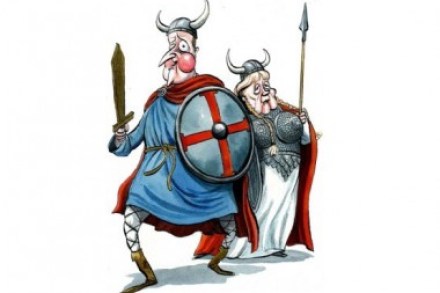
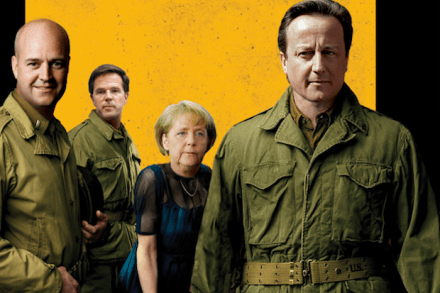
If David Cameron were to divide Europe up, he’d make some crude distinctions. There would be the basket cases, like Italy, Spain, Greece, France — examples, by and large, of how countries should not be run. Then there’d be the former Soviet bloc, sceptical about Brussels because they recently escaped a remote, controlling bureaucracy and don’t want to repeat the experience. Then come the good guys, the people with whom he intends to reshape the continent: the Germans, the Dutch and the Scandis. This is the group that the Prime Minister has started referring to as his ‘Northern Alliance’. Mr Cameron has, until now, had little interest in the machinations of the European Union.

Why Angela Merkel is part of Cameron’s ‘Northern Alliance’

[audioplayer src="http://traffic.libsyn.com/spectator/TheViewFrom22_27_February_2014_v4.mp3" title="Fraser Nelson and Stephen Booth discuss Cameron's Northern Alliance"] Listen [/audioplayer]For a Prime Minister seen to have no real interest or clout in Europe, David Cameron is doing pretty well – and far better than this morning’s newspapers suggest. He has built around him an alliance of reformers, which I describe in my Spectator cover piece today (and discuss in this week’s podcast). It is what Cameron calls a ‘Northern Alliance’: the Scandinavian states, plus the Dutch and Germans. His friend and conservative leader, Fredrik Reinfeldt of Sweden, is all up for reform.

Sales of The Spectator: 2013 H2

It’s that time of year again, where The Spectator's circulation figures are out – and our success continues. In October, I announced that we had more than one million unique visitors in a month. This week, we passed the 1.3 million mark with more than 3.2 million pageviews — something even I didn’t expect. Here’s how our analytics look: Interestingly, a quarter of our traffic now comes through social media. Another 26 per cent is from search engines, up from 20 per cent last year. Google, Twitter, Facebook and Flipboard are fast becoming the new newsagent – people can browse headlines, click what they like and discover for themselves that The Spectator is the (as Graham Greene put it) the best-written weekly in the English language.

Chuka Umunna fails to defend the economics of a 52p tax. But voters like it, he says.

How many FTSE 100 chief executives support Labour? How many FTSE 250 chief execs back Ed Miliband? Difficult questions for Chuka Umunna, Labour's Shadow Business Secretary, in his outing on the BBC's Sunday Politics today. Labour’s plan to jack up the top rate of income tax to 52 per cent (up from 47 per cent) has sent a fairly clear message about its attitude to business. Digby Jones, an ex-CBI boss who served in Gordon Brown’s government, has summarized Miliband’s position as: 'if it creates wealth, let’s kick it.' Stuart Rose, ex-M&S ceo, says the 50p tax borders on 'predatory taxation.' The head of the London Stock Exchange says Milband’s 50p tax (or 52p, when you count National Insurance) will deter entrepreneurs.

Mark Harper has brought back the concept of honourable resignation

Compare and contrast. We have Chris Smith, chairman of the Environment Agency, whose shortcomings can now be seen covering 23,000 acres of Somerset. And yet, when visiting yesterday, he did not say sorry (the word he used instead was ‘proud’). He says he sees no reason for him to resign, even when it is clear that the failures he has overseen have led to a spectacular catastrophe (we call for his resignation in this week's Spectator). Exhibit B is Mark Harper, who has just quit as immigration minister because he failed to spot that his cleaner had lied about having permission to work in Britain. She went to far as to produce papers saying she had indefinite leave to remain.

Why Britain can’t use foreign aid money to help Somerset

Should Britain’s foreign aid budget be raided to help homes hit by the flood? There are plenty calls for this today, making the splash of the Daily Mail (below). A local MP, Ian Liddell-Grainger, says:- "We send money all over the world now we need to give people down here the hope that they will get what they need. We should divert some of it down here. We don't have to divert it forever, but we need it now." But this demand is based on a misunderstanding of how aid money is allocated. David Cameron’s commitment to double the aid budget until it is equivalent to 0.7 per cent of Gross National Income has another caveat: that ‘aid’ will not be defined by him, but by the OECD.

Why condemn the US diplomat caught on tape denouncing the EU? She has a point

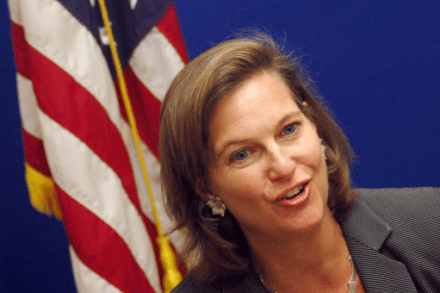
I have my criticisms of the Obama administration, but it does seem to have the right idea about the European Union’s diplomatic efficacy. His top diplomat for European and Eurasian affairs, Victoria Nuland, has been taking a lot of stick after she was caught on tape (or hacked, as we Brits would call it)  discussing the Ukraine problem with the US ambassador in Kiev, Geoffrey Pyatt. She was rude about the EU, but the condemnation of her language seems to have overlooked her central point. The EU has been trying to muscle in on talks about Ukraine’s pro-democracy moves. It could have helped by offering membership to Ukraine, but it prevaricated – and now wants to insert this prevarication into the negotiations.

It’s time to end the Liberal Democrats’ Fish Slapping Dance

Danny Alexander offers his 'dead body' to stop a non-existent tax cut. David Laws accuses Michael Gove of thwarting some imagined plan on school inspectors. Each day seems to bring a fresh attempt at Liberal Democrats finding a new reason to thwack the Conservatives – while the Tories cheerfully take it. Britain’s government is starting to look less like coalition and more like the Fish Slapping Dance from Monty Python (above) and in my Telegraph column today, I ask what the point is. I’ve come to respect Nick Clegg, and although CoffeeHousers will disagree, I regard him as an unusually decent politician who had wanted to build his opposition-loving rabble into a principled party championing British liberalism.

My night with White Dee – and Channel 5’s Big Benefits Row

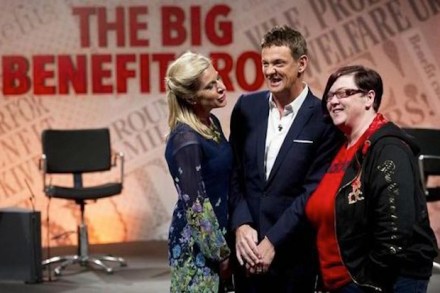
What do you get if you mix the Jeremy Kyle show with Question Time? Channel 5 tried to find out this evening in a one-off debate about welfare called the Big Benefits Row.  I was one of the 25 – yes, 25 - guests they asked along. Matthew Wright tried to keep the order, and the debate ranged (or, rather, raged) from the morality of benefits for immigrants to high MTR rates for welfare. It was more of a verbal explosion than a debate – you'd have working single mums screaming ('give me a job, innit!') at benefit-dependent single mum. Edwina Currie baiting the lefties, with visible enjoyment. Even a mini protest ('every mum’s a working mum') and Katie Hopkins who, with her ‘they're all scroungers!’ message, wound up the audience perfectly.

What the LibDems are up to

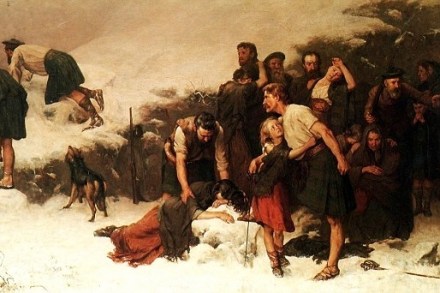
David Laws' attack on his former BFF Michael Gove is leading the news bulletins today, and rightly. Its wider significance lies in that the Liberal Democrats have decided it’s time to start picking fights not just with Tories in general but Michael Gove in particular. So Gove, having offered all that hospitality to David Laws, finds the guy he thought was his clansman wield the dagger on the instructions of his commander. This isn’t quite Westmister’s equivalent of the Glencoe Massacre, but the dynamics of the coalition have changed – in precisely the way that James Forsyth outlines in his political column this week. The LibDems' support halved soon after they went into coalition.

Sally Morgan is wrong: quangos are not stuffed with Tories

Sally Morgan’s claim this morning that No10 is trying to purge non-Tories from quangos doesn’t ring true to me. Last time I checked, Team Cameron was still putting Labour types into quangos, oblivious to the game that Labour has been playing so long for so well. Exhibit A is the egregious Chris Smith, a former Labour Culture Secretary who has somehow ended up chairing the Environment Agency (whose incompetence can now be seen covering 23,000 acres of the in Somerset Levels). In the Labour years, the Labour Party was very good at deploying its own people to charities and quangos – making a good government-in-exile to attack a Tory government for cuts, etc.

Dominic Raab is a brilliant fighter. It’s time he focused on Labour

Dominic Raab is one of the most impressive members of the Tory back benches, able to pick a string of good fights and – even rarer – able to win them. He’s a black belt and seems to regard politics as karate by other means. He’s a 3rd Dan in fighting and a 10th Dan in rebellion. But his latest victory – forcing the government into a humiliating climbdown over deporting foreign prisoners – was one too far. Thanks to Labour votes, his amendment failed so all he really achieved was embarrassing the Home Secretary. Yes, Raab can fight. Yes, he can win. But in my Daily Telegraph column today, I suggest it’s time for him (and other rebels) to stop.

Take note, Fiona Millar – you can’t close the class divide by closing private schools

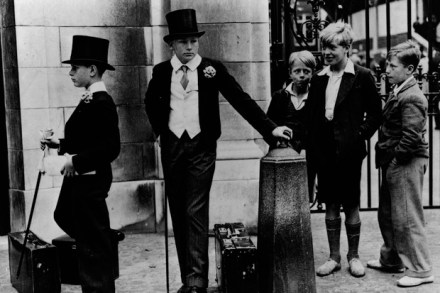
If there was a coalition to keep the poor down in Britain, Fiona Millar would be its chairman. If a wicked emperor were to seize Britain and want to make sure the rich held all the best jobs, he’d set up a system where there was a direct link between wealth and quality of education. He’d smile with evil content at what Chris Cook has revealed as the ‘graph of doom’ which shows such a relationship in British state schools. So we have designed a system of near-perfect unfairness. And yet, the people who are supposedly against inequality ignore this problem completely – and instead focus their ire on those reforming these state schools.

Why Ed Balls is deceiving us about his plans, and the 50p tax

Now and again, you have to ask: why did Gordon Brown get away with that massive government overspending that bequeathed such a calamitous deficit? The answer is that he dressed up his profligacy with technical-sounding language, and fooled everyone. Ed Balls thinks he can fool us again. He has told the Fabian Society today that he'd balance the 'current' budget – but that's only one part of government spending. (Investment is the other part, and he'd happily borrow for this.) But this caveat doesn't appear to have been explained to those reporting on his speech, and today's news reports wrongly declare that Balls would balance the books overall. (Only George Osborne has made this commitment.) So Balls gets the headlines, without having to make the commitment. Result!

Why Larry Summers is wrong about the British economy – and why George Osborne is right

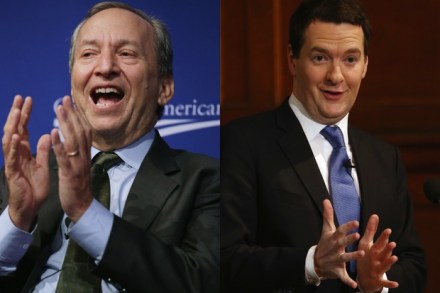
There was a spat at Davos this morning between George Osborne, the Chancellor, and Larry Summers, ex-US Treasury Secretary (and very occasional Ed Balls adviser). The gist of it was that Summers is not a fan of Osborne's austerity, and implied America's stimulus had allowed it to get back to peak GDP more quickly that austerity-struck Britain. Osborne was too polite to tell him what nonsense this is, but I’d like to show Coffee Housers two graphs that make the case. First, the stimulus. It was an abject failure, as readers of Nate Silver’s book, The Signal and the Noise, will know. US unemployment was running at 7.3 per cent at the time and White House economists said that, without a stimulus, it would go to 9 per cent. But with the stimulus, it would peak at 8 per cent.

Explaining the IDS vs Osborne split on welfare

‘Do you know what they used to call us?’ asked Theresa May ten years ago. ‘The nasty party.’ No one used that phrase, but ‘they’ had a point. The Conservatives seemed to be a group of efficient mercenaries, useful for fighting the economic war that broke out in the 1970s. But in the good times they seemed robotic, Spock-like and heartless. The message was: if you work, we’re with you. If you shirk, you’re the enemy. This was summed up by Peter Lilley’s infamous ‘Little List’ skit, above. ANd again in George Osborne's 2012 Tory conference speech, where he invited his audience to imagine the anger of a worker passing "the closed blinds of their next door neighbour sleeping off a life on benefits".

Charles Saatchi’s letter to Taki – I’m a cage fighter. Still want to insult me?

We're putting the new Spectator to press this morning, and we have an interesting reader's letter from Charles Saatchi. It's addressed to Taki, as opposed to the editor, and takes issue with his disobliging references last week. He has this to say: 'Dear Ms Taki [sic], Although the Spectator is a lovely read, I always skip your column, I'm afraid. I am simply not interested in your social life.  I know that you delight in telling readers that your friends of Prussian nobility find you hilariously entertaining company at their swanky Europoncy parties. But it was very hapless of you to spring to Nigella's defence last week, as she always found you toe-curlingly vile, and would have been aghast at having you as her valiant supporter.

Coming soon – the Bank of Miliband. Be very afraid.

If you think bankers do a bad job of banking, just wait until government tries its hand. This seems to be what Ed Miliband is proposing today: a Labour government would set up two new banks, to challenge the existing five big ones. And so his 1970s revival continues. There’s no evidence that new banks would help much, as the Bank of England Governor has already indicated. But as I say in my Telegraph column today, Ed Miliband isn't too worried about lack of evidence. He's proposing to be a different kind of political leader. His list of ‘predators’ – ie, nasty businesses to whom he promises to give six of the best - grows longer all the time.

Benefits Street exposes Britain’s dirty secret – how welfare imprisons the poor

[audioplayer src='http://traffic.libsyn.com/spectator/TheViewFrom22_16_January_2014_v4.mp3' title='Fraser Nelson and Frank Field MP discuss Benefits Street'] Listen [/audioplayer]No scandal has been more successfully covered up than the appalling truth about what happens to Britain’s poorest people. We have, as a country, grown used to pretending they don’t exist; we shovel them off to edge-of-town housing estates and pay them to stay there in economic exile. We give them welfare for the foreseeable future, and wish them luck in their drug-addled welfare ghettos. This is our country’s dirty little secret, which has just been exposed by a devastating Channel 4 documentary. And the left are furious.