Emily Rhodes

Life’s too short to read tedious books

‘My friend and I were working out how many more books we’ll read before we die,’ a customer said to me in the bookshop, the other day. ‘We read a book every couple of weeks, so we figured around 500.’ I rapidly did the maths. Twenty years. It seemed a little pessimistic for someone who can’t have been much older than fifty. Those of you who feel inspired to do your own calculations might feel depressed by how few books you’ve got left, or overwhelmed by how many you’ve yet to read. At 29 years old, I’m not so far from the beginning of my reading life and it feels quite uncanny to force an endpoint on something that I think of as continuing far into the future.

The Exiles Return by Elisabeth de Waal – review

The Exiles Return has been published as a beautiful Persephone Book, with smart dove-grey covers and a riotously colourful endpaper. Before this glorious incarnation, it existed for many years as a ‘yellowing typescript with some tippexed corrections’, one of the few things that Elisabeth de Waal held on to during her ‘life in transit between countries’, one of the few things eventually handed down to her grandson, celebrated author and potter Edmund de Waal. In The Hare with Amber Eyes, Edmund de Waal told the astonishing and very moving story held in his collection of netsuke, which was also passed down through the generations.

Books do furnish a room | 7 March 2013

The first time you run out of space for your books is a rite of passage for booklovers. It’s the moment that you realise the extent of your addiction to these papery worlds. It’s also a time of anxiously wondering what on earth you’ll do with all the books you have yet to accumulate. Double stacking, piles on the floor, and visits to the charity shop are really just temporary measures; the only satisfactory solution is to get a new bookcase. Ikea has just released colourful limited editions of their Billy bookcases – thrilling news for spatially challenged booklovers. There are three new styles of this bestselling piece of Ikea design: one has an orange background, another a blue, and the last features a queasy-making black-and-white pattern.

The birth of the Walking Book Club

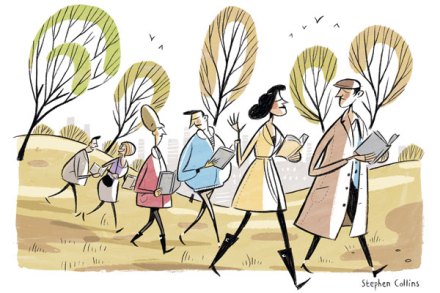
In they stride, in muddy trainers or wellies, swirls of cold air caught on their clothes, children in off-road buggies, dogs bedraggledly in tow. I’ve always been thrilled that so many of our customers at Daunt Books in Belsize Park and Hampstead come in fresh from Hampstead Heath. Growing up in north London, I’ve spent many an hour walking on this scrubby land, as wild as London will get. Every November I march a group of friends across the Heath for an ‘annual birthday stomp’; in the summer I swim in the icy ponds and laze in the hot grass afterwards. Many of my friends think I’m quite dotty for loving Hampstead Heath so much, so it was such a joy to find all these customers who not only shared my love of books but also of the heath.

Writing of walking

At 3pm this afternoon Radio 4’s Ramblings with Clare Balding will broadcast a programme about The Walking Book Club, to which Emily Rhodes belongs. ‘I love walking in London,’ said Mrs Dalloway. ‘Really it’s better than walking in the country.’ As a keen reader, writer and walker, I am always intrigued when an author writes a walk into their work of fiction. Clarissa Dalloway’s walk from Westminster to Bond Street at the beginning of Mrs Dalloway is one of Virginia Woolf’s most astonishing authorial feats.

A tale of HS2 cities

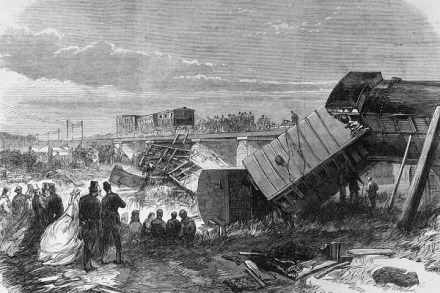
The route was unveiled this week for phase two of HS2 — and those who got hot under the collar about phase one (London to Birmingham) are furious again, on the same economic or environmental grounds. But perhaps they might rediscover some of the joy of a fast train if they read a little Dickens. In 1851, when Britain’s railways were being developed on rather a larger scale than today, Dickens wrote a short article about his trip from London to Paris by what was then considered to be high-speed rail. ‘A Flight’, as he called it, fizzes with excitement: ‘Here we are — no, I mean there we were, for it has darted far into the rear — in Bermondsey where the tanners live. Flash! The distant shipping in the Thames is gone. Whirr! … Whizz!

Some literary thirteens for 2013

I suspect I might not be the only one who finds it unnerving to be at the start of a year that features, so prominently, the number thirteen. 2013 – it feels like bad luck just to read it in my head, let alone say it aloud! But worry not, I have assuaged my fears by turning to literature. There are some remarkable books which make use of the number thirteen, making me think that this number can be better understood as a source of inspiration, rather than a bringer of bad luck. Most infamous must be Orwell’s 1984 with its opening line: It was a bright cold day in April and the clocks were striking thirteen. At least 2013 was rung in with just twelve strikes of the clock. How terrifying to be in a world where thirteen strikes is normal! (Of course the day would be in April, T.

Suzanne Collins, J.K. Rowling and the albatross of success

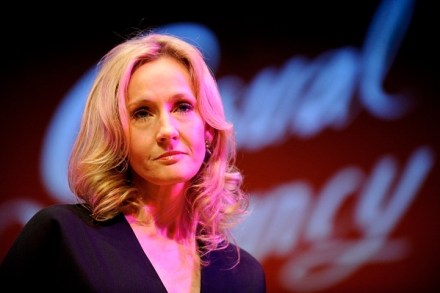
Suzanne Collins, author of The Hunger Games, has announced that her next book will be a picture book. Rather than writing a follow-up dystopian adventure for her teenage readers, she has decided to engage with four-year-olds in Year of the Jungle, a story about how her family coped when her father spent a year serving in Vietnam. Collins is not the only staggeringly successful children’s author who has taken an unexpected step away from her fan base with her writing. Whereas Collins is turning to younger children, J.K. Rowling turned to grown-ups with her recent adult novel about provincial life, The Casual Vacancy. Many Harry Potter fans were disappointed. While they didn’t expect wizards, magic and Hogwarts, neither did they expect such a grim, miserable novel.

The Wizard of Oz

The Conservatives’ next election campaign will be run by Lynton Crosby, an Australian whose success has earned him the title ‘The Wizard of Oz’. On examining L. Frank Baum’s classic children’s book, the nickname seems more pertinent than you might imagine. Lynton Crosby’s skill, according to Andrew Gilligan in the Telegraph, is not so much a genius for strategy, but the ability to ‘instil direction and confidence’. The Wizard has a knack for this too. When Dorothy and her companions return to the Emerald City to see Oz, having defeated the Wicked Witch of the West as bidden, his rewards for them would be useless if they didn’t have confidence in his power.

When ‘boycott’ isn’t quite the right word

Boycott Amazon was the message from Margaret Hodge MP in last weekend’s Observer. This comes in the wake of new revelations about just how little UK tax is paid by Amazon and other corporate giants Starbucks and Google. According to Conservative MP Charlie Elphicke, Amazon’s UK sales amounted to £3.9 billion last year, but it paid just 2.5 per cent tax on its estimated profits thanks to channelling sales through its Luxembourg HQ. There is a feeling that although it is legal, it isn’t fair that a company which has warehouses and employs 15,000 people in the UK doesn’t pay enough tax. Some argue that it is down to HMRC to tighten these tax loopholes so as to prevent multi-national corporations from taking advantage of them.

Poppy appeal

As Remembrance Sunday draws closer and we pin poppies to our coats, we can also see them adorning the jackets of books. This powerful symbol of remembrance features on the covers of many books about the First World War, which tend to be put on display at this time of year. The inspiration behind the remembrance poppy is John McCrae’s 1915 poem, which begins ‘In Flanders fields the poppies blow / Between the crosses, row on row’. The poppies are linked to the crosses of the graves, as though each poppy marks the place of a fallen soldier. They seem flimsy and delicate, ‘blow’ing in the wind, but in the final verse, ‘blow’ is replaced with the more optimistic ‘grow’.

Everyone loves a Penguin

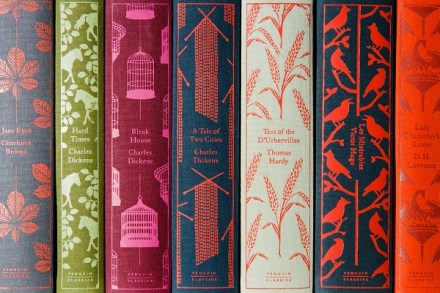
Markus Dohle, Chief Executive of Random House, must have had a long hard think about what a booklover could possibly treasure more than a Kindle. The answer is, of course, a Penguin. Everyone loves Penguin. Their paperback covers have become such a design cult that people flock to buy not just their books, but also bags, mugs, postcards, and even deckchairs, trussed up in Penguin livery. If Random House wants to stand up to the mighty Amazon, then this strong brand is a boost to their arsenal. Why else would Random House want to merge with Penguin? Last year Random House reported revenues of 1.7 billion euros, with an operating profit of 185 million euros. This year, they published Fifty Shades of Grey – a phenomenal money-spinner.

Something wholesale

I suspect that few – if any – of you have heard of Bertram Books. You could be forgiven for thinking that they are a lesser-known series of P.G. Wodehouse novels, but in fact Bertram Books is a book wholesaler, a large yet overlooked part of the book industry. It strikes me as peculiar that there is this invisible middle man between publisher and bookseller, known about by everyone in the industry, but by nobody outside. No one buying a book from a bookshop would have a clue that Bertram’s has been instrumental in getting it there. Most customers assume that books come to a shop directly from the publishers rather than via this third party.

Girls’ own

Everyone was so busy celebrating Hilary Mantel’s second Booker Prize victory last week that it was easy to overlook the announcement that another of our literary prizes has been saved from extinction. The Orange Prize had lost its sponsor — but has been rescued by a group of women sponsors, including Cherie Blair. It ought to be a matter of rejoicing — but the notion of a women-only prize is still deeply contentious. The usual complaint is that a prize for literature by women is patronising, outdated, and isn’t fair to men. Despite the fact that pretty much every prize discriminates against something in its entry requirements — be that nationality, age or genre — none seems to generate quite as much fuss as this one.

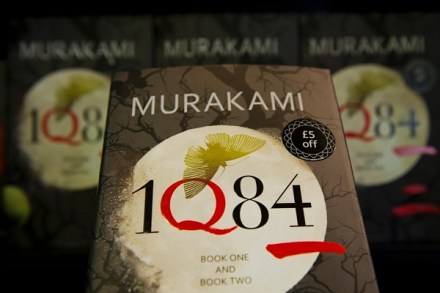
China bans Haruki Murakami’s ‘1Q84’: George Orwell would have seen the irony

Books – or lack thereof – are the latest manifestation of anti-Japanese sentiment in China. The escalating dispute over the Senkaku/Diaoyu Islands has provoked some Beijing bookshops to remove Japanese books from their shelves. The most prominent book to be made to disappear is Haruki Murakami’s recent novel 1Q84, a critically acclaimed worldwide bestseller. Rather ironically, given the circumstances, the title echoes Orwell’s 1984 – in Japanese, ‘Q’ and ‘9’ are homonyms. Orwell has an uncanny knack of turning up at the choicest moments. Remember the glitch in July 2009 when Amazon deleted 1984 from everyone’s Kindles?

What comes after Fifty Shades?

After the record-breaking success of the Fifty Shades trilogy, publishers are desperately trying to answer the multi-million dollar question, what comes next? What will all those millions of readers who have raced through Fifty Shades want to read now? With a depressing lack of imagination, many publishers seem to have landed on the answer of more erotica. Each week, more and more shiny paperbacks with suggestive covers, claiming they are ‘the next Fifty Shades’, arrive in the bookshop where I work. If this is the future of reading, then it is bleak indeed.

Second to the right, and straight on till morning

Much has already been written of the breathtaking, brilliant and slightly bonkers Olympics opening ceremony, but there is one more thing to say on a literary note. Just after we were treated to hundreds of dancing doctors and nurses, once the children were all settled down for the night, tucked in under their snazzy illuminated duvets, the camera snuck under one of the duvets to show a little girl, reading a book by torchlight. Reading under the covers was a wonderful part of my childhood, as I'm sure it was for many other book-lovers and the quotation from J.M. Barrie's Peter Pan, read aloud by J.K. Rowling, was an apt choice for this moment.

The Tortoise and the Lib Dems

The Lib Dems have been thoroughly ineffectual in the coalition. So much so that some of us — including Hugo Rifkind in this magazine — have asked why they bother to turn up for work. I wonder whether the Lib Dems press on with the coalition because they can’t face admitting to its failure. They are no better than an unhappy housewife, clinging to a loveless marriage because she believes she is happier trapped in a wretched partnership than on her own. If this is the case, then Nick Clegg would do well to read Elizabeth Jenkins’s 1954 novel The Tortoise and the Hare. Achingly sad, but ultimately uplifting, this elegant book captures every minute detail of a brutally failing marriage. Naive young Imogen is married to Evelyn, a domineering bully of a barrister.

Staycation reading

When it comes to choosing good books to read on holiday, I am a great believer in selecting reading matter to match the destination. What better to read in Sicily than Giuseppe Tomasi de Lampedusa’s The Leopard, for instance? And how wonderful to read Laurie Lee’s beautiful As I Walked Out one Midsummer Morning while in Spain. This school of thought can be taken to extremes — I even have a friend who chooses her holidays based entirely on what she wants to read. The only downside to this approach is that when summer stretches ahead of you with no sunny holiday on the horizon, then you feel not only like you’re missing out on a lovely trip, but also on the chance for some exotic reading.

Gone with the corsets

Painful, barbaric and Victorian are the words I think of when someone says corset, and yet these torturous contraptions are enjoying a resurgence in popularity. Rigby & Peller, Marks & Spencer and eBay all report a huge increase in demand — corset sales on eBay, for instance, have risen nearly 200% over recent months. It seems that more and more women are willing to sacrifice comfort for a corset’s sculpted silhouette, with its tiny waist and rather larger upper region. Ladies, before you lace yourself in, think back to Scarlett O’Hara in Gone with the Wind. Near the beginning of this enormous novel, Scarlett, bent on seducing Ashley Wilkes, decides to wear a low-cut green muslin dress with a tiny 17-inch waist.