Daniel McCarthy

Daniel McCarthy

Daniel McCarthy is a US columnist for The Spectator and is the editor of Modern Age: A Conservative Review.

Trump’s economic nationalism is an effort to save capitalism

From our US edition

This article is in The Spectator’s November 2019 US edition. Subscribe here. Elizabeth Warren looks like a deadly serious prospect for the Democratic presidential nomination. Bernie Sanders may never make it to that promised land, but there is no question that his spirit is still moving the Democrats toward democratic socialism. The party’s activist base and youth wing grow more anti-capitalist by the month. It’s enough to turn many a libertarian or Chamber of Commerce conservative into a Trump supporter, despite the president’s own defiance of free-market orthodoxy on trade. Yet the president might as well be Milton Friedman compared with some on the right who are, if anything, outflanking the left in their critiques of capitalism.

capitalism

Democrats don’t want to impeach Trump

Democrats are eager for the 2020 election to be defined by something other than the issues. The impeachment of Bill Clinton in 1998 is well remembered as a partisan fiasco. Yet the attempted impeachment of President Trump is off to an even more partisan beginning: Republicans in 1998 succeeded in winning over many House Democrats to support an impeachment proceeding. In yesterday’s House vote, Democrats did not convince even a single Republican of the merits of the impeachment inquiry—and two members of Nancy Pelosi’s own party voted against it. Yet Pelosi and Adam Schiff are determined, and with the Democrats holding more than a two-seat majority in the House, they succeeded in pushing the inquiry through.

The Democratic party’s post-Christian America

From our US edition

The new Pew report doesn’t mince words in its headline: 'In US, Decline of Christianity Continues at Rapid Pace.' In 10 years, the percentage of Americans who identify as Christians of any kind has declined by 12 percent. In 2009, just over 50 percent of Americans identified as Protestant; today only 43 percent do. Catholics have declined from 23 percent to 20 percent of the adult population. The biggest declines in Christian identification by demographic group have been among millennials (down 17 points) and Democrats (down 16 points). But dwindling Christian commitments are in evidence across all categories: 'white people, black people and Hispanics; men and women; in all regions of the country; and among college graduates and those with lower levels of educational attainment.

christian

Romney Republicanism could never win

From our US edition

This article is in The Spectator’s inaugural US edition. Subscribe here to get yours. As Donald Trump strides toward his fourth year in the White House, his enemies have yet to answer the most basic questions of 2016. Why is Trump president? Why not a nice Republican like Mitt Romney or Jeb Bush? Two maps tell the tale. The first is the obvious one, the map of states whose electoral votes Trump won, a map that includes states like Pennsylvania and Wisconsin that no other Republican presidential aspirant had won since the 1980s. But the second map is even more important — it shows not why Trump won but why the Republican party was doomed to lose without Trump and Trumpism. It’s the map of George W.

romney bush

Impeachment is regime suicide

From our US edition

The Democratic party and the chattering classes are playing a dangerous game with impeachment. Their are two modern precedents — Nixon’s resignation before his probable impeachment in 1974 and Bill Clinton’s actual impeachment in 1998. But neither is comparable to the contemplated impeachment of Donald Trump. All impeachments are partisan, but this one is in doubly bad faith: it has no chance of succeeding in removing Trump, and it has no chance of acquitting him in a way that will strengthen faith in the country’s institutions. The only outcome possible is to confirm for Democrats and Republicans alike the idea that 2020 is a regime-change moment, for reasons that go far beyond Trump.

impeachment rush

Impeachment is a bad bet for everyone

From our US edition

Is Donald Trump going to be impeached? Nancy Pelosi is not giving herself much room to maneuver: once a Democratic-led committee of inquiry is assembled, its results are a foregone conclusion. It will recommend impeachment — to fail to do so would only strengthen the president and make Democrats look stupid on the eve of an election. As things are, Pelosi evidently found the pressure from within her party already too great to withstand: her sense of the political risks of impeachment was outweighed by her sense of the danger to her own position from continuing to resist it. So the die is cast. Perhaps this tells us, too, that Joe Biden’s support for the Democratic nomination is dwindling behind the scenes.

impeachment

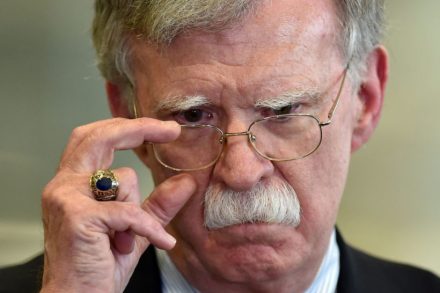
John Bolton is gone — Boltonism isn’t

John Bolton is out. It was a long time coming — Trump resisted hiring him in the first place, passing him over in favour of a military man, H.R. McMaster, at first. Bolton is a near-synonym for war and regime change, a hawk’s hawk. That was an obviously awkward fit for a president who got elected by campaigning against America’s Mideast wars. But just because John Bolton is gone doesn’t mean Boltonism is. Secretary of state Mike Pompeo is hardly less hawkish, just less principled. And Pompeo is the worse for mixing human rights-moralizing with his bellicosity: he represents an opportunistic confluence of humanitarian hawkishness and neoconservatism.

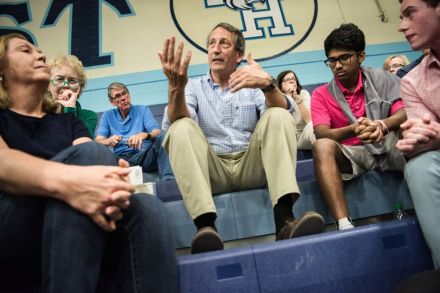
Mark Sanford’s hopeless politics of debt

From our US edition

Mark Sanford might not eat brains, but he is the closest thing in American politics to the living dead, an authentic Zombie Republican. His career died a decade ago when he was governor of South Carolina and absented himself from office for a few days to go off hiking the Appalachian Trail – or rather boffing the Argentinian mistress. He was censured, nearly impeached, but clung to office anyway until his term expired in 2011. And then, two years later, he shambled back to a familiar haunt, the US House of Representatives. Sanford began his brief national career as a Class of ’94 House Republican insurgent. And there he was again, nearly a decade later, after winning a 2013 special election.

mark sanford

Joe Biden won’t beat Donald Trump

Joe Biden has led Democratic polls since day one, holding the kind of consistent lead within his party that Donald Trump held heading into the 2016 primaries. The numbers say he will be the nominee. They also say he will beat Trump. They’re wrong: you should still bet against Biden getting the nomination or getting into the White House.  Biden himself knows that his age and state of mind are a problem, and Glenn Thrush’s recent New York Times story showed that Barack Obama knows it, too. “At some point” in 2008, Thrush reports, while Biden was on his way to becoming the Democrats’ VP pick, he “told Obama aides that ‘Barack would never have to worry’ about him positioning himself for another presidential run.

Liberalism cannot stop the shootings

From our US edition

What makes a young man pick up a gun, head to a crowded place, and shoot as many people as he can? Liberals have two answers to this question. First, the availability of guns is by itself enough to cause mass shootings. Some people will want to kill, and the guns let them do it easily. Second, young men are not liberal enough not to kill. They might be Donald Trump supporters, and if that isn’t the same thing as being a white nationalist – for a growing number of liberals, it really is – it is a kind of gateway drug, and the president’s failure to say what liberals want him to say, as often as they want him to say it, allows young men to be radicalized into killers. What could Trump say to stop these killings?

shootings

The Democrats’ stillborn revolution

From our US edition

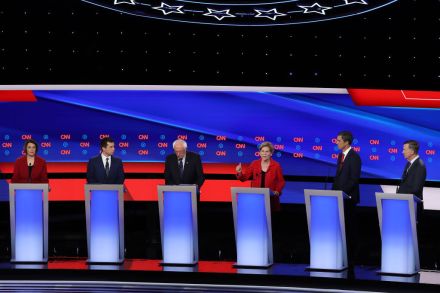
Like some Hobbit or Harry Potter film from 10 years ago, the Democratic debates this summer are so epic in length they must be divided into two parts, each an hours-long endurance test subjecting viewers to candidates 10 at a time, only two or three of whom per night have ever been heard of before. Tuesday’s most familiar faces were Bernie Sanders and Elizabeth Warren, the most left-wing of the serious contenders for the nomination. Pete Buttigieg and Beto O’Rourke were the almost-famous figures, the second-tier actors you know you’ve seen before but can’t quite place.

stillborn revolution

The nationalist surprise

From our US edition

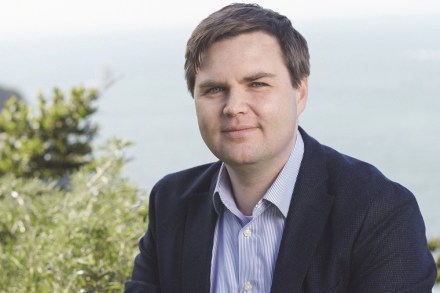
How many times do pundits with conventional sensibilities have to be surprised before they twig to their own blindness? They were surprised by Brexit. They were surprised by Donald Trump. And now, while they’re distracted by Donald Trump’s latest tweets, they’re setting themselves up to be surprised by another nationalist miracle — the wholesale replacement of the decrepit conservative movement by a new national conservatism. The press missed the story of this week’s National Conservatism Conference in Washington, D.C., an event organized by Yoram Hazony and his newly created Edmund Burke Foundation. The media hive mind had decided that Trump’s tweets were the axis around which political news must revolve for about 72 hours.

nationalist vance

Ross Perot was the populist who betrayed populism

From our US edition

Ross Perot, who has just died at age 89, is wrongly remembered as the man who cost George H.W. Bush his re-election in 1992. He should be remembered as the man who cost his own populist ideas their chance to remake American politics 20 years before the election of Donald Trump. Perot showed the promise of populism — then betrayed it, bottling it up for the next two decades. As far as Perot was concerned, if populism could win without him, it shouldn’t win at all. And so he made it as difficult as possible for anyone else — Jesse Ventura, Pat Buchanan, and yes, even Donald Trump — to build on what Perot achieved in 1992. And maybe Perot did cost Bush I his re-election, just not in the way most people think.

ross perot

Justin Amash is the anti-Ron Paul

From our US edition

Sometimes in politics you win without actually winning. Barry Goldwater and George McGovern, two candidates who lost in blow-out landslides to Lyndon B. Johnson and Richard Nixon, are the obvious examples. Johnson won in 1964, but it was Goldwater’s campaign that indicated where American politics was heading in the next 20 years. McGovern lost in 1972, but the 'acid, amnesty, and abortion' ideology that held him back at the time became, in only slightly diluted form, the regnant social orientation of the Democratic party from his day to our own.More recently, Ron Paul lost his two campaigns for the Republican presidential nomination — in 2008 and 2012 — but won anyway.

justin amash

The Democrats are too fake for 2020 

From our US edition

Joe Biden bled last night. Kamala Harris slashed him to ribbons over his opposition to busing and his kind words for long-ago segregationist colleagues. But Harris, who has a knack for turning left-wing dogmas into vivid images and personal stories, made only the most generic of pitches on her own behalf in her closing statement. Most of the other officeholders on stage were similarly uninspired. Bernie Sanders was a bracing alternative to Hillary Clinton four years ago. But his message is now just repetition—nothing makes him a different or better candidate than he was in 2016, even as the country has changed profoundly and the field of rivals he now faces is nothing like the one-on-one race with Clinton.

fake

After 30 years of bad wars, who thinks one with Iran will be good?

From our US edition

Don’t believe the hawks who tell you they don’t want a war with Iran. Instead, ask them if they’d go to war to stop Iran from getting nuclear weapons, or if they’d prefer war to peace if peace meant the mullahs’ regime could cling to power. War is a means to an end, and the hawks believe the ends of regime change and nuclear nonproliferation justify war, if it comes to that. Peace too is only a means to an end, and war is what happens when the means of peace are deemed insufficient.President Trump has a cooler head than most of his critics when it comes to nuclear weapons, as he’s proved so far with his North Korea policy. And North Korea actually has the bomb, which Iran is some distance from possessing.

bad wars

Is Roy Moore the post-Trump future?

From our US edition

When America’s educated elite imagines what the Republican party will look like after Donald Trump, whether he’s defeated next year or leaves office in 2025, they think in terms of the past. The Grand Old Party will once more be the party of Mitt Romney and the Bush dynasty, those formerly reviled figures now celebrated by the center-left as decent Republicans in contrast to Trump. They are the obvious and inevitable alternative to him. Aren’t they? If you don’t have Mr Hyde, then you must have Dr Jekyll. If you topple Saddam Hussein, then you obviously get a tolerant, pluralistic liberal democracy. America’s educated elite is not really in truth well-educated at all, and it has the moral sophistication of a Star Wars movie.

roy moore

Facebook is the world’s worst coffee house

From our US edition

Spectator USA is barely a year old, but its British parent has been around since the 19th century. Indeed, The Spectator’s pedigree is even older than that, as the magazine takes its name from an earlier, 18th-century sheet produced by Joseph Addison and Richard Steele. Today The Spectator’s British website harks back to the days of Addison and Steele in the name of its daily commentary department, the ‘Coffee House,’ for in the 18th century, coffee houses were the places where things like The Spectator and other specimens of what would later evolve into magazines and newspapers were usually to be found. Before there were newsstands or bookstores with magazine racks, there were coffee houses. ​Today Facebook is like the world’s worst coffee house.

facebook

America’s war games

 Washington, DC Trump, believe it or not, is smarter than the last two presidents, who started fires they couldn't extinguish Donald Trump has an itchy trigger finger, and his name is John Bolton. The President’s national security adviser is a lifelong war hawk who, unlike Trump, was a diehard supporter of the Iraq War. Now Bolton has Iran in his crosshairs. He’s not the only member of the administration drawing a bead on the mullahs. Secretary of State Mike Pompeo is also a throwback to the mentality of the George W. Bush years of high misadventure in the Middle East. But Trump, believe it or not, is smarter than the last two presidents, who started fires they couldn’t extinguish in Iraq and Libya.

The great folly of US-Russia misunderstandings

From our US edition

Vladimir Putin is not nearly as clever as American liberals like to believe. His meddling in the 2016 election backfired, after all — spectacularly. The Kremlin did not expect Donald Trump to win, just as no one in Washington did. If Trump had lost, the Kremlin’s gambit would have paid off: stolen emails would have damaged America’s newly elected president as she faced a hostile, Republican-controlled House and Senate. She could hardly expect cooperation from them on Russian sanctions or anything else, and the GOP could be counted on to react to another Democratic administration by adopting an oppositional foreign policy.

us-russia