Barry Humphries

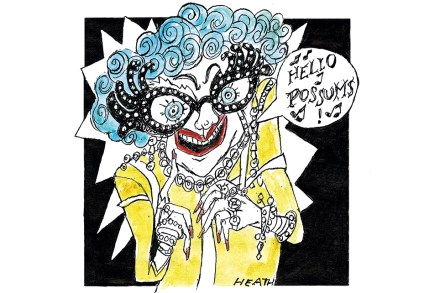
Barry Humphries was an actor, comedian and author. He was the creator of Dame Edna Everage and Sir Les Patterson.

Why does no one dress for dinner at Claridge’s any more?

Barry Humphries has died at the age of 89. This was his last diary for The Spectator in our 2022 Christmas issue. F.Scott Fitzgerald declared in an excellent late story that ‘the second half of life is a long process of getting rid of things’. It is certainly what I am striving to do. I have far too much stuff so I’ve decided a little culling is needed. Some weeding out imperative, deaccessions inevitable. I’ve started with books; I’ll end up with people and finish with me. I kneel on the floor of my book room with a large cardboard box at my side. Do I really need all those George Meredith novels?

Why does no one dress for dinner at Claridge’s any more?

F. Scott Fitzgerald declared in an excellent late story that ‘the second half of life is a long process of getting rid of things’. It is certainly what I am striving to do. I have far too much stuff so I’ve decided a little culling is needed. Some weeding out imperative, deaccessions inevitable. I’ve startedwith books; I’ll end up with people and finish with me. I kneel on the floor of my book room with a large cardboard box at my side. Do I really need all those George Meredith novels? Edgar Saltus is harder, but will I miss those duplicates of Purple and Fine Women and The Pace That Kills with the variant dust-wrapper and the misprint on page 43?

The Price of Fame

Try not to meet us in the flesh We’ll disappoint you if you do, Our dandruff and our garlic breath Are better tucked away from view. Try not to catch us off the cuff We’ll topple your romantic dreams Not concentrate or smile enough, You’ll see us parting at the seams. You hang our pictures, read our books Or watch us on the telly nightly, You’ve clocked our more despondent looks, Know if we’re straight, or gay, or slightly. Better to love us from afar Let distance tint your overview, Up close you’ll see how crass we are; How disappointingly like you. I learnt this lesson three years back, I sat in Hatchards signing books, A lady who had bought a stack Had flashed me several meaning looks.

Diary – 29 October 2015

I’m counting ‘Wows!’ Suddenly everyone is using this irritating expletive expressing incredulity, amazement and nothing at all. I’ve heard it from the lips of daughters in law, professors of literature, rabbis and housewives. No doubt at least one priest has said it after a particularly lurid confession. It is spreading like leprosy over ordinary discourse and will, in time, die out like ‘Zounds’ or ‘Gee whizz’. I wonder if it will turn up as an anachronism in Downton Abbey? I saw on television the other night a superb production of Priestley’s An Inspector Calls with great performances from David Thewlis, Ken Stott and Miranda Richardson. The adaptation was impeccable and no one said ‘Wow!

Barry Humphries’s diary: The bookshop ruined by Harry Potter

Do fish have loins? Last Tuesday, in a pretentious restaurant, I ordered a ‘loin of sea trout’. It looked just like an ordinary piece of fish — a bit small, as is usual in pretentious restaurants — on a plate sprinkled and drizzled as though the chef had perhaps coughed over it rather violently or vigorously scratched his head before giving it to the waiter. In Australia, I was once offered a shoulder of some other fish, so I suppose one might even be able to enjoy a rump of whitebait or even a saddle of flounder. But generally speaking I don’t mind loin when applied to the loinless, and somehow a loin of fruitcake sounds appetising, or even a loin of sourdough bread.

Barry Humphries: in praise of Australian art

In my career as a music hall artiste I travel the world, mostly in the Dominions, the United States and the cleaner countries of Europe. Aside from giving incalculable pleasure to thousands of people, I love, on my days off, to visit picture galleries: usually the porticoed kind, in search of those overlooked little masterpieces that lurk, not seldom, in provincial museums. Today, most art galleries have a shop selling postcards of paintings from other museums, Magritte oven mitts and Piero della Francesca fridge magnets. They sell books as well, sometimes useless coffee table tomes like Art Deco Cufflinks Down the Centuries and London Transport Textiles and Their Creators.

Diary – 11 April 2013

Whenever feminists have complained in my presence about neglect of female high-achievers, other than rock singers and courtesans, I always like to mention brilliant Margaret Thatcher. It always makes them furious. They can’t bear to think of her as one of the most successful women of the 20th century. I had afternoon tea with her and Denis once in their chintzy flat at No. 10, where she expressed a great interest in Rupert Murdoch, whom she rather admired. My father-in-law, Stephen Spender, was also a Maggie fan and once, after he had delivered a speech about Henry Moore at Westminster Abbey, she repeated the whole speech back to him at the party afterwards word for word. Tragically her prodigious memory failed her in the end.

London Notebook | 1 November 2012

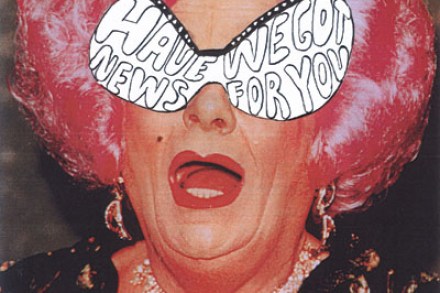
What is a real woman? My difficult client, the Australian gigastar Dame Edna Everage, is seriously miffed at BBC’s cancellation of her forthcoming appearance on Have I Got News For You. She flew from Australia especially to record this show, installing herself, as usual, in the Oliver Messel suite at the Dorchester Hotel at her own expense, but the producer changed his mind yesterday and politely gave her the shove, claiming that the show only featured ‘real people’. The insult is all the more hurtful since she has, in the past, done Desert Island Discs and published a volume of autobiography which was always listed in the ‘non-fiction’ category. ‘Not a real woman!’ the Dame spluttered to me on the phone last night.

Diary – 2 June 2012

Whenever, in an idle moment, I dip into one of my own books, I am almost immediately consumed by an unstoppable fou rire. It is immodest of me to make this confession, but I find my own work irresistibly funny. It pleases me to know that other more illustrious authors whom I admire are also deeply amused by their own books. Kafka, Max Brod tells us, always exploded with laughter while reading aloud from his own desolate tales. Ronald Firbank cackled uncontrollably while writing his orchidaceous novels and D.H. Lawrence, not famous for his sense of humour, laughed often and not seldom inexplicably at his own writings. Even the saurian countenance of Samuel Beckett was creased with laughter as the author contemplated his own sardonic playlets.

Slovenia Notebook

Last week I headed to Maribor in Slovenia for a music festival featuring the Australian Chamber Orchestra under the directorship of maestro Richard Tognetti, the virtuoso violinist. I even briefly performed a couple of Edith Sitwell poems to music by William Walton, but my efforts were at the beginning and end of a long programme featuring the New York avant-garde of the Sixties, including a work by John Cage which contained a long movement of complete silence disturbed only by the sound of the audience leaving. I think I once read that Cage believed there to be three different kinds of silence required by his music: the silence of expectation, the silence of appreciation and the silence of paralytic boredom. I’m not sure about the last.

An Australian in Lautrec’s Paris

The remarkable career of Charles Conder At the small but distinguished exhibition at the Courtauld Institute — Toulouse-Lautrec and Jane Avril (until 18 September) — we glimpse many of the habitués of the Moulin Rouge with the exception of Charles Conder. A marginal figure in at least four works by Lautrec, he is also the subject of a fine portrait drawing at the Art Gallery of Aberdeen. Conder was born in London in 1868 and as a child went to Australia with his parents. He showed an early aptitude for art and at the age of 15 was employed as an illustrator for the Sydney Morning Herald.

Christmas Notebook

I felt immeasurably old this morning in Sydney when a youth on a bicycle yelled at me in the street ‘I love your body of work!’ I returned the flattering salutation with the modest smile I keep for such occasions, but my fan had already pedalled into the traffic. I felt immeasurably old this morning in Sydney when a youth on a bicycle yelled at me in the street ‘I love your body of work!’ I returned the flattering salutation with the modest smile I keep for such occasions, but my fan had already pedalled into the traffic. But it was the first time that my not inconsiderable achievements as a music-hall artiste had been publicly described as ‘a body of work’.

Diary – 20 June 2009

Los Angeles I have just spent a hippocentric few days on a horse ranch in Santa Barbara County, California. I was the guest of my friend Monty Roberts, the inventor of horse whispering. Monty first developed ‘Join-Up’ to stop the cycle of violence typically accepted in traditional horse-breaking. His methods still infuriate traditionalists who believe that cruelty is the only way to domesticate horses. I have never been in the least horsey, having taken a flyer as a boy when a nag that was supposed to be almost comatose took off and launched me over a fence. I was so grateful to find myself intact after this misadventure that I decided, then and there, never to risk my skeleton again in hazardous athletic practices.

San Francisco Notebook

I am in San Francisco where I began an American theatrical adventure ten years ago. It is a beautiful and stylish town but it is impossible to enjoy a stroll in the city centre without being pestered by beggars. Not seldom hostile, these pungent tatterdemalions seem to be accepted by the locals as though they existed, like the cable cars, Alcatraz and the Golden Gate Bridge, in order to lend their city its special identity, as did the flower children of the Sixties. During the big sales last week, the walk from Saks to Neimen Markus was like struggling through a crowd scene in Les Misérables. Marie Antoinette populated her park with faux milk maids, shepherds and picturesque peasants, and a whimsical 18th-century grandee — was it Beckford?

Christmas notebook

The trouble with living in London is that apoplexy is always just around the corner. A few weeks ago my telephone developed a funny sub-aqueous rustling noise sufficient to drown all conversations, so after a few stiff cups of tea, and setting aside several hours for the task, I phoned BT to have it fixed. The next day a nice man appeared with a name a bit like a Sudanese teddy bear, and within a mere hour had found and fixed the problem — a corroded wire outside the house. He departed smiling into the sunset, having refused a £10 tip. The next day we realised that in fixing the problem he had cut off all extensions within the house: the bedroom, the kitchen, the office, all except the sitting room.

London Notebook

Only the most venerable and knowledgeable London cab driver has heard of Belsize Circus, a roundabout near the slums of Kilburn Heights where I have my lodgings. During the second world war many bombs fell nearby but, as was the case with most of London, the worst damage by far was wrought after the war by local councils and town-planners. This morning I saw a massive new building arising on the site of an innocuous petrol station. It is already so transcendentally hideous it could only have been enthusiastically approved by Camden Council. It claims to have been put up by something called the Notting Hill Housing Association and is emblazoned in huge rainbow letters with ejaculations like ‘Hello! Affordable! Smile! Unusual and curious!

Diary – 10 November 2007

When will the Americans withdraw? I don’t mind how long they stay in Mesopotamia but it’s high time they got out of Grosvenor Square. They’ve been muttering about relocating their embassy, but will it happen? Mayfair, my favourite English village, is ruined by their barricades, tank traps and miles of concrete Toblerone. Grosvenor Square and surrounding streets are becoming impenetrable and it looks as though there are going to be more hideous constructions and obstructions judging by the builders’ sheds and huts that are proliferating in this once tranquil square. Perhaps they should relocate to the old BBC Television Centre in Wood Lane. That is also an area more convenient for terrorists, who would find Mayfair a bit of a schlep.

Diary – 25 August 2006

SydneyI am here to announce a new stage show. When last here I was having breakfast in a harbourside café with a composer friend and I was just telling him about a particularly vile freelance paparazzo who haunted the area. Suddenly I saw the glint of a telephoto lens across the street. It was him! Emerging from the restaurant at a brisk pace I saw the wretch jogging towards me, grey ponytail threshing and camera rampant. He got so close I could smell the morning drink on his breath. The spirits of Russell Crowe, Sean Penn and Kate Moss suddenly inhabited me, and in trying to brush aside the intrusive Nikon, my knuckles accidentally collided with the photographer’s pulpy jowl, causing his trendy wire-rimmed spectacles to skitter on to the road.

Diary – 12 May 2006

When the gifted Australian actor Russell Crowe threw a telephone at an American hotel desk clerk, I sent him a letter of congratulation. As one might expect in a wonderful but barmy country like America, the desk clerk became an overnight millionaire. I have just completed a 15-week theatre tour of the US, so I have been in a lot of hotels and been tempted in nearly all of them to maim, and possibly even disembowel, arrogant illegal aliens loitering behind computer screens at the front desk, or impersonating waiters, or gender non-specific ‘servers’, as waiters quaintly prefer to be called.

Diary – 17 December 2005

If I die I hope it won’t be in Melbourne. The chief obituarist of a Melbourne morning paper takes a dim view of me, and since the London Daily Telegraph pioneered the custom of pissing on the recently deceased, the Melbourne obituarist is pretty likely to do the same to me. A couple of years ago he wrote an autobiography in which he impugned my patriotism in a rather nasty way. It’s quite a fat autobiography, as are usually the memoirs of uninteresting people — the women who talk longest on the telephone are invariably women who have nothing to talk about.