Alice Loxton

Alice Loxton is a historian and author of Uproar! Satire, Scandal and Printmakers in Georgian London, out now.

Starmergeddon? How the locals will change Labour

35 min listen

This week: Lara Pendergast is joined by Tim Shipman, Lionel Barber and Alice Loxton, author of Eleanor: A 200-Mile Walk in Search of England’s Lost Queen.  They unpack Michael Gove’s cover piece which asks whether the local elections will push Labour further to the left. As the Greens threaten Labour in its metropolitan heartlands and Reform eats into its working-class vote, is Keir Starmer facing a battle for the soul of his party? They also consider the collapse of the political centre, the weakness of Britain’s current leadership class, and why being ‘not Keir Starmer’ may not be enough. Also this week: King Charles’s diplomatic triumph in Washington.

Starmergeddon? How the locals will change Labour

Alice Loxton: Eighteen – A History of Britain in 18 Young Lives

40 min listen

My guest on this week’s Book Club podcast is the historian Alice Loxton, whose new book Eighteen: A History of Britain in 18 Young Lives is just out in paperback. In it, she tells the story of the early lives of individuals as disparate as the Venerable Bede and Vivienne Westwood. On the podcast, Alice tells me about Geoffrey Chaucer’s racy past, what Bede was like before he was venerable, and why her editor wouldn’t let her take her characters to Pizza Express. She also reassures me that – in a post-Rest is History world, where history is more exciting and accessible than ever – there is still a place for the fusty old historians.

James Heale, Angus Colwell, Alice Loxton, Lloyd Evans, Richard Bratby, Christopher Howse and Catriona Olding

38 min listen

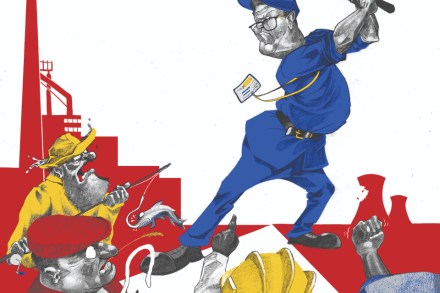
On this week’s Spectator Out Loud: James Heale analyses the splits in Labour over direction and policy (1:27); Angus Colwell asks if the ‘lanyard class’ are the new enemy (6:21); Alice Loxton explains why bite-sized histories have big appeal (9:58); Lloyd Evans reports on how Butlin’s is cashing in on nostalgia (15:00); Richard Bratby on Retrospect Opera, the non-profit record label that resurrects the forgotten works of British opera (20:40); Christopher Howse provides his notes of typos (27:27); and, Catriona Olding reflects on the death of her partner, the Spectator’s Jeremy Clarke, two years ago this week (32:15).  Produced and presented by Patrick Gibbons.

The real Brexit betrayal, bite-sized history & is being a bridesmaid brutal?

44 min listen

The real Brexit betrayal: Starmer vs the workers‘This week Starmer fell… into the embrace of Ursula von der Leyen’ writes Michael Gove in our cover article this week. He writes that this week’s agreement with the EU perpetuates the failure to understand Brexit’s opportunities, and that Labour ‘doesn’t, or at least shouldn’t exist to make the lives of the fortunate more favourable’. Michael makes the argument that ‘the real Brexit betrayal’ is Labour’s failure to understand how Brexit can protect British jobs and industries and save our manufacturing sector. Historian of the Labour Party Dr Richard Johnson, a politics lecturer at Queen Mary University writes an accompanying piece arguing that Labour ‘needs to learn to love Brexit’.

The short history of short histories

My friend Ruby recently started a TikTok channel called ‘Too Long Didn’t Read’. With boundless enthusiasm and a colourful wardrobe, she prances around Hampstead Heath, summarising classic novels in 60 seconds. The channel ‘sums up anything ever written so you can talk about it to your mates’. Ruby is not alone in her approach of offering such educational digests. Scan the tables at Hatchards in Piccadilly and you will find endless shortest histories, or – for brevity’s sake – ‘shistories’. Popular formulas include ‘The Shortest History of …’, ‘A Brief History of … or ‘A Little History of …’.

Labour’s growing pains, survival of the hottest & murder most fascinating

43 min listen

This week: why is economic growth eluding Labour?‘Growing pains’ declares The Spectator’s cover image this week, as our political editor Katy Balls, our new economics editor Michael Simmons, and George Osborne’s former chief of staff Rupert Harrison analyse the fiscal problems facing the Chancellor. ‘Dominic Cummings may have left Whitehall,’ write Katy and Michael, ‘but his spirit lives on.’ ‘We are all Dom now,’ according to one government figure. Keir Starmer’s chief aide Morgan McSweeney has never met Cummings, but the pair share a diagnosis of Britain’s failing economy. Identifying a problem is not, however, the same as solving it.

Hugh Schofield, Igor Toronyi-Lalic & Michael Simmons, Lisa Haseldine, Alice Loxton and Aidan Hartley

37 min listen

On this week’s Spectator Out Loud: Hugh Schofield asks why there is no campaign to free the novelist Boualem Sansal (1:26); The Spectator’s arts editor, Igor Toronyi-Lalic, reacts to the magazine’s campaign against frivolous funding and, continuing the campaign, Michael Simmons wonders if Britain is funding organisations that wish us harm (8:00); Lisa Haseldine reflects on whether the AfD’s rise could mean ‘Weimar 2.0’ for Germany (17:08); reviewing Thou Savage Woman: Female Killers in Early Modern Britain, by Blessin Adams, Alice Loxton explores the gruesome ways in which women killed (25:05); and, from Kenya, Aidan Hartley reflects on how a secret half-brother impacted his relationship with his father (35:13).  Produced and presented by Patrick Gibbons.

The gruesome fascination of female murderers

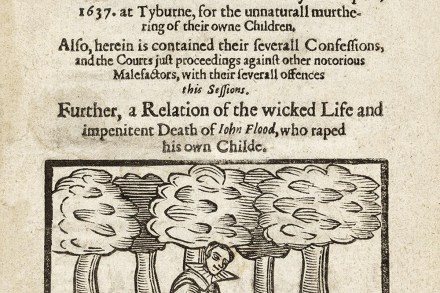
On 27 January 1688, Mary Hobry, a French midwife living in London, strangled a man to death. The corpse lay in her bed for several days before she carved it up. Then, in the dead of night, she used her petticoat to drag the dismembered body through the neighbourhood – Castle Street, Drury Lane, Parker’s Lane – to be disposed of. The torso was dumped on a rubbish heap; the legs, arms and head were tossed in a cesspit. What did Mary think, I wonder, as she tiptoed home, finally rid of her husband? The secret was not to last long. Within hours the evidence was uncovered, sending the West End into scandalised uproar. When the head was found, covered in excrement, it caused a ‘great noise’ to erupt in the streets.

A-level day is not Judgement Day

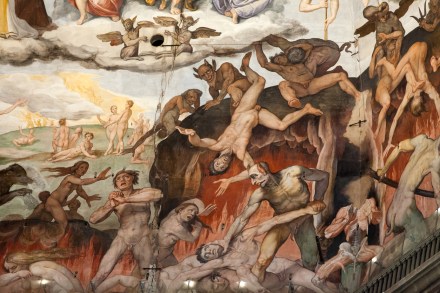
The Guild Chapel in Stratford-upon-Avon presents its congregation with a vision of terror: a medieval Doom painting depicting the Day of Judgment. On the left are those who have behaved themselves – the Saved – who joyously bound towards the gates of Paradise. On the right, sinners pay the price for falling short of the moral mark: they are tortured by demons and fed into the Mouth of Hell, to be swallowed by a fanged serpent. This summer, another Day of Judgment looms. Yesterday, thousands of UK 18-year-olds will receive their A-Level exam results. In one nervous scroll, years of schoolwork was validated, university places confirmed or denied, and future careers seemingly mapped out.

The making of Good Queen Bess

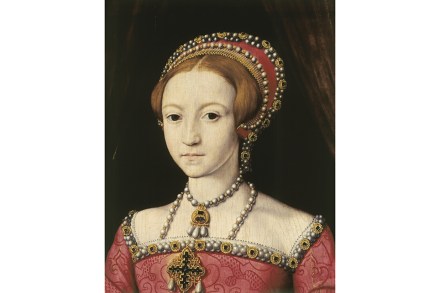
In the course of British history there have been few royals with a childhood as traumatic as that of Elizabeth I. She endured the torment of her mother Anne Boleyn’s execution, her father’s death, the comings and goings of four stepmothers, sexual abuse from a stepfather (who was executed soon after), the death of a half-brother, imprisonment and the death of a half-sister before finally acceding to the throne. All this by the age of 25. Throughout her young life, Elizabeth veered from sole inheritrix of the crown to hated bastard child Not many could cope with such a relentless identity crisis. Throughout her young life, Elizabeth veered from sole inheritrix to the crown to hated bastard child.

Historian’s notebook: What the Dean of Westminster would save from a burning Abbey

Last Wednesday morning, the Cellarium Café of Westminster Abbey was filled with excitable French visitors. It was the press preview of Notre-Dame de Paris, The Augmented Exhibition. ‘What do you make of our croissants?’ I ask the sharp suited French curator. ‘Comme ci, comme ça’ he chuckles, taking another bite. While Notre Dame undergoes restoration following the 2019 fire, its stewards have toured the world via an immersive digital exhibition, now doing a stint in the Chapter House of Westminster Abbey. With an iPad-like device in hand, visitors become une mouche sur le mur of major events in the cathedral’s story: the 12th century building site, Napoleon’s coronation, Viollet-le-Duc’s creation of the iconic 19th century spire.

Historian’s notebook: Chaucer’s questionable fashion sense

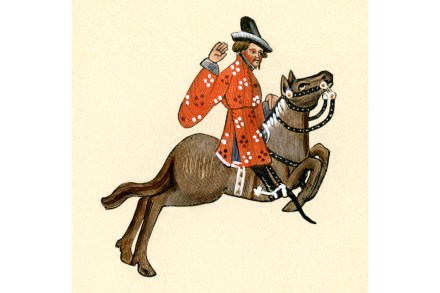
I am chatting to Jon, an ex-tree surgeon from Derby, in one of the galleries of the British Museum. He became an amateur metal detectorist when his wife, Julie, gave him the kit on Valentine’s Day a few years ago. ‘Our honeymoon to Barbados was cancelled because of Covid’, he explains, ‘so this present was the trade-off’. It has proved a source of marital bliss: Jon adores his new hobby, and Julie enjoys ‘weekends of peace’.  How remarkable that these objects have spent centuries lying forgotten underground until – Beep! Beep! A few months ago, Jon pulled a strange, curved object from the sandy Staffordshire soil, which at first he thought was an aluminium drawer handle.

The English have always loved gossip

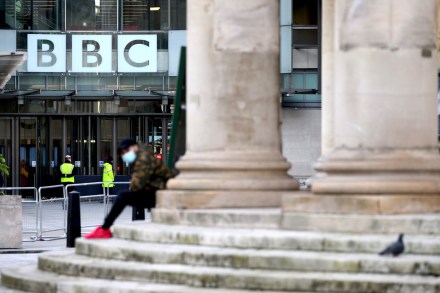
Our national conversation is overwhelmed by tittle-tattle, rumour and gossip. Last week, a salacious email listing George Osborne’s alleged improprieties was circulated among the Westminster bubble. Inevitably, it was then circulated to everybody else, too. Meanwhile, the internet is aflutter with rumours about the identity of a BBC journalist who’s alleged to have paid a teenager tens of thousands of pounds for sordid pictures – and this isn’t even the first sex scandal involving a broadcaster this year.  Foreign visitors were amazed at this insatiable desire to ridicule the private follies and foibles of high society Some might think our modern obsession with grubby tales shows a lack of seriousness. But a love of gossip is nothing new among the English.