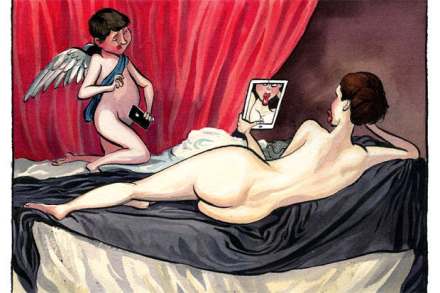
Dating

A novel that will make you want to call social services

Nina Stibbe has a way with children. Her first book, a memoir, was a deceptively wide-eyed view of a literary Hampstead family observed in all its turbulence by the teenage Stibbe, working as the nanny. Written as letters home to her sister, Love, Nina won over fellow writers and critics; reviews spoke of a quirky, life-affirming comic genius. Now she’s written her first novel, and again she has the domestic arena in her sights. Man at the Helm is a wicked anatomising of a dysfunctional family seen through the eyes of a nine-year-old narrator. Think What Maisie Knew with laughs and four-letter words, plus a touch of The Young Visiters

How to shop for the apocalypse

 New York City An architect friend who usually designs Manhattan skyscrapers was recently asked to pitch for a far more interesting project. The client, a senior partner at Goldman Sachs, wanted him to design a family house in upstate New York with a difference. It wouldn’t just be completely ‘off the grid’, with its own power and water supplies, but — and there isn’t yet an architectural term for this — it would be post-apocalypse. The conventional house would be mirrored below ground with pretty much identical living quarters that would be completely secure and so self-contained that there would be facilities to hydroponically grow plants and vegetables without soil.

Dear Mary | 7 March 2013

Q. Every morning I walk to work and stop to pick up a cappuccino from a local café outside which is invariably sitting a (handsome) man, alone apart from his dog, having breakfast. We always say hello and I sense that he likes at least the look of me, but there is no opportunity to say anything else. He must live locally but I don’t know who he is, and I can’t ask the people who run the café as they don’t speak English. I can’t sit down with him at the one table outside as that would be far too obvious (and too cold). I can tell he is

The woman on the airport bus

By jogging from the railway station to the grim concrete underpass outside the arrivals terminal, I caught the last courtesy bus from bus stop K to the budget hotel with seconds to spare. Cheapskate that I am, I was glad to be spared the humiliation of being charged £20 by a cynical cab driver to be taken the long way round the one-way system to a destination less than a mile away. Which is what normally happens to me at Gatwick. I was tired after a long journey and the issue had assumed an importance in my mind that was perhaps disproportionate. So my euphoria at seeing hotel bus number

Low life | 28 February 2013

Neil Clark’s wonderful piece three weeks ago, ‘Running out of sweeties’ (The Spectator, 16 February), has lingered in my mind. He pointed to a type of Englishness characterised by kindness, eccentricity and a complete absence of malice, which used to be known, he said, as ‘sweet’. Like rare and delicate flowers, our nation’s sweeties are facing extinction, he claimed, in the harsher economic and social climate. These holy innocents see no evil, hear no evil, speak no evil, and are always the first to volunteer, yet today’s rigorously equal society allows them no room. Sad. I’ve known sweeties from all walks of life. There used to be more in the