


In watch parlance, digital is usually a triggering word. But the cheap quartz LED displays of the 1970s are far from being the only horological connection to the term.
Almost a century before the button battery revolutionized watchmaking, horologists were already experimenting with digital time displays and, in 1883, Austrian watchmaker Josef Pallweber patented his system for what would become the jumping hour. The principle is straightforward enough. Rather than having an hour hand move gradually around the dial, a disc carrying the numerals advances instantaneously every 60 minutes.
While the horological satisfaction of seeing the jump is rather wonderful, I am beginning to wish fewer watchmakers discovered it
IWC began producing pocket watches with Pallweber’s jumping hours and minutes system a year after its invention. The great design revolution of the Art Deco era saw the complication have a mini renaissance, and in 1928 Cartier introduced the Tank à Guichets, which was made up of a metal covering in place of a conventional dial and crystal with windows cut into it to display a jumping hour and dragging minutes. Said to resemble a ticket-office window, in the 1920s it was splendidly odd and has remained so.
Cartier revived the model in 2025 after earlier limited-edition releases, and, as with almost anything Cartier, collectors went wild, quickly followed by the rest of the industry. Of course, the Tank à Guichets will always be cool. Its appeal doesn’t depend on whether jumping hours are fashionable this season; this is the House of Cartier.
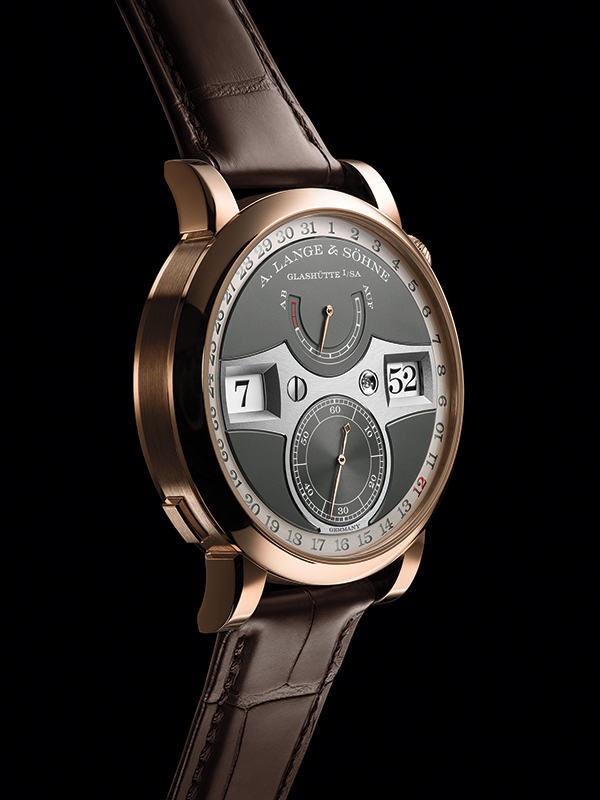
In 2018, beating the re-release of the Tank à Guichets by a few years, IWC revisited Pallweber for the brand’s 150th anniversary, while A. Lange & Söhne has been making its magnificent Zeitwerk since 2009. Audemars Piguet can also reference examples from the 1920s, including the model that inspired this year’s Neo Frame Jumping Hour. These are all companies with a genuine pedigree in the complication, so when the jumping hour found its spotlight again, they were ahead of the curve.
The jumping hour has gone from being a relatively obscure complication to something of an industry obsession. In addition to Cartier and Audemars Piguet, Louis Vuitton, Chronoswiss, Bremont, and a small army of independents have all brought out versions in the past couple of years. But while a good idea will always be adopted universally, part of the pleasure of owning something unusual is that it remains unusual.
At more sensible prices, there is British brand Christopher Ward’s C1 Jump Hour Mk V, which costs from $3,095, while fellow Brit Mr. Jones Watches offers the Number Cruncher for $395. The latter has a cartoon monster clutching the hour in its hand while the minutes revolve in its stomach. There is no pretense of producing an important contribution to the history of horology, but what it brings is the mechanical irony of using traditional watchmaking techniques to deliver pure frivolity.
Bremont is one brand that definitely gets a pass (at least with me) and moves to the top of the good list. After a rebranding in 2024, launching a jumping hour a year later was an unexpected choice for a young brand built on aviation and military associations. But its Terra Nova with a cushion-shaped case inspired by early trench watches is quite unlike anything else out there. Happily, the original bronze edition was limited to 100 pieces, and several later models have also been restricted in number.
The jumping hour brings attention back to passing time as wearers stare at the little window, waiting for the number to jump – one small distraction and the magic is missed. While the horological satisfaction of seeing the jump is rather wonderful, I am beginning to wish fewer watchmakers had discovered it.
Of greater concern is what happens when the watch industry’s enthusiasm for a particular idea gets out of hand. In the trade, a novelty is simply a new watch. But produce too many jumping hours and the point of difference disappears, and it tips into dangerous territory.
Watchmaking has always been a copycat business. One brand finds an audience, everyone else discovers a remarkably similar idea in the archives, and before long we have a trend. I would hate to see the jumping hour become a passing gimmick, but, as with everything, there is a limit to how many versions the world actually needs.






Comments