
American biker culture is dominated by the idea of extensive stretches of blacktop, straight and open, which leads to motorcycle design that produces machines suited to long, steady rides. The British tradition, which imagines its bikes navigating twisting country lanes and cities where the only grid is the electrical one, means that the products that roll off the line in Blighty are, to borrow an equestrian phrase, more “skittish”.
The difference between, say, a Harley Davidson and a Triumph owes much to this contrast of road geography. Riding position, cornering, acceleration, breaking, comfort and the rest are all influenced by the idea that one is made for cruising the Pacific Coast Highway and the other the A303 and its web of B roads.
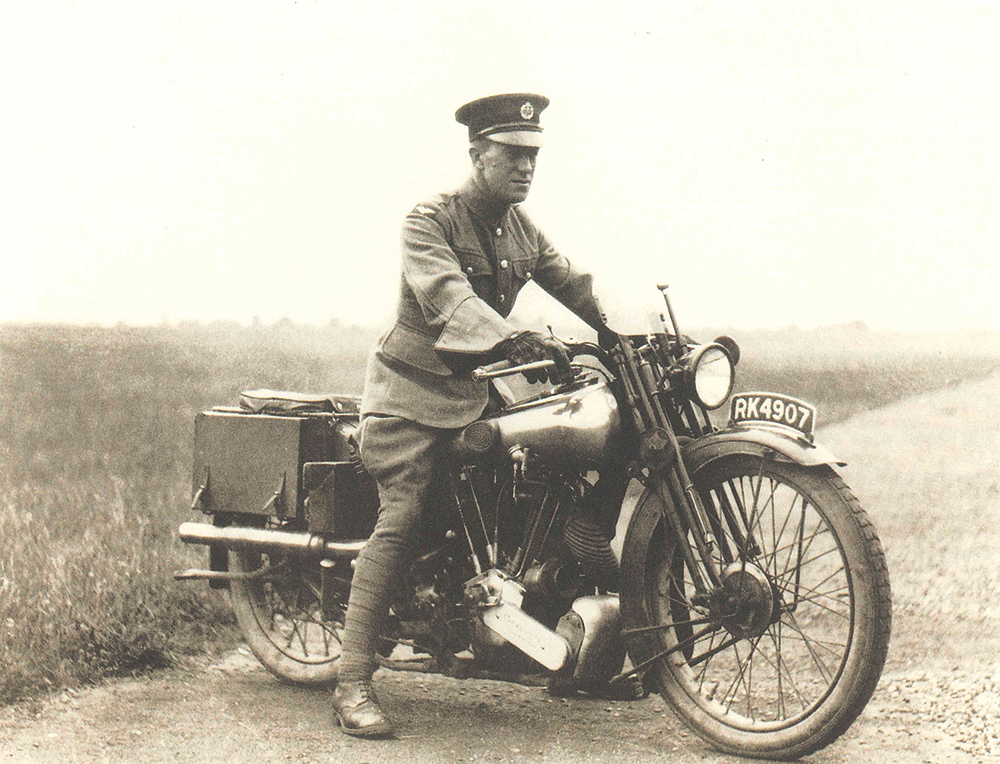
I stole “skittish” from confirmed biker T.E. Lawrence (of Arabia) who, in his 1936 book The Mint, describes a race he had with a World War One biplane overhead, piloting his beloved Brough Superior bike. He writes: “A skittish motor-bike [sic] with a touch of blood in it is better than all the riding animals on earth, because of its logical extension of our faculties, and the hint, the provocation, to excess conferred by its honeyed, untiring smoothness.”
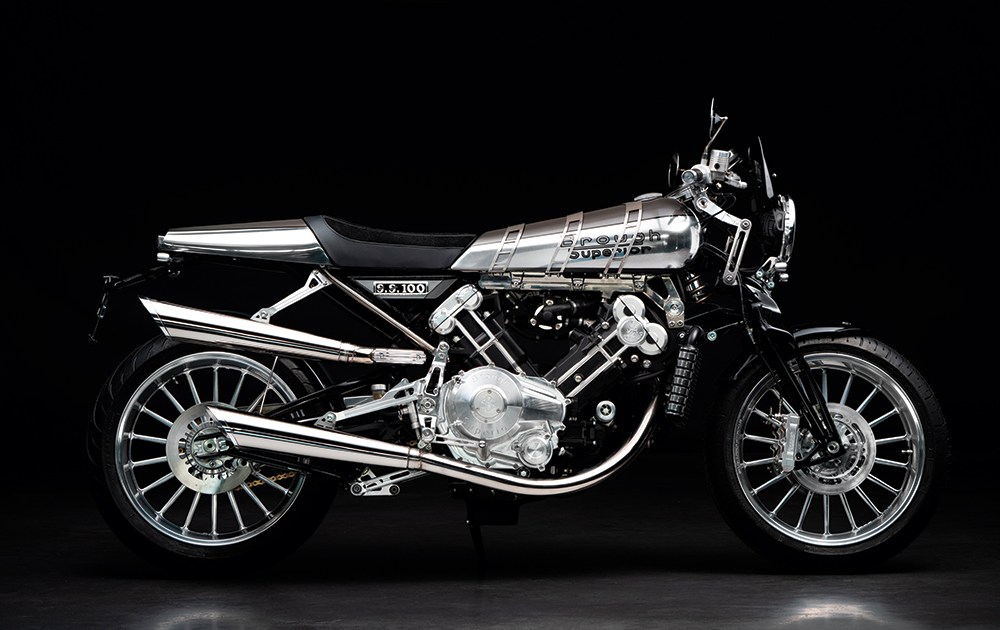
Lawrence owned seven Brough Superiors, produced by George Brough of Nottingham, England – thoroughbred machines that were called S.S.100 (Super Sports 100) on account of their ability to reach 100 miles an hour. The marque shone brightly, making around 3,000 bikes between 1919 and 1940.
Today, Brough Superior roars again. But not out of Nottingham. If you want to meet the men who have revived the marque you’ll need to go visit them in Toulouse, France, as I did.
Toulouse is a pretty city, and is also the home of aircraft manufacturer Airbus, which means it is surrounded by workshops supplying high-tech materials and possessed of state-of-the-art manufacturing skills. It’s also the home of one Thierry Henriette, an engineer who, for some two decades, made custom racing motorcycles for people who liked interesting rides, under the name Boxer Design.
But then in 2019 he had the opportunity to buy the Brough Superior brand, and he didn’t hesitate. “Brough Superior has always been the one for me,” he says, sounding not unlike a French Captain Ahab who’s finally conquered his elusive white whale.
The new Brough Superiors are not so much revival copies as reimagined versions of the early bikes, in the way that Mini and Fiat have restyled the original Mini Cooper and Fiat 500. Though decidedly more retro than that analogy might suggest.
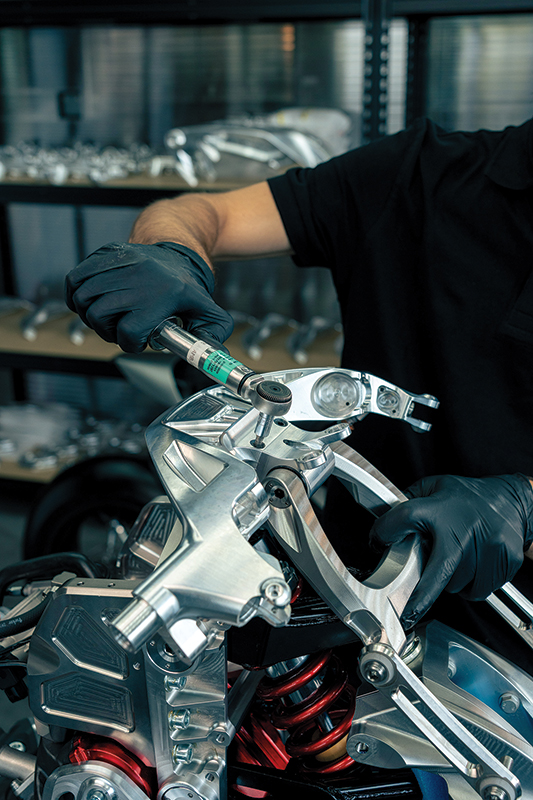
The signature model is named, like Lawrence’s machines, the S.S.100, and it has the slim, streamlined design and elongated fuel tank with dual fillers of the original. To ride, it is indeed skittish, but once you get used to how light and powerful it is, it’s a lot of fun. The V-twin, four-stroke 997cc engine, made in the Brough Superior workshop from components machined there out of aluminum blocks, runs with a smooth thud that delivers a visceral excitement.
Other models now join this – the Pendine Sand Racer scrambler, the Dagger S roadster, and the luxury Lawrence with its carbon fiber body. All have a very distinctive look, so if you pull up pretty much anywhere on one of these, you will turn heads. I tried out a Dagger S, which felt more like a modern machine than the S.S.100, easy to ride, while the ancestor of Lawrence’s bikes, like a spirited steed, needs more concentration to master it.
The new Brough Superiors are not so much revival copies as reimagined versions of the early bikes
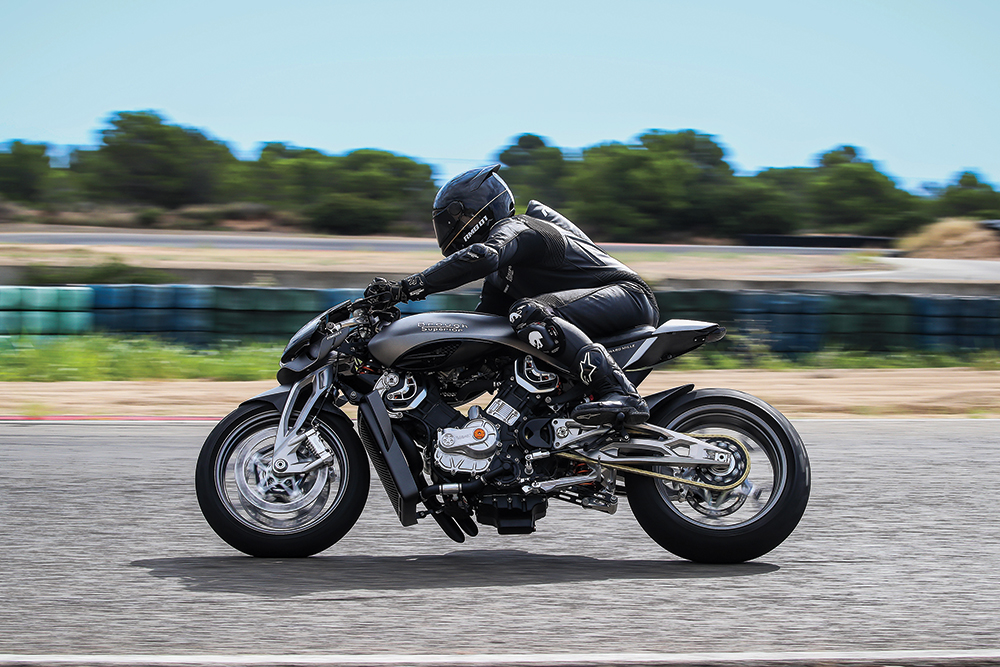
While all these road bikes channel something of the old-school, handmade, industrial spirit of George Brough’s original creations, there is now a new member of the Brough Superior family that looks like it belongs not so much in a Northampton workshop as in the world of sci-fi. This is the RMB01, a collaboration between the French bikemaker and Swiss watchmaker, Richard Mille. Looking like a leaping mechanical animal, the RMB01 is, perhaps unsurprisingly, not street-legal – this beast can only be ridden on racetracks.
Just like the watches that inspired it, the RMB01 is essentially a skeleton frame through which you view the engineering. Richard Mille’s tonneau watch cases are renowned for showing the interior operation through crystal, a design feature favored by the founder, who is obsessed with motor racing and the engines of F1 cars in particular.
Other synergies between the design of the RMB01 and the watches that Mille makes include the use of super-sophisticated materials and some design features that echo the aesthetic of the watches, though of course at a comparatively gargantuan scale.
But perhaps the most interesting thing here is that there is no collaboration watch. Apparently, Richard Mille met the Brough Superior team at a Paris automotive show and was intrigued by their new take on the legendary bike brand. They got talking and the result is the RMB01. I can’t think of another example where a watch firm has done a collaboration in which the resulting product is not a timepiece. But then Richard Mille has always been a rule breaker.
Launching his RM 001 watch in 2001 – just 17 made, lightweight, tough, and complicated – Mille brought a bold new attitude to the often-traditional Swiss watch industry. In short, he declared that you could innovate and charge for it. In this, too, we see a parallel with Brough Superior. There are only 300 S.S.100s and they cost between $81,000 and $105,000, depending on the buyer’s specifications; while there will only ever be 150 RMB01s, and each will set you back around $235,000, excluding local taxes.
But then a Richard Mille watch might come in a series of tens or fewer – and is likely to retail for even more. Innovation and attitude, like a well-tuned motorcycle, can go a long way.





Comments