
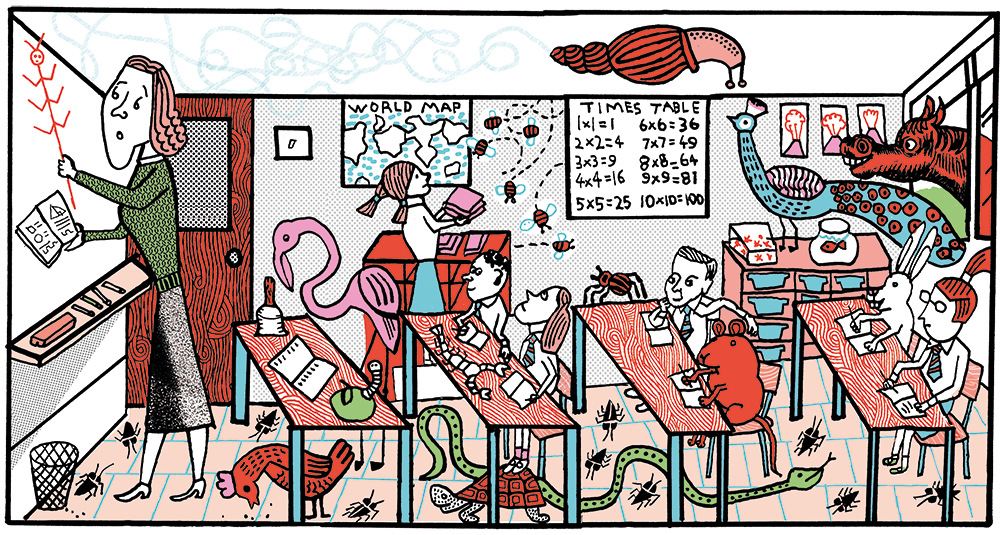

A school pet saved my sister’s life. At our Sussex prep school, pupils took turns to take Hobnob, the classroom hamster, home for a week to look after him. When it was our go, my sister and I would fight over who got to feed him. One evening, at Hobnob’s dinner time, the two of us raced full pelt across the house to be the first to get to his cage. She tripped and whacked her head very hard on the stone kitchen floor. My mother took her to hospital for a scan, just in case. There was no sign of concussion, but the scan revealed something unexpected – hydrocephalus, water on the brain, which is fatal if left untreated. My sister had the operation later that year.
Hobnob, then, was responsible for a great good, albeit indirectly. But do many schools have a Hobnob equivalent today? Or are school pets one of those small but joyful things jettisoned by the safetyism of modern education?
‘Writing a risk assessment for a snail was quite possibly the hardest thing I’ve ever done’
Since 2008, the RSPCA has maintained that keeping pets at school is cruel, recommending instead the woefully inadequate alternative of soft animal toys. Many heads and governing boards, ever concerned about tight budgets and maintenance costs, will no doubt have heeded the advice.
I called up my old school, Vinehall, which last year merged with Marlborough House, and was pleased to discover that, although classroom animals were ditched for a time, they’ve had a comeback.
‘It wasn’t until the recent merger and my arrival [from Marlborough House], because I bought my menagerie with me,’ says Moyna Edmondson, the kindergarten lead. ‘But it seems to have been very, very popular and well received.’
Her current menagerie includes a snail, guinea pigs, a tortoise and baby chicks, hatched from their eggs in an incubator
kept at the school. Edmondson has been a teacher for 20 years and has always had animals in the classroom. However, school pets have ‘sadly fallen foul of our paperwork-driven society… Writing a risk assessment for a snail was quite possibly the hardest thing I’ve ever done.’ (In case you’re wondering, the box-tickers needed reassurance that there is no danger of biting or scratching. From a snail.)

The most obvious benefit of Edmondson’s animals is the joy they bring: ‘The snail sometimes obligingly heads up the wall and across the ceiling, causing absolute merriment.’ But they are useful teaching aids too. ‘The chicks teach important lessons of life, death and the struggle to make it through,’ she says. ‘We look at the chicks that didn’t make it out of the shell. Yes, the children get sad, but they understand [death] more if it’s introduced at that age. We talk about how in nature you have to be fit and strong to survive.’
Unlike in my day, though, the animals no longer go home with the children, since there’s no way of ensuring they are being handled properly. ‘You could be controversial and say, “Well, a snail’s not going to mind or stick insects aren’t going to mind”, but there will always be people who claim they do.’
Do parents ever complain about the animals? ‘I quite often get a parent saying, “Oh my God, now we’re going to get nagged to get an animal at home.” And I say, “No, that is the whole point. You don’t have to. These animals belong to your children…” Our animals give every child a chance to feel the ownership and pride of having pets in their life and illustrate their rural heritage.’ She says that when the children go to the dining hall for lunch they collect scraps from the kitchen to bring back to the animals, which creates a link between the kindergarten and other parts of the school.
Snails and chicks are small beer, though, compared with what’s on offer at Hanford, a girls’ day and boarding prep in Dorset: 16 ponies, six guinea pigs, chickens, bees and many dogs. ‘For Hanford, animals are not an add-on,’ says Sophie Blewitt, the head. ‘They’re very much part of our day-to-
day existence.’
Anyone who’s ever owned a pony can tell you how laborious and expensive it is to keep. Hanford has a head of riding, along with another member of the riding team and a groom. The girls also help with mucking out the stable or grooming the horses. ‘There’s a real sense of responsibility and resilience,’ says Blewitt. ‘Girls also sign up to do the early morning catch. At 7.15 a.m. there’s a little gaggle of about a dozen girls you see go bowling out of school with hi-vis jackets on. They walk up with our head of riding and they go and bring in the ponies from the fields to the stables. It is just the loveliest way for them to start the day.’
This sense of collective responsibility for the ponies might be in part what makes them so wildly popular. The girls can choose whether they want to ride, but last term not a single one chose not to.
‘Parents would be up in arms if we decided to get rid of the dogs’
Blewitt is clearly proud of the school’s ponies, as well as its dog culture: there are usually around ‘six to ten’ on site any given day. I wonder if any parents are nervous about leaving their children surrounded by dogs they don’t know, but Blewitt says not. Indeed, parents choose to send their children to Hanford because of all the animals. ‘They would be up in arms if we decided to get rid of the dogs,’ she says. ‘They are buying into an ethos where animals are in the lifeblood of our school. That’s what they want. They’re not shying away from the idea that a dog will be in a classroom while their daughter is in their maths lesson.’
As cute as ponies and dogs are, they require a level of care many schools just won’t be able to provide. Animals that seem more unusual or exotic can in fact be low maintenance, so there are cheaper but still imaginative options: Giant African snails (Sharow C of E Primary, Ripon), a tailless whip scorpion (Abingdon School, Oxfordshire), cockroaches (Lockers Park School, Hertfordshire), tarantulas (Papplewick, Ascot) and praying mantises (St Mary’s, Melrose). Whitgift in South Croydon has flamingos and peacocks on its grounds, but mysteriously no representative from the school wanted to speak to me for the piece (who ever heard of an unostentatious peacock owner?).
There are many ways beyond the classroom or the grounds that animals can become an integral part of school life. Some schools have formed clubs and societies around animals, such as beagling at Eton or Aysgarth’s ferret club. Sometimes an animal might be part of some obscure historic tradition, such as at Bromsgrove (founded in 1553) which has an old rule allowing the head boy to keep a goat on the school green. Then there’s the very modern phenomenon of ‘therapy’ or ‘counsellor’ animals, usually dogs, that are brought along to classrooms to help children who’ve been told by the adults in their life that they suffer from anxiety.
But perhaps I shouldn’t be cynical. After all, a hamster saved my sister’s life.






Comments