
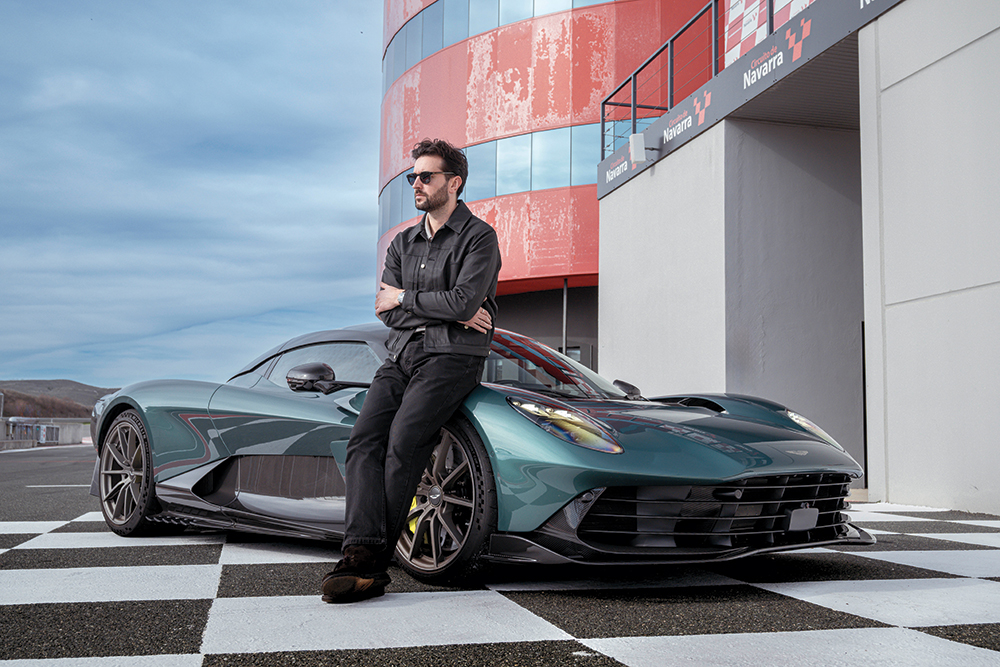
Walking up to the Valhalla is an intimidating experience. Low to the ground, it looks like a prototype race car and every bit the million-dollar starting price tag. Its large gullwing doors swing up, presenting an interior bathed in carbon fiber. After climbing in awkwardly, the carbon bucket seats hug you in and the squared-off steering wheel reminds you this is no ordinary Aston. Close the door and you’re cocooned in like a Le Mans Hypercar.
The Valhalla isn’t a track-only racing machine, though. It’s a hybrid road car, made in partnership with Aston Martin’s Formula 1 team, but with surprising levels of comfort and usability. It has 1,046hp, with power coming from both the 4.0-liter twin-turbo V8 that’s mounted – for the first time – behind the driver, as well as the two front electric motors. These drive the front wheels, making it four-wheel drive, so when you do come to test out the acceleration, there is plenty of grip. But they also give the car its EV-only mode, which cuts the engine and can silently drive it for up to 9 miles. This is a novel and incredibly useful feature. It gives it a practicality you wouldn’t imagine possible for a hypercar, ensuring you can drive efficiently through cities and towns in a way similar to any other modern EV.
It’s far from tame, but the Valhalla inspires confidence on and off the racetrack
It is, of course, far removed from most other cars you’ll see on the road. There’s the way it looks for starters. For their own supercars, rival car brands have gone in a more aggressive direction in recent years. Sharp angles, multiple inlets and fixed rear wings have become the norm. This is not the case with Aston Martin, which for the Valhalla has opted for elegance as well as functional design. There’s a smooth flow to the car’s looks, from the simple lines of the front hood to the curves of the rear three quarters. It’s also easy to instantly recognize as an Aston Martin, thanks to a modern iteration of the distinct large front grille design it’s utilized for decades.
But there is also highly technical aero at work. Integrated channels funnel air over the front wheel, down into the large side intakes and out of the rear diffuser. An F1-style air scoop helps cool the engine, while active aero contributes to the car’s remarkable handling. Developed by Aston Martin Performance Technologies, the engineering arm of the F1 team, the Valhalla’s rear wing sits flush with the bodywork in EV, Sport, and Sport+ mode. Activate Race mode, however, and it ascends, adding up to 600kg of downforce. It has DRS for better straight-line speed, and works as an air brake for added stopping power. The rear wing works alongside an underbody front wing, which guides air under the car, further improving handling and stability.
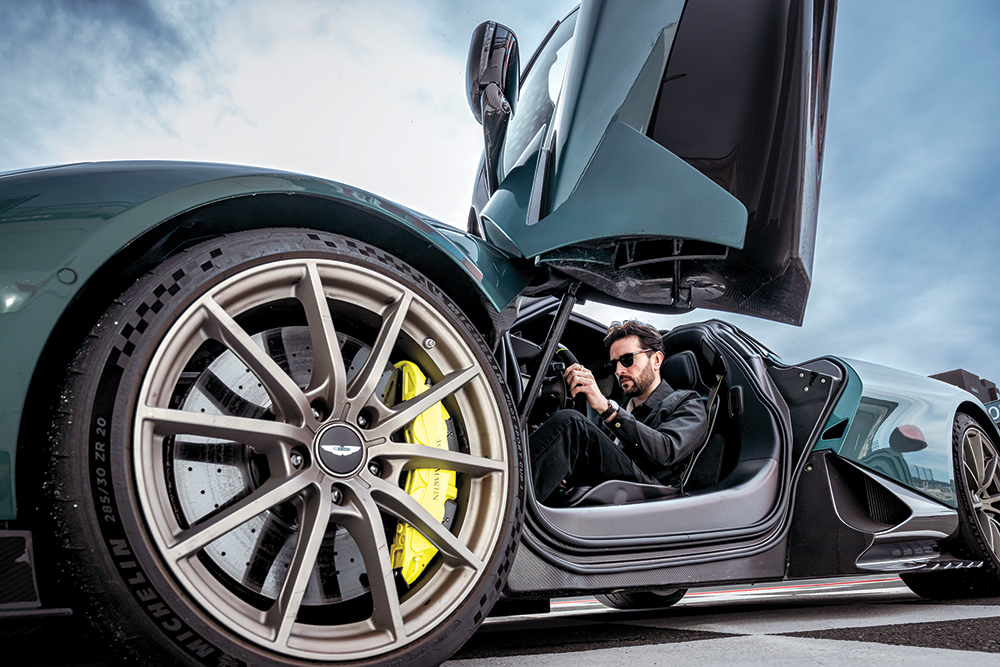
It’s all incredibly complex, but it helps make the Valhalla accessible and surprisingly easy to drive. The handling is predictable and the grip plenty, and while the acceleration is brutal (0-62mph in 2.5 seconds), it’s smooth and doesn’t spike or surprise. It’s far from tame, but the Valhalla inspires confidence on and off the racetrack.
This belies its dramatic looks and the huge power figures; after just a short while behind the wheel you feel as though you can drive on the limit. This is testament to the engineering work Aston Martin has put into the Valhalla. It’s one of the fastest, most extreme cars the firm has ever made, but it’s also one of the easiest to drive quickly – that’s no mean feat.





Comments