

Early in 1968, when I was just 13, my father came home one evening with a letter in his hand and an uncomfortable look on his face. ‘You’ve won a big scholarship…’ Long pause. ‘…to Glenalmond.’
‘But you promised I was going to St Edward’s,’ I protested. St Edward’s was the principal school in the scholarship scheme in which I was indeed a big winner. We had been to see its red-brick campus in Oxford and I was braced for my first boarding experience there. But Glenalmond? Where was it anyway? We had to find it in a road atlas, 300 miles away in rural Perthshire.
I was nobody’s school hero, but I was a Darwinian survivor with a touch of swagger
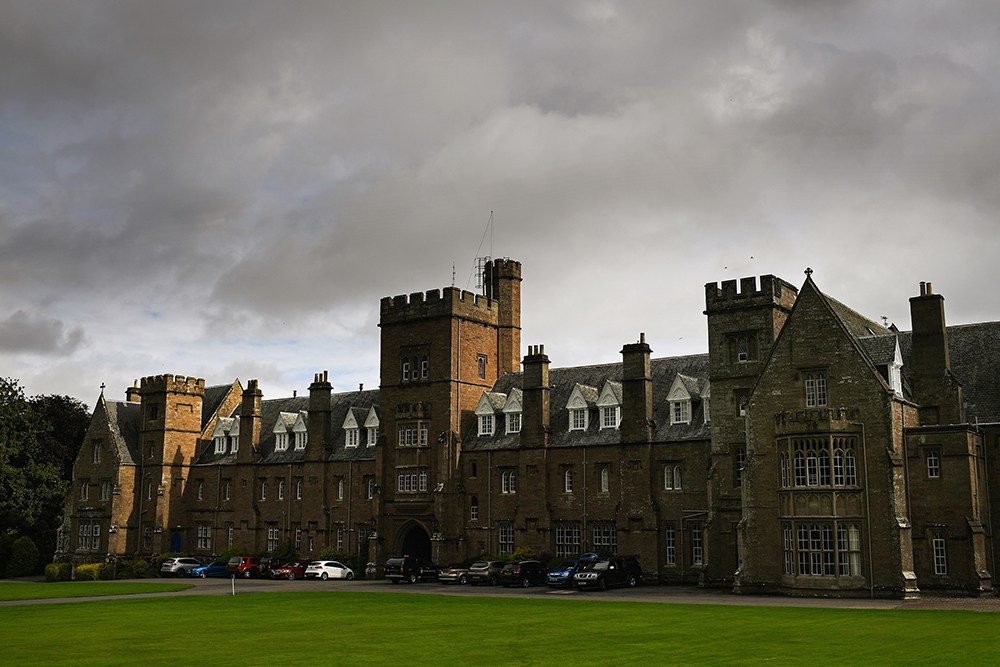
The scholarship was accidental in the sense that my mother, asked for an alternative to St Edward’s on the application form, had named the Scottish school of which she knew nothing because a friend of hers had two boys there. I continued to sulk as we packed the car, drove north, approached the castellated Victorian frontage in its wooded setting, and met my housemaster-to-be.
‘A creep,’ I muttered from the back seat on the way home. As for the school, ‘it looks like a prison’. But I was firmly told to shut up, this being the age before children were entitled to opinions. And in September off I was packed, with a Sunday kilt from the emporium of R.W. Forsyth in Princes Street, Edinburgh, and a comical pair of long green woolly boxers for underneath, never once to be worn.
How was it for me? Physically and mentally tough, but bloody good fun. We played rugby four or five times a week in winter and existed as a semi-feral tribe in which the phrase ‘pastoral care’ would have meant nothing to us if it had ever been uttered. ‘Bullying’ wasn’t big but nor was sympathy for weaklings. And we rarely met girls; the civilising force of co-education was still a generation away.
On the academic front, we were encouraged to be intellectually curious. I particularly remember Charles Shiffner, who taught history not as dates but as a river of ideas. The Warden (headmaster) David Graham-Campbell, a former Eton housemaster, was truly from the school before the old school, but a wise and kindly seeker of good in every pupil.
Overall, I look back on my 17-year-old self as a dissident smartarse, a ‘pseud’ in the slang of the time. If I had a role model, it was Malcolm McDowell’s character in If…., Lindsay Anderson’s violent 1968 film satire of public-school life. I bagged the best study, ducked the cadet corps and kept a secret stash of McEwan’s Export. I was nobody’s school hero, but I was a Darwinian survivor with a touch of swagger.

Glenalmond got me to Oxford and the rest is history. Half a century later, I’m in touch with few contemporaries but still the place has a hold. A while ago I felt an urge to visit, so I took a train to Perth and a taxi from the station. When it rounded the last bend of the school’s front avenue, the sudden impact of seeing that frontage again was a thump in the chest I’ll never forget.
I’m reminded of a prizegiving speech in the late 1980s by Willie Whitelaw, Margaret Thatcher’s deputy prime minister. I wasn’t present and he wasn’t a Glenalmond alumnus (he was a Wykehamist), but his text published in the school magazine has stayed with me. His theme was of loyalty to the institutions that form us. He recalled a Falklands War cabinet in June 1982 when the Scots Guards, in which he had served throughout the second world war, were in action on Mount Tumbledown. He felt compelled to send a note out of the meeting asking: ‘How did we do?’ In a funny way I feel the same about news of Glenalmond.
Not that I’ve always been so attached. In the 1990s, when the school was in low financial water, I wrote a mischievous piece in The Spectator which brought a furious rebuke from the chair of governors. But when I read last year that the school had gone into ‘partnership’ with Professor Basak Akdemir, a Turkish shipping executive, backed by Dr Khalid bin Mohammed al-Attiyah of Qatar, I urgently needed to know more.
So I met the Professor, who told me she had looked at more than 60 British schools in a quest to find the right one in which to invest – and had fallen for Glenalmond at first sight, but found it under threat of closure, stricken by falling numbers and Labour’s imposition of VAT on fees. Her initiatives so far have ranged from a new mattress for every boarder to the opening of an offshoot school in Thailand.
I have twice in my life spoken at prize givings for other schools. My theme, a variant of Whitelaw’s, was that the institutions which form life’s milestones often change and sometimes let us down, but that we should draw comfort and reassurance from those that stay constant. One of those for me has been The Spectator. The other – though I never thought I’d say this – turns out to be Glenalmond.




Comments