
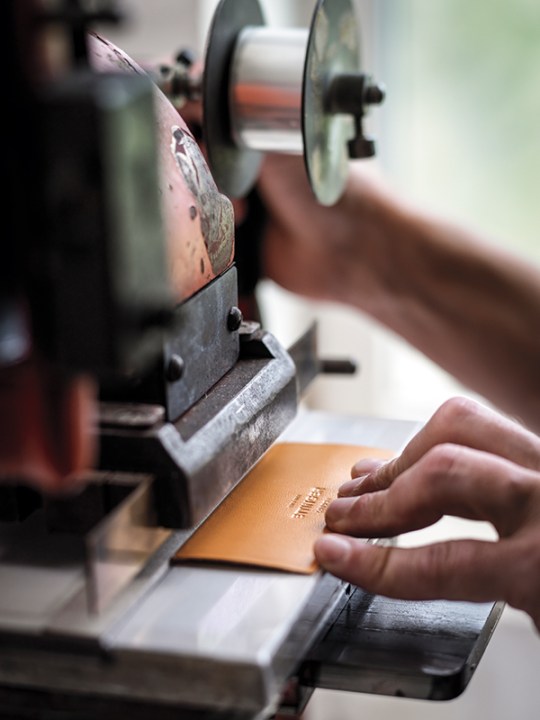
With eight years until its centenary, Ettinger’s story has seriously gathered pace over the last few decades. A house founded in 1934 as a supplier of leather goods to Harrods, Fortnum & Mason, and Asprey, it was granted a license to produce official leather merchandise for the Wimbledon Championships in 1992; was granted a Royal Warrant by the then-Prince of Wales – now His Majesty Charles III – in 1996; acquired James Homer Ltd., one of England’s oldest leather factories, in the Midlands town of Walsall (the saddlery and leather-goods capital of Victorian Britain) in 1999. Then came the international expansion milestones: the opening of its Tokyo (2013) and Seoul (2021) boutiques, and a residency in Turnbull & Asser’s New York Townhouse in 2019.
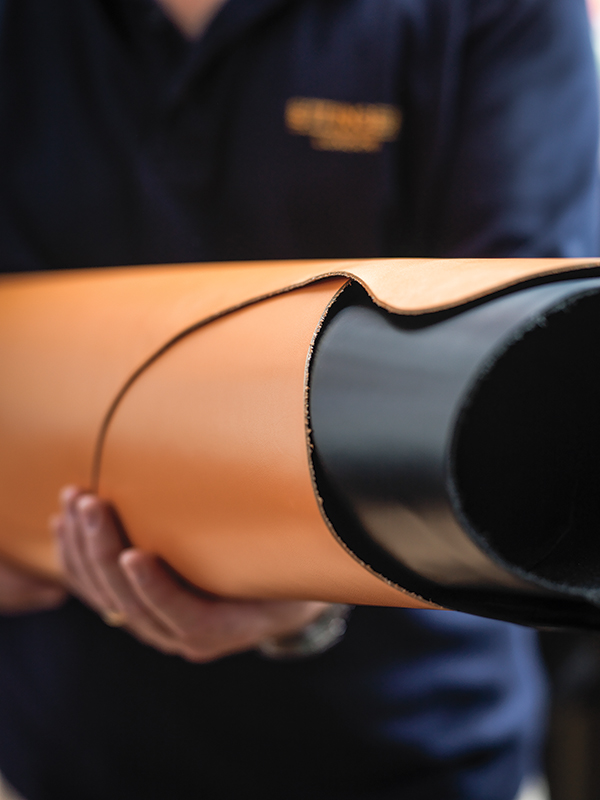
The major catalyst for all this evolution was Robert Ettinger, the son of the brand’s founder, who became CEO in 1995. Raised between London, Vienna, and France, and having cut his teeth through business apprenticeships in Germany’s luxury gifting industry and Canada’s jewelry trade before joining the family firm in 1980, Robert was a major force behind the global expansion (Ettinger now exports approximately 85 percent of what it produces).
Perhaps more crucially, though, Robert has set about his task with an instinctive knack for reconciling respect for leathercraft heritage with a willingness to stray from its fustier traditional tenets. Namely, a bolder approach to aesthetics. Contrasting interior panels had been an Ettinger signature for some time, but in 2000, it was the founder’s son who took the notion into bold new territory with fresh primary colors – striking orange, laid-back turquoise, opulent purple, and an audacious scarlet – in the Sterling Collections (a reference to the British bank notes these colors echo).
‘We’re in no danger of AI taking our craftspeople’s jobs – it will never make a beautiful leather purse or wallet’
In the autumn/winter 2018 Capra collection, inspired by the 1930s golden age of travel, he introduced Ettinger’s first-ever pieces in white leather, bold siblings to the pieces in black, marine blue, and nut-brown hues that Ettinger’s faithful followers were used to. Robert has also broadened the house’s repertoire: watch and jewelry rolls, travel pieces, key rings, pill boxes, desk and golf accessories – even pet accessories now sit alongside the brand’s hallmark wallets, briefcases, glasses cases, and bookmarks.
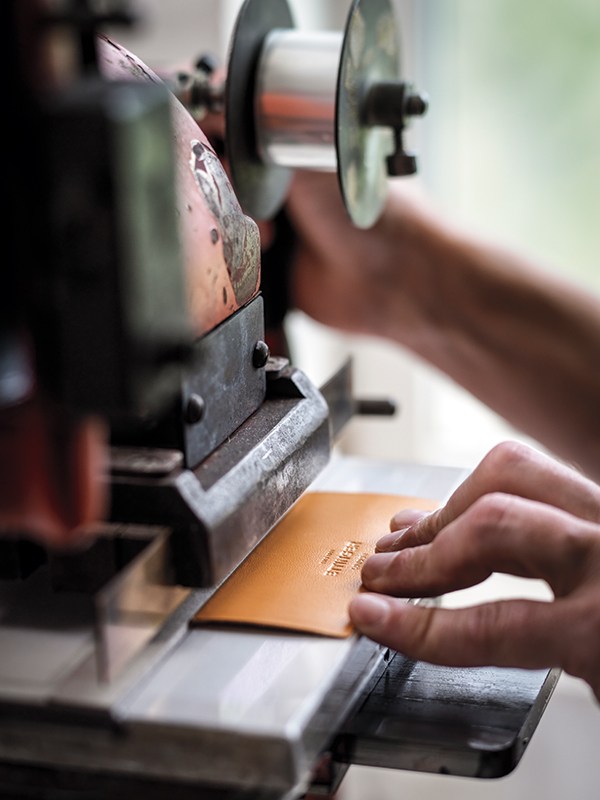
There is, however, one area where Robert has no desire to bend the rules: craftsmanship. “When it comes to making leather goods, 85 percent of the process can only be done by hand – and by very, very skilled human beings,” he tells me. “We’re in no danger of AI taking our craftspeople’s jobs – it will never make a beautiful leather purse or wallet. The only machines we use are metal cutters, a hydraulic press to cut the shapes, a splitter to reduce the thickness of the leather where necessary, and sewing machines.”
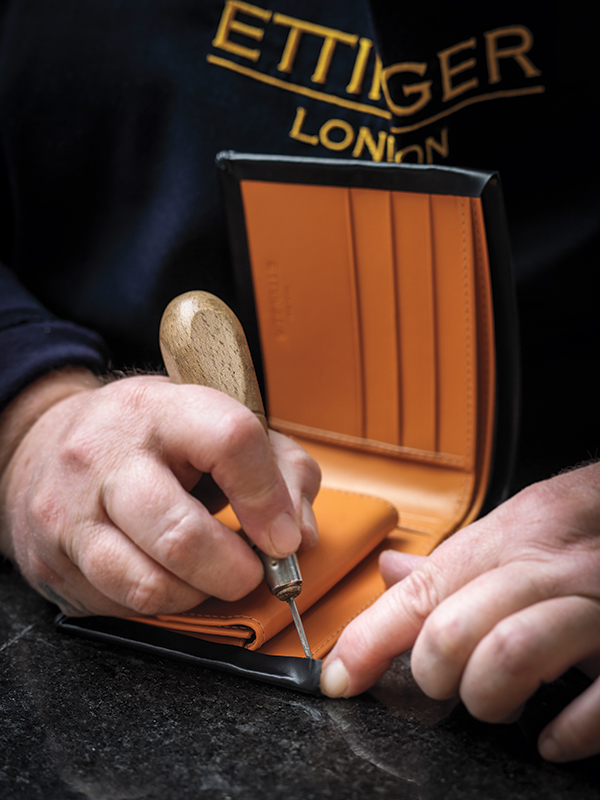
If artisanal craft is one of the key drivers behind Ettinger’s ethos, the other is respect for the materials which are the house’s stock in trade. Ettinger’s signature bridle hide is a traditional English vegetable-tanned leather developed for equestrian tack, that combines exceptional strength with understated elegance, durability, shape retention, and a tendency to improve in feel and texture with age.
“It’s such a malleable, workable, incredible material,” Robert says, adding that human attempts to come up with what nature perfected over millions of years are doomed. “People have always tried to synthetically replicate leather with materials such as Corfam, Porvair… but they just don’t work like leather,” he says. “You can’t skive or stitch them in the same way, and these faux leathers generally have some form of oil-based derivative in them, so they’re not squeaky-clean, as some say they are.”
Still family-owned, the business answers to no luxury conglomerate or distant shareholders, allowing it to move more “nimbly” – Robert’s word – than its rivals. What the house has clearly ascertained, during the founder’s son’s three-decade tenure at the helm, is that the surest way to preserve tradition is not to stand still; to keep moving. But with one eye fixed on the rear-view mirror.


Comments