
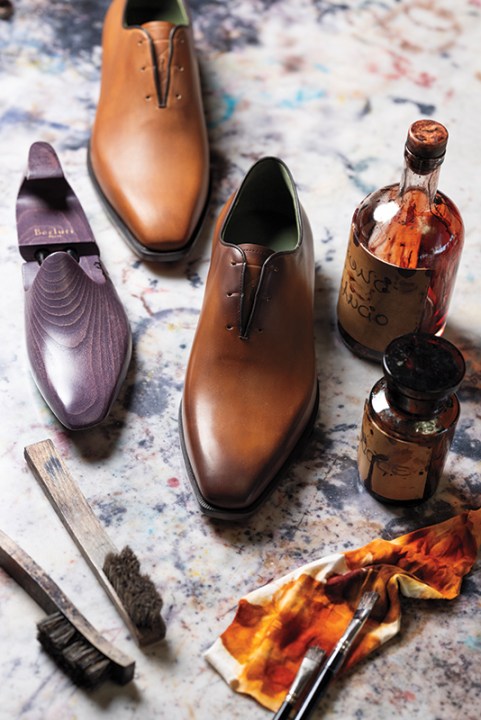
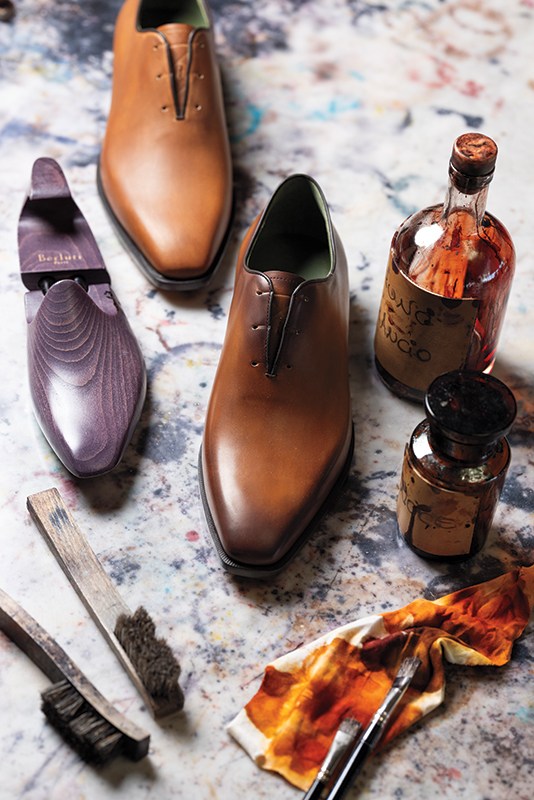
Andy Warhol, John F. Kennedy, Pablo Picasso, and Frank Sinatra all had something in common – and it’s not just celebrity. They all, at one time, walked in a pair of Berluti shoes. And if shoes communicate something personal about their wearer (as Olga Berluti, third generation of the shoemaking dynasty, once asserted), what might we have learned by looking at these men’s footwear? For example, the bespoke, square-toed loafer commissioned by and designed for Warhol in the 1960s reflects the American artist’s famously subversive attitude. That loafer design, by the way, has since entered Berluti’s permanent collection, appropriately called the Andy, and become a house classic.
A certain rebellious spirit runs throughout Berluti’s history, starting with its founder, Alessandro, who broke away from his farming family’s farming lineage to become a barrel-maker. Despite being born in Le Marche, a region in central Italy renowned for its shoemaking tradition, he traveled to Paris to set up business in 1895. Berluti’s dual heritage is one of a kind. “Our house is unusual in that it has one foot in Italy and one foot in France,” says Jean-Marc Mansvelt, CEO of Berluti, ahead of the reopening of its Milan flagship store in June. “That dual heritage is unique and creates real complementarities and synergies.”
While the brand’s made-to-order offering is produced in the Paris atelier, its ready-to-wear footwear and leather goods are crafted in Ferrara, Italy. Located just over an hour outside of Bologna, the production site is definitely more than just a factory. Opened in 2015, Manifattura Berluti is, as Mansvelt puts it, “a testimony to understated craft.” Lined with lush lavender buses, the monolithic building resembles a giant mirrored shoebox, seemingly intended to conceal its industrial purpose. The facade is clad in untreated red cedar which is (fittingly, given the processes within) expected to develop a natural patina over time.
‘Our house is unusual in that it has one foot in Italy and one foot in France. That dual heritage is unique’
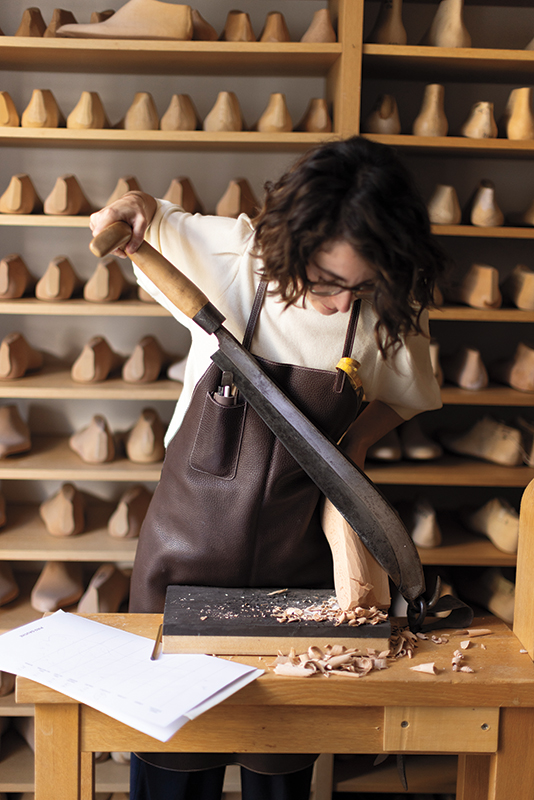
Inside, each department, from prototyping to completion, converges into the agora, a large, open-plan atrium completed with a grid of interlocking beams whose shadows evoke the lacing of a shoe. “Everything starts with a sketch,” says a representative from the Berluti team. “Aesthetics is certainly important, but comfort and ergonomics are at the forefront of everything we do.”
Then, a conversation between the artistic and technical teams results in a mold onto which a design is drawn. That design is digitally converted into a 2D pattern and sent to the Manifattura’s cutting floor. Here, leather specialist Fabio is in charge of placing the shape of the shoe on Venezia calfskin, a material developed by Olga Berluti in the early 1990s that remains central to the house’s identity. Carefully selected full-grain hides undergo a meticulous double-tanning process using mineral salts alongside natural extracts derived from chestnut trees and the black wattle plant.
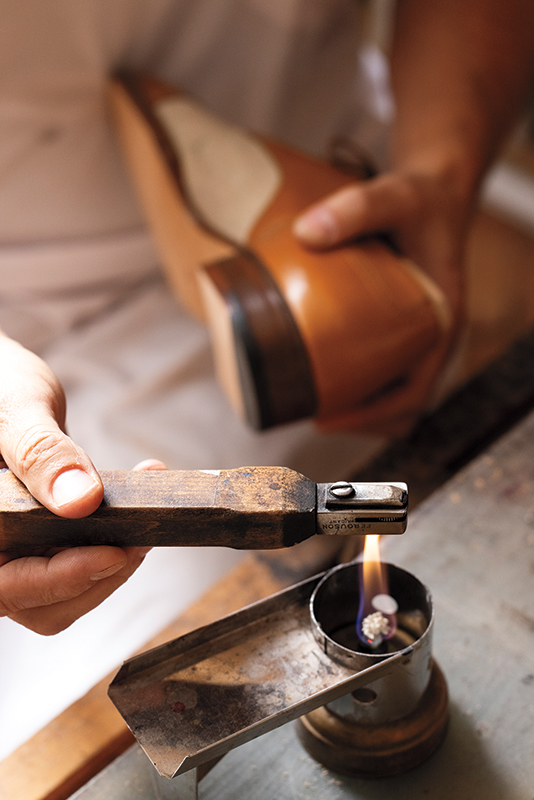
“On average, four pairs of shoes are crafted from a single beautiful hide,” Fabio explains. Once all the components are assembled on the upper, the sole is attached with a single continuous internal stitch following the Blake construction method, a technique favored in traditional Italian shoemaking. The result is a design with a sleek profile and no visible stitching.
The shoe is now ready for some color or, more properly, a patina. Introduced by Talbinio Berluti and later refined by Olga, the process involves the painstaking application of translucent layers of pigment to create extraordinary depth and luminosity (it’s said that the effect was inspired by the shifting tones of moonlight). The nature of the technique means no two pairs of Berluti shoes will age the same, with each evolving in its own way over time.
In the color studio, hundreds of bottles of pigments are stacked along the shelves. Aubergine, forest green, deep blue, and ocher are some of the shades through which Berluti expanded the traditionally conservative palette of men’s footwear. According to house lore, the finishing touch involves a few drops of Dom Pérignon rosé, and while no bottles of Champagne are evident, the space feels like somewhere where a secret is preserved.
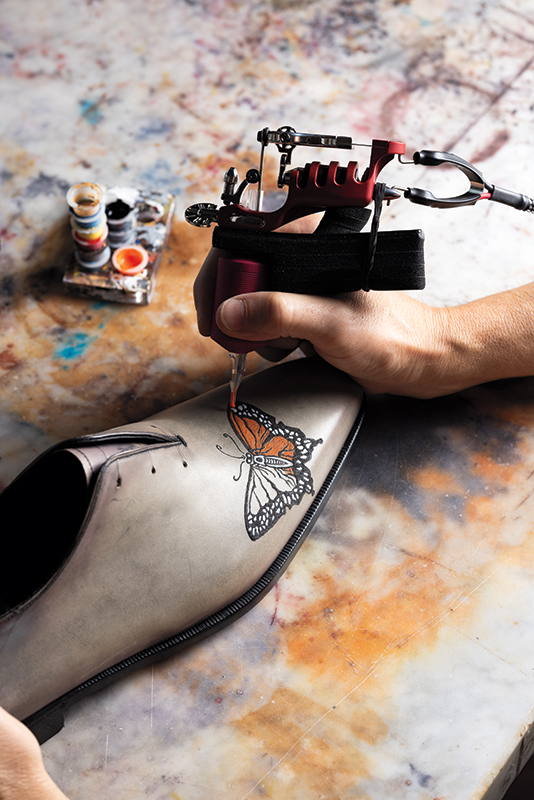
Berluti is not only interested in protecting this knowledge, but in passing it down. As well as being a hub of production, Manifattura Berluti is also home to the Académie du Savoir-Faire, an in-house school dedicated to training the next generation of craftspeople. Its presence here is a testament to the company’s commitment to quality and excellence.
“Paradoxically, even though we no longer do runway shows, we feel we are on trend – specifically this search for authenticity,” says the brand’s CEO, pointing out that Berluti is, once again, setting its own rules. “It’s a more sincere, less spectacular idea of luxury, focused on objects that are carefully crafted to last.” After seeing how a Berluti shoe is made, it is difficult to disagree.






Comments