
If I told you that Ofsted had lost its soul, you might be surprised that it ever had one. You might also wonder why it matters. As someone teaching when Ofsted was introduced, and who has been subject to seven inspections under seven different frameworks, five of them as a headteacher of a comprehensive, I’ve discovered that it does matter. Over the years, I fought the good fight on each occasion, and in the process, I learnt to respect my opponent. Not this time, however. This time, two days of fraught psychological drama came to an end of frustration and lament.
School inspectors are powerful but, in my experience, mostly well-motivated. At its best, Ofsted has been about setting standards, not accepting excuses. Historically, it insisted on evidence-based judgments which can be seen as fair and an incentive to continue to work hard and improve further. Although in practice some inspectors have been churlish and punitive, some schools devious or craven, and some ministers have misused inspections for political purposes, the fact of Ofsted’s existence has helped to keep us all honest.
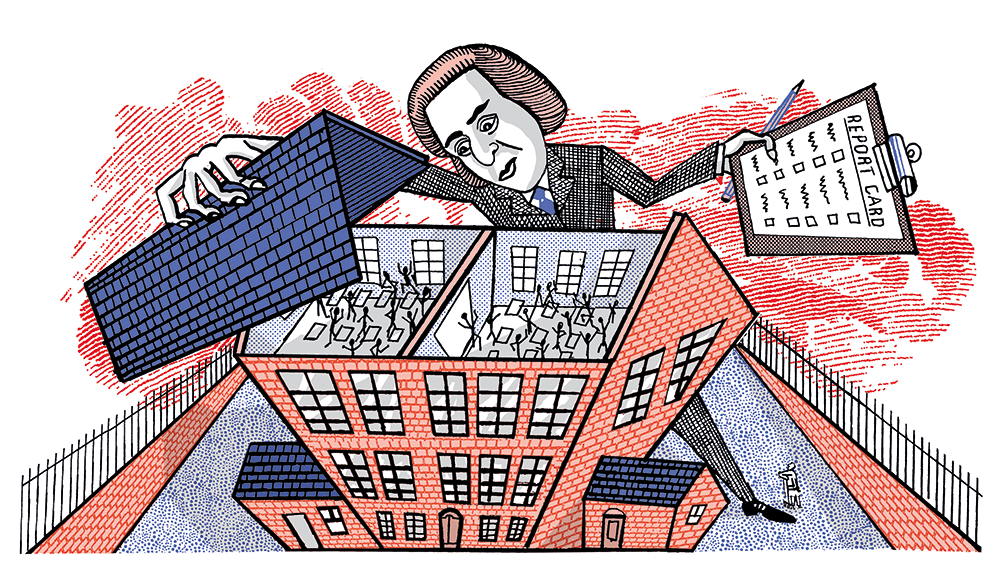
The introduction of a colour-coded Report Card reduces the art of inspection to a painting by numbers
Until now, the inherent assumptions of Ofsted’s framework were not the problem. Then in 2023 the headteacher Ruth Perry took her own life after her school’s rating was downgraded from ‘outstanding’ to ‘inadequate’. The framework was overhauled. Single-word overall judgments were abandoned, replaced by a Report Card with a choice of five colour-coded gradings for each of six areas. Safeguarding comes first and is either ‘Met’ or ‘Not Met’. Wellbeing is prioritised and headteachers are asked how they are at each point. Inclusion is threaded through everything. The curriculum, the most significant thing in the last framework, is now paired with teaching. Attendance is given a higher profile in an unholy marriage with behaviour. His Majesty’s Inspectors are employed more fully and more generously. On the surface it almost looks positive. But it is a disaster.
At this point I must say that our school’s experience of the inspection team, the process, the dialogue with them and the report they wrote was good. They worked hard to do their job thoroughly and engaged well with staff, pupils and governors. They were considerate, even kind, yet also astute. The tools in their hands, however, are not up to the job.
The new framework suffers from design failure. An organisation that supposedly understands teaching should know better than to combine attendance and behaviour into one category. The motivation behind tying the two together is obvious. Seeing the deterioration in attendance since the pandemic, Ofsted wishes to hold schools more accountable. But attendance is measured by data. Behaviour is evidenced by what is seen in person. The two things are different.

The introduction of a colour-coded Report Card reduces the art of inspection to a painting by numbers. In the old system, good inspectors were able to see what others would miss, ideally through sympathetic and compassionate eyes, and then express their findings with a carefully written report. The Report Card is a crude substitute, resembling the printout of an MOT test when the tyres need fixing. It no longer matters how good the school is, how sound its infrastructure, how enduring its educational values, and how apt its priorities are, as long as the right boxes are ticked.
The poor inspectors are blinkered by bullet points. The new rules mean that a school must hit every bullet point in a category to meet a particular grade. The detrimental, and predictable, effect is that inspectors must spend their time chasing each one of these points relentlessly. Last year we made a film, ‘Tenacious Together’, with pupils and external partners, to connect school and society, learning and life. Several times I asked the inspector to watch it. How long was it? Thirty-nine minutes. Too long. What if he just watched the first ten minutes? Even that eluded him. It would have been such good evidence, but not in the way his spreadsheet demanded. Preoccupied inspectors cannot listen, or think, or follow a useful line of inquiry to discover something of interest.
Philosophically, the effect is to weaken human agency. Inspectors are less trusted. Schools are left wondering what the point of the inspection is. Parents are no longer as responsible for their child’s attendance at school. It is more of an audit than an inspection. Boxes are ticked. Are the two-dimensional criteria met? Yes or No.
How this came about can be explained in one word: safeguarding. Ofsted was terrified of a repeat of the Perry tragedy. Perry was not alone in having her good school put into special measures because of safeguarding. At that time, when Ofsted decided a school wasn’t safeguarding pupils effectively it was automatically deemed ‘inadequate’, no matter how good the education. A headteacher I know experienced something similar when an inspector took issue with a safeguarding record. That one thing rendered everything else invalid. A humane inspector can give you half an hour to fix a minor bureaucratic anomaly. But in the wrong hands it could be different – and no one is immune from having unknowingly overlooked something important. Safeguarding must be done well and be taken seriously. There is too much at stake. And that is why it needs its own audit.
Inspectors are less trusted. Schools are left wondering what the point of the inspection is
In a better, more differentiated world, safeguarding and attendance would be audited by Ofsted annually and locally, with good advice given and time to correct processes and procedures. Schools would then be inspected as places of learning on a regional basis every three years, and subjects across the schools in each area by key stage nationally every five to seven years. Each form of inspection would be genuinely apt at its own level, the inspectors able to work with the dignity and distinction due to their office.
If school inspections are worth doing, let’s do them well by giving inspectors the opportunity to be clear-sighted, exercise judgment and provide support and encouragement, constructive criticism and praise. Only by standing alongside headteachers and other leaders can they appreciate what we do well and spur us on to do better where we fall short. Without honesty, transparency and humanity, no such conversation is worth having. Nor is it possible without trust. Trust was sadly lost under the previous framework, but it is not going to be regained under this one, which dehumanises the relationship between schools and inspectors.
When I said to my Catholic colleague that the conversation with the lead inspector on the afternoon of the second day used to be like receiving absolution from a priest, he did not disagree. Perhaps Ofsted did once have a soul after all.





Comments